
 Worksheets
6th Science QA #1 Review
Total questions: 80
Worksheet time: 20hrs 0mins

How well a substance can be hammered into sheets.
Malleability
Conductivity
Luster
Magnetic
A substance that breaks into pieces.
Brittle
Malleable
Conductor
Dull
How well a substance allows heat or electricity to flow through it.
Malleablility
Conductivity
Luster
Ductile
A substance that does NOT allow heat or electricity to flow through it.
Insulator
Conductor
Semiconductor
Magnetic
A substance that sometimes conducts electricity and sometimes does not (depending on temperature).
Insulator
Conductor
Semiconductor
Malleability
How well a substance reflects light.
Malleability
Conductivity
Luster
Ductile
A substance that reflects light well.
Brittle
Conductor
Ductile
Shiny
A substance the does NOT reflect light.
Malleable
Insulator
Magnetic
Dull
The ability to be made into a wire.
Malleability
Conductivity
Ductile
Magnetic
When a metal is shiny, we say it is ___________.
lustrous
malleable
ductile
conductive
When a metal can be pounded into thin sheets, we say it is ___________.
lustrous
malleable
ductile
conductive
When a metal can be made into thin wires, we say it is ___________.
lustrous
malleable
ductile
conductive
Which state of matter are most metals at room temperature?
solid
liquid
gas
degrees
Which of the following metals conduct heat and electricity? (Choose all that apply.)
iron
nickel
copper
aluminum
gold
Which of the following materials would make a good conductor of heat and electricity? (Choose all that apply.)
pots and pans
rubber tubing
copper wires
iron nails
a plastic handle
Which of the following materials would make a good insulator? (Choose all that apply.)
a cotton oven mitt
rubber tubing
copper wires
iron nails
a plastic handle

Which element is malleable and ductile?
Phosphorus (P)
Argon (Ar)
Sodium (Na)
Chlorine (CI)

Which type of elements are found on the left side of the staircase (zigzag line)?
Nonmetal
Metalloid
Metal
Noble Gas
Which one of the following is not a property of metals?
Shiny Luster
Ductile
Brittle
Malleable

Of all the elements, about 75 percent are classified as
Nonmetal
Metalloid
Metal
Noble Gas

What is the only nonmetal element on left side of the periodic table?
Helium (He)
Hydrogen (H)
Lithium (Li)
Calcium (Ca)

Which element is a metalloid?
Helium (He)
Arsenic (As)
Element
Semiconductor

Nonmetals are found on the right side of the metalloids.
TRUE
FALSE
Which of these grouping of elements could have the characteristic of brittle? (Check all that apply)
Rare Earth Metal
Metalloid

An element is brittle and has a high luster. It is also solid at room temperature, but cannot be pulled into wires. Where would this element be located?
left of the stair step
right of the stairs step
on the stair step
at the bottom of the periodic table
Atoms bond together in different ways to make ________________.
Substances
Matter
Molecules
pure, made of only one type of atom
What state of matter appears invisible?
solid
liquid
gas
plasma
What kind of matter has its own shape?
liquids
solids
gases

Orange Juice
solid
liquid
gas

What state of matter is this
solid
liquid
gas

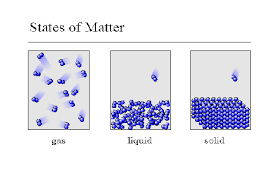
These are ______ particles because they are tightly packed together.
solid
liquid
gas

These are ______ particles because they are a little further apart and can slide and glide around.
solid
liquid
gas

These are ______ particles that move around freely.
solid
liquid
gas
Which object shows a liquid?


Vapor and steam are both...
Solid
Liquid
Gas

A pencil and a rock are both...
Solid
Liquid
Gas
At higher temperatures
particles in an object have less kinetic energy
particles in an object move faster
a gas contracts
Which of the following states of matter has the LOWEST level of kinetic energy?
Solid
Liquid
Gas
Plasma
Solids–
have more volume than liquids and gases.
have molecules that are tightly packed together and have less volume than gases.
can change to fit the shape of a container because the molecules are loosely connected.
have the most kinetic energy of all the states of matter.
Which statement compares the volume of solids and liquids correctly?
Solids have less volume than liquids and retain their shape.
Molecules in liquids spread out to fill all available space, while solids stay in their shapes.
There is no difference between the volume in solids and the volume in liquids. The volume can change when the container is changed.
Solids and liquids have a fixed volume because the molecules stay relatively close together.

What type of particles does the image show?
Gas
Liquid
Solid

What type of particles does the image show?
Gas
Liquid
Solid
Describe Solid particles.
The are tightly bonded, vibrate in place, and have very little space in between them.
They are not bonded, have a lot of kinetic energy, and have a lot of space in between them.
They are loosely bonded and can move around each other, have some kinetic energy, and have a little space in between them.
Describe liquid particles
They are not bonded, have a lot of kinetic energy, and have a lot of space in between them.
They are loosely bonded and can move around each other, have some kinetic energy, and have a little space in between them.
They are tightly bonded, vibrate in place, and have very little space in between them.
Describe Gas particles.
They are loosely bonded and can move around each other, have some kinetic energy, and have a little space in between them.
They are tightly bonded, vibrate in place, and have very little space in between them.
They are not bonded, have a lot of kinetic energy, and have a lot of space in between them.
Solid objects can't expand or contract because solid particles don't have any kinetic energy.
False, they can still expand or contact even though the particles don't move.
False, even solid particles have kinetic energy. The particles vibrate, so solid objects can expand and contract.
True, only liquids and gases can expand and contract.
What is Kinetic Energy (K.E.)?
I don't know.
Exercise
The energy of motion. More kinetic energy means particles move slower and get colder.
The energy of motion. More kinetic energy means particles move faster and get hotter.


A/An ________ is a substance made up of a single atom.
element
compound
molecule
plant
All __________ are made up of two of more atoms.
molecules
elements
atoms
ecosystems

Which of the following statements correctly describes a molecule?
A molecule consists of two or more of the same types of atoms bonded together
A molecule consists of a single atom.
A molecule is made up of multiple different types of atoms
A molecule and an atom are the same thing.
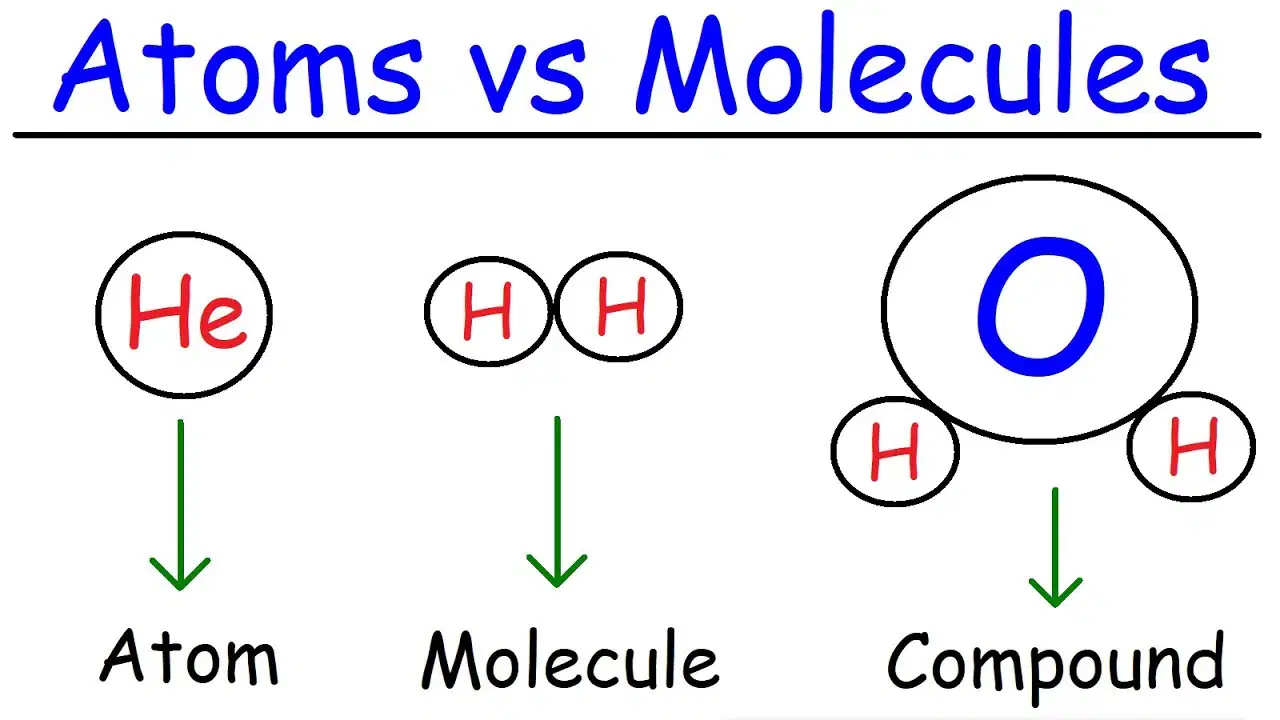
Which of the following does the image show? (check all that apply)P
a molecule of oxygen
a molecule of Hydrogen
a water compound
an single atom of a metal

How are liquid particles different than gas particles?
they are bonded in place
they are the same
they are in close contact and move over and around
they fly freely through space
How are particles in a solid different from a liquid or a gas?
they are bonded but vibrate in place
they aren't different
they move freely through space
move over and around other particles

A(n) ______ will always take the shape and volume of its container.
gas
liquid
solid
crystal
A state of matter with a definite volume, but no definite shape is a(n) _______.
liquid
solid
gas
All solids have a closely packed, fixed arrangement of particles.
True
False
Who is considered the Father of the Periodic Table?
Dimitri Mendeleev
John Dalton
Antoine Levoisier
Mr. Hanrahan
Which of the following is NOT a metalloid?
Aluminum
Silicon
Boron
Arsenic
Which of the following is a Nonmetal?
Sulfur
Gold
Iron
Calcium
Which of the following is a Metal?
Sodium
Carbon
Oxygen
Argon
An element is malleable, ductile, and has a glowy luster. What type of element is it?
metal
non metal
metalloid
rare earth metal
What type of element is used for making tools, kitchen utensils, and appliances?
metals
non metals
metalloids
rare earth metals
What are real-world uses of rare earth metals? (check all that apply)
electric cars
cell phones
neomydium magnets
air
What type of element is used to produce fertilizers, computer chips, and fire retardant glass?
metal
non metal
metalloid
rare earth metal

