
NEW
Font size
 Worksheets
Characteristics & Applications of Waves - KAP/GT
Total questions: 35
Worksheet time: 18mins
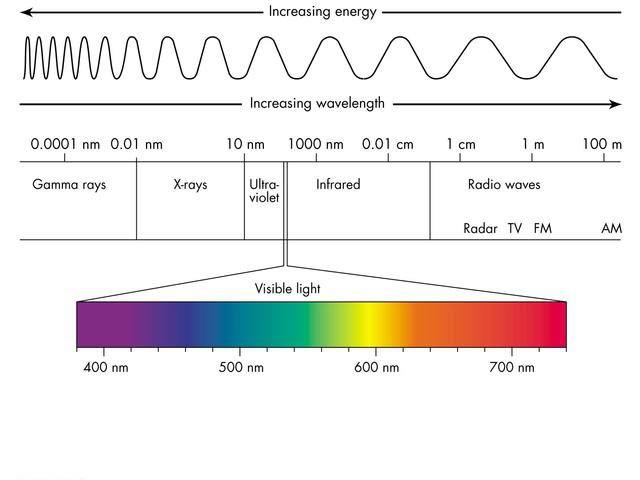
What is the correct order of the visible light spectrum, starting with the longest wavelength?
Red, yellow, orange, blue, violet, indigo
Violet, indigo, blue, green, yellow, orange, red
Green, yellow, blue, indigo, red, orange
Red, orange, yellow, green, blue, indigo, violet
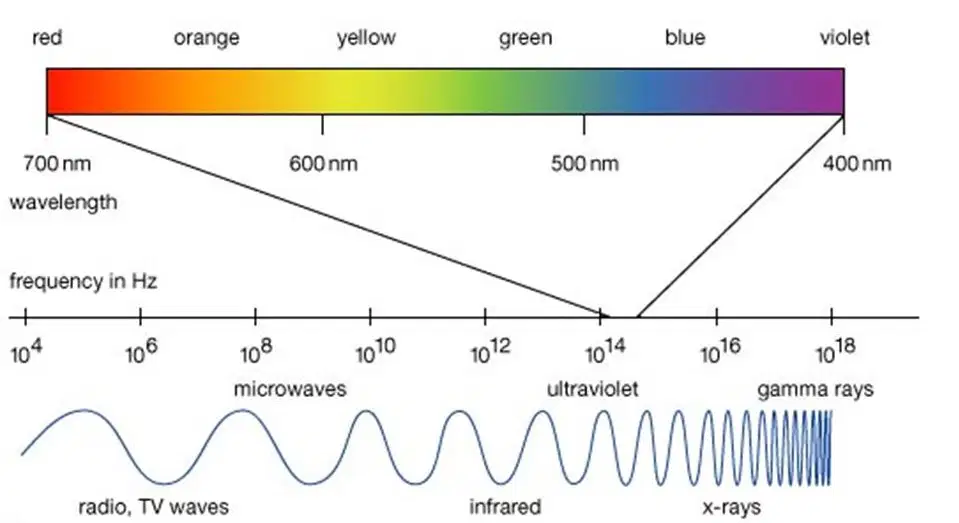
What waves have the longest wavelength and lowest frequency?
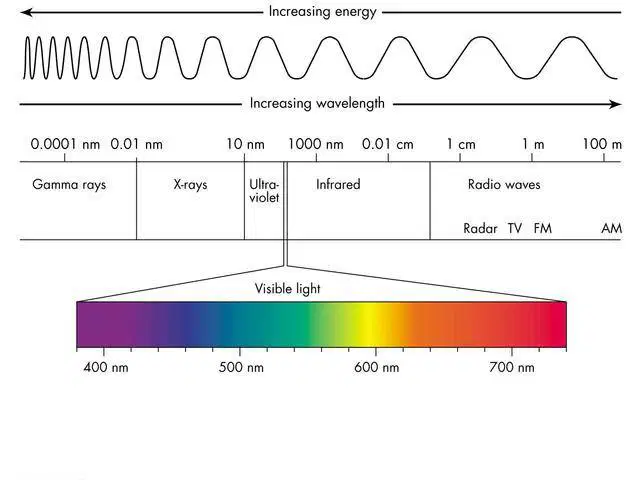
Of the following, which waves have the shortest wavelength, highest frequency, and highest energy?

Which color has the longest wavelength?
Yellow
Red
Green
Purple

According to the image, the wavelength of an infrared ray is...
10-5 m
1012 Hz
105 m
10-12 Hz

According to the image, the frequency of infrared waves is...
In the electromagnetic spectrum, which of the following is true of waves with long wavelengths?
They have high frequencies
They have low frequencies
They have moderate frequencies
They have inconsistent frequencies
What part of the electromagnetic spectrum can be seen by humans?
Visible Light
Microwaves
Ultraviolet Waves
Infrared Waves
What part of the electromagnetic spectrum can be sensed as heat by humans?
Visible Light
Microwaves
Ultraviolet Waves
Infrared Waves
Which characteristic of waves best distinguishes one form of electromagnetic energy from another?
Speed
Wavelength
Amplitude
Distance Traveled
Which of the following is NOT a type of radiation present in radiation from the sun?
Infrared
Ultraviolet
Visible
Radio

Which has a higher frequency?
Wave N
Wave O
Same frequency
There is no frequency

The distance between E and H is called
Crest
Wavelength
Amplitude
Frequency
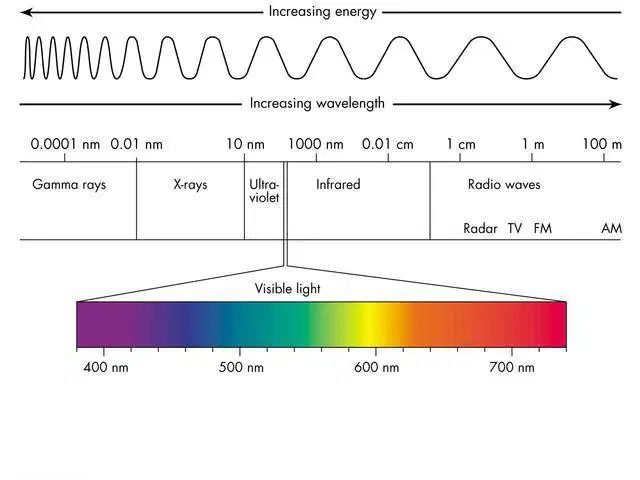
Our eyes detect light that lies only within a small region of the electromagnetic spectrum. This region is called visible light.
Which of these statements describes the visible spectrum of light as seen by the human eye?
The lowest frequency appears red, and the highest frequency appears violet.
The lowest frequency appears green, and the highest frequency appears red.
The lowest frequency appears blue, and the highest frequency appears orange.
The lowest frequency appears yellow, and the highest frequency appears green.
The electromagnetic spectrum is made up of bands of waves with different _____
Speeds
Frequencies
Reflections
Mediums
All of the waves listed below are a part of the electromagnetic spectrum except
X Rays
Sound Waves
Gamma Rays
Light Waves
How does the hazard level of electromagnetic waves change as the frequency of the waves increases?
Energy and wavelength increase; it becomes more hazardous.
Energy and wavelength decrease; becomes less hazardous.
Energy decreases, wavelength increases; it becomes less hazardous.
Energy increases, wavelength decreases; it becomes more hazardous.
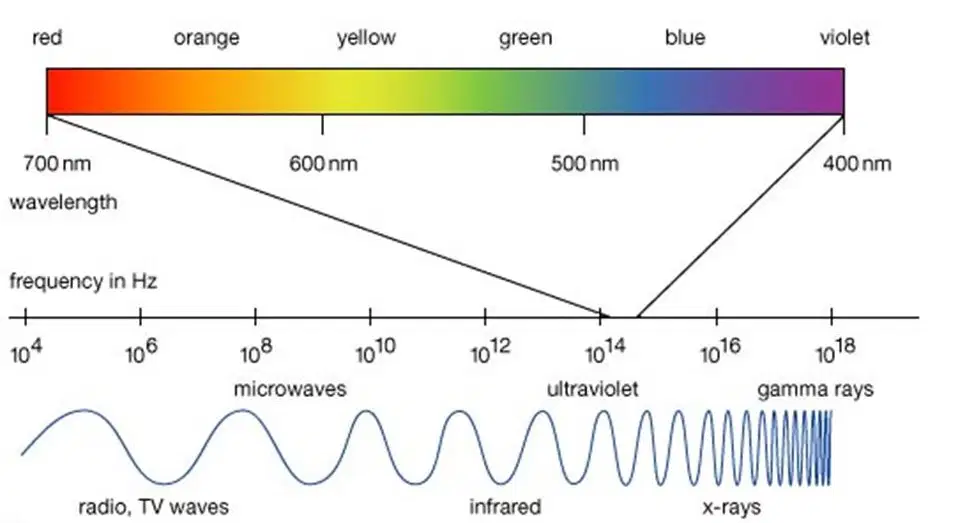
Electromagnetic waves come in many different wavelengths. Shorter wavelengths carry more energy and penetrate further through materials. Which of the waves below has enough energy to pass through skin and damage cells on the inside of the body?
Visible Light
Infrared
Gamma Rays
Radio Waves
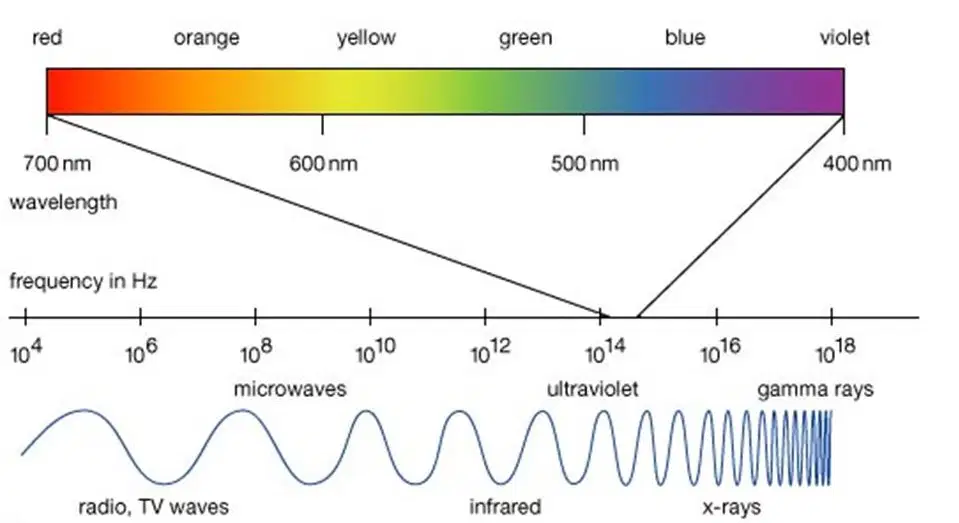
Electromagnetic radiation is energy that travels in waves. Two types of electromagnetic waves are microwaves and gamma rays. Which of these statements is true?
Gamma rays travel faster than microwaves in a vacuum.
Gamma rays have more energy than microwaves do.
Gamma rays have a lower frequency than microwaves do.
Gamma rays, but not microwaves, can travel through a vacuum.
The different types of electromagnetic radiation are often organized on the electromagnetic spectrum from radio waves to gamma waves.
Which statement is true about this order?
They are arranged in order of decreasing energy
They are arranged in order of decreasing frequency
They are arranged in order of how useful the light is
They are arranged in order of decreasing wavelength
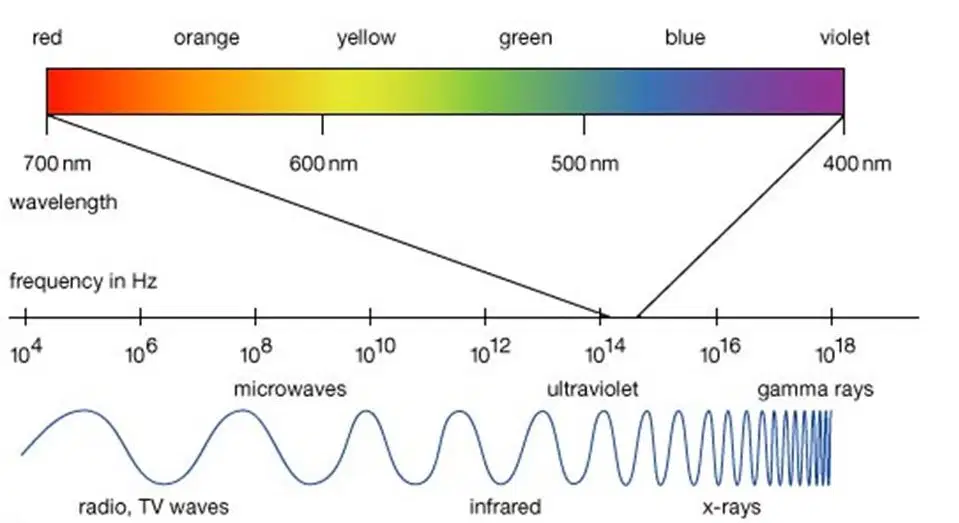
Sunscreen bottles often include the phrase: “Protects against UVA and UVB waves.” This refers to ultraviolet radiation coming from the sun. Which of the following is true of ultraviolet radiation?
Ultraviolet radiation has shorter wavelengths than x-rays, therefore it is more dangerous than xrays.
Ultraviolet radiation has longer wavelengths than infrared light, therefore it is more dangerous than infrared light.
Ultraviolet radiation has shorter wavelengths than visible light, therefore it is more dangerous than visible light.
Ultraviolet radiation has longer wavelengths than gamma radiation, therefore it is more dangerous than gamma radiation.

The diagram below shows the electromagnetic spectrum. Which letter represents gamma rays?
B
C
A
E
The diagram below shows the electromagnetic spectrum. Which letter represents radio waves?
C
E
F
G
Which of these types of electromagnetic radiation is used extensively in communications?
Radio Waves
Gamma Rays
Infrared
X-rays
Infrared rays play an important role in -
warming the Earth.
photosynthesis of plants.
helping doctors find cavities and examine broken bones.
creating Vitamin D in humans.

Electromagnetic waves that help your body produce vitamin D are called -
Ultraviolet rays
X-rays
Gamma Rays
Infrared
What do television transmitters emit?
Visible Light
Infrared
Radio Waves
Ultraviolet waves
How are electromagnetic waves different from mechanical waves?
As the frequency of an electromagnetic wave increases, the amount of energy in that wave...
increases
decreases
stays the same
Which of these types of EM radiation has a long wavelength which can penetrate soft tissue but NOT bones?
Radio waves
Visible light
Gamma Rays
X-rays
Which type of high-energy EM radiation is used to treat cancer through the process called radiotherapy?
Radio waves
Gamma Rays
Visible light
Ultra-violet
Which type of low-energy EM radiation is used by remote controls used in TVs, projectors, and other home electronic appliances?
Infrared
Gamma Rays
Ultraviolet Rays
X-rays
Which of these types of EM radiation has the lowest frequency and is used to transmit sound and pictures in a radio or television?
Radio waves
Gamma Rays
Visible light
X-rays

