
NEW
Font size
 Worksheets
First Quarter Science 7 Re-Test
Total questions: 45
Worksheet time: 23mins
Who proposed the plum pudding model of atom?
John Dalton
J.J. Thomson
Ernest Rutherford
Democritus
What resembles the Plum Pudding Model of the atom?
Tiny, solid ball with negative charges stuck on the outside
A complex mathematical equation describing electron behavior.
A miniature solar system with planets orbiting a central nucleus.
A positively charged sphere with negatively charges scattered throughout.
Why do scientists use models?
They are exact representations of reality.
They only exist in computer simulations.
They are always simple and easy to understand.
They can be used to test ideas and make predictions.
Which of the following CAN NOT be a scientific model for the atom?
A song with lyrics full of subatomic particles and their charges.
An image (picture, concept map, flowchart, etc.) that considers all laws of science.
A round Styrofoam colored with parts representing electrons and other subatomic particles.
A computerized interactive game where you can put subatomic particles and guess the correct image for atom.
Which of the following shows an electron cloud model of atom according to quantum mechanics?


Who formulated the Atomic Theory of Matter and supports Democritus’ theory which states that matter is made up of an atom that is a tiny indestructible sphere with mass.

J.J Thomsom

Ernest Rutherford

Neils Bohr

John Dalton
What do you call the smallest particle of matter having its own kind of properties that set it apart from other particles?
Element
Compound
Nucleon
Ion
Chemical formula were used by scientists and chemists to describe the elements present in a certain compound. What do you call the chemical formula of table salt?
S
H2O
NaCa
NaCl
Matter is made up of tiny particles that are constantly moving. There are spaces between particles and they attract each other. Which of the following elements will form a compound of water?
two atoms of Hydrogen and one atom of oxygen
two atoms of Hydrogen and two atoms of Oxygen
one atom of Sodium and one atom of Chlorine
one atom of Carbon and two atoms of Oxygen
Which of the following statement is NOT TRUE about the particle of water?
the smallest particle of water is called molecule
water molecule is made up of two atoms of hydrogen and an atom of oxygen
water molecule can split into hydrogen and oxygen by electrolysis
water molecule is attracted to magnet
The particles of solid are compactly arranged in order. Which of the following materials is solid?
steel
air
vinegar
steam
The particles of gases are freely moving, they do not have definite shape and no definite volume. Which of the following elements is NOT a gas?
Hydrogen
Oxygen
Helium
Magnesium
Which of the following particles are constantly moving?
particles of ice
oxygen atom
water molecules
all matter
Which would happen to the particles of solids, liquids and gases if they are heated?
atoms move faster and eventually particles contracts or move closer
atoms move faster and eventually particles expands or move apart
atoms move slower and eventually particles contracts
atoms move slower and eventually particles expands
Which of the following is NOT TRUE about solid structure?
It refers to materials whose particles are compactly arranged in order. It has a definite shape and volume.
solid
liquid
gas
plasma
What states of matter has a definite volume but no definite shape?
solid
liquid
gas
plasma
What states of matter has No definite shape and No definite volume?
solid
liquid
gas
plasma
Which of the following does intermolecular force of attraction strongest?
steel
wood
ice
cotton
Describe the changes in the particles of solids when heat is absorbed?
The particles of solids move away from each other when heat is absorbed.
The particles of solids move closer with each other when heat is absorbed.
The arrangement of particles of solids remain the same when heat is absorbed.
The arrangement of particles of solids is Not affected with heat and energy.
What do you call the process when solid turns into liquid?
melting
condensation
freezing
evaporation
What process occurs when liquid water changes into steam or vapor while Abigail is boiling water for her tea?
melting
freezing
condensation
evaporation
Which of the following statement explains the changes of steam or water vapor into clouds during condensation?
When particles of steam releases energy, they move closer with each other and forms liquid particles during condensation.
When particles of steam releases energy, they move away from each other and forms into liquid particles during evaporation.
During the process of melting, the particles of steam absorbs heat energy.
During the process of freezing, the particles of steam absorbs heat energy
Which of the following shows how particles behave when heated?
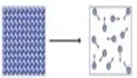
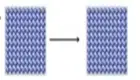
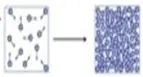
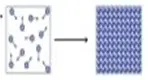
Heat energy affects the changes that occur with the particles of substances. Which of the following is
NOT TRUE?
When particles of ice absorbs heat, the particles move faster and they expand.
When particles of liquid absorbs heat, the particles move faster and they turn into steam or vapor.
When particles of steam absorbs heat, the particles move faster and they turn into liquid water.
When particles of matter absorbs heat, the particles move faster and they undergo phase change.
Which of the following comes first in conducting scientific method?
Make Conclusion
Gather data
Identify Problem
Hypothesize
Which of the following step should be done after making conclusion?
Identify Problem
Communicate result
Make Hypothesis
Analyze data
A group of students was asked to investigate how fast sugar dissolves in cold and in hot water. Refer to the following option:
I. The temperature of water
II. The amount of sugar
III. The length of time the sugar completely dissolved in hot water
IV. The length of time the sugar completely dissolved in cold water
What is the independent variable in the investigation?
II, III and IV
II and III
I, II and III
I only
A group of students was asked to investigate how fast sugar dissolves in cold and in hot water. Refer to the following variables:
I. The temperature of water II. The amount of sugar
III. The length of time the sugar completely dissolved in hot water
IV. The length of time the sugar completely dissolved in cold water
What is the dependent variable?
I only
II only
II and III
III and IV
Aileen was assigned by her science teacher to find out the effect of stirring in the length of time a chocolate powder is dissolved in 100mL of tap water. What variables should she control to have a fair test?
I. amount of chocolate powder III. amount of tap water in each cup
II. manner of stirring IV. length of time the chocolate is dissolved in tap water
I, II and III
I and III
III only
IV only
Which of the following is the unit of mass?
kilogram
Celsius
meter
second
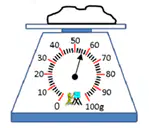
What is the mass of the ¼ cup of salt as shown below:
50 grams
56 grams
60 grams
53 grams
What instrument is used to measure the hotness and coldness of a body?
meter stick
thermometer
triple beam balance
beaker
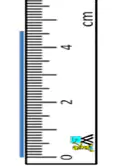
Zea had measured the height of eggplant she had planted 10 days ago using a ruler. How long was the plant as recorded:
2.4 cm
4.55 cm
4.10cm
4mm
Why variables that are not involved in an experiment should be kept constant?
to get the results in shortest possible time
for them not to affect the result
to minimize needed materials
to cut time used in the study
Which statement describes a solute?
it is the solid formed in a solution
it is the liquid part of the solution
it is the component of the solution in smaller amount
it is the component of the solution in bigger amount
Which of the following is common solvent?
salt
gasoline
iron
water
Which of the following affects the rate of dissolution of solid solute?
size of solute
temperature of solvent
manner of stirring
size of solute, temperature of solvent, and manner of stirring
A liquid has the following properties: one observable phase, color less, boils at varying temperature. Which of the following BEST describes the liquid?
solution
colloid
suspension
compound
An alloy is made from 80% iron, 15% chromium, 10 % magnesium and 5% copper. Which of the following is the solvent?
copper
chromium
magnesium
iron
Which is TRUE on saturated solution?
it contains two or more solute
it contains the maximum solute it can hold
the solute is dissolved by the solvent
it contains more solute than solvent
What is the mass percent of sugar in a solution made by dissolving 20g of sugar in 60g of water?
25%
35%
30%
40%
Which is more concentrated?
The 5grams salt in 10grams of water.
The 18grams salt in 10grams of water.
The 5grams salt in 90grams of water.
The 18grams of salt in 90grams of water.
How does temperature affect the solubility of sugar?
The sugar dissolves faster in cold water.
The sugar dissolves slower in hot water.
The sugar dissolves faster in hot water.
The sugar is Not affected with the temperature of water.
A red litmus paper was dipped in a vinegar and the paper turns to red. The solution is___.
acid
base
oxide
neutral

