
 Worksheets
Unit 2: Matter - Review
Total questions: 45
Worksheet time: 24mins
Which of the following is an element?
Oxygen (O2)
Water (H2O)
Salt (NaCl)
Ammonia (NH3)
Which of the following is an compound?
Oxygen (O2)
Iron (Fe)
Magnesium (Mg)
Ammonia (NH3)
ONE capital letter in its symbol(s)
compound
element
homogeneous mixture
heterogeneous mixture
TWO or more capital letters in its symbol(s)
element
compound
homogenous mixture
heterogeneous mixture
Which of the following statements is true?
A mixture can be physically separated, a substance cannot be.
Both a mixture and substance can be physically separated.
Only a substance can be physically separated.
Only a mixture can be chemically separated.
Trail Mix
Heterogeneous Mixture
Homogenous Mixture
Element
Compound
Coffee
Heterogeneous Mixture
Homogenous Mixture
Element
Compound
Nitrogen (N)
Heterogeneous Mixture
Homogenous Mixture
Element
Compound
Air
Heterogeneous Mixture
Homogenous Mixture
Element
Compound
Solids have a _______ shape
variable
Solids have a _______ volume
variable
Liquids have a _______ volume
variable
Liquids have a _______ shape
fixed
Gasses have a _____ shape
fixed
Gasses have a ______ volume
fixed
Which of the states of matter has the LEAST amount of kinetic energy (energy of motion)
Solid
Liquid
Gas
Plasma
Which state of matter has the MOST kinetic energy (energy of motion)
solid
liquid
gas
plasma
Which state of matter has the SECOND MOST amount of kinetic energy (energy of motion)?
solid
liquid
gas
plasma
Which of the following is the idea that all matter is made up of particles that are in constant motion?
Kinetic Theory
Bose-Einstein Condensate
Elemental Classification
Molecular Motion Theory
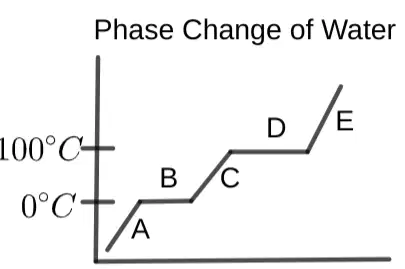
At what point is the water changing into a liquid (melting)?
A
B
D
E
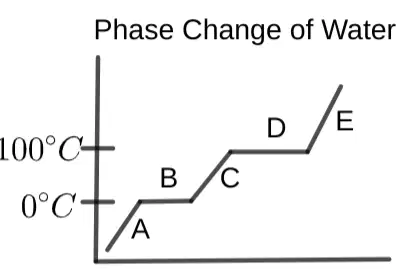
At what point is the water in the gas state?
A
C
D
E

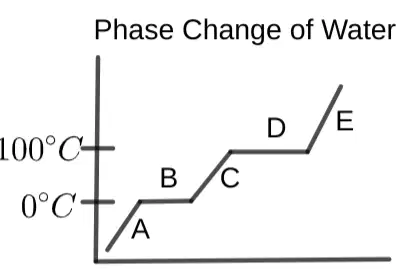
At what point is the water in the liquid state?
A
C
E
D
Exothermic or Endothermic?
Exothermic
Endothermic
Melting: Exothermic or Endothermic?
Exothermic
Endothermic
Vaporization: Exothermic or Endothermic?
Exothermic
Endothermic
Sublimation: Exothermic or Endothermic?
Exothermic
Endothermic
Freezing: Exothermic or Endothermic?
Exothermic
Endothermic
Condensation: Exothermic or Endothermic?
Exothermic
Endothermic
When energy ENters the system
Exothermic
Endothermic
When energy EXits the system
Exothermic
Endothermic
(a) changes will NOT change the identify of the substance.
(a) changes will change the identify of the substance
Flammability
Physical Property
Chemical Property
Malleability
Physical Property
Chemical Property
Conductivity
Physical Property
Chemical Property
Reactivity
Physical Property
Chemical Property
Hardness
Physical Property
Chemical Property
Ability to rust
Physical Property
Chemical Property
Density
Physical Property
Chemical Property
Boiling Point/Melting Point
Physical Property
Chemical Property
Which of the following is NOT a sign a chemical change has occured?
Bubbles produced during boiling
Change in color
Production of a gas
Formation of a precipitate
You have a rock with a volume of 15cm3 and a mass of 45 g. What is its density? What equation would you use?
d = m/v
v = m/d
m = d*v
A platinum bar measures 5.0 cm long, 4.0 cm wide, and 1.5 cm thick. It has a mass of 700.0 grams. What equation would you use to solve for the bar's volume?
v = m/d
d = m/v
v = l x w x h
m = d*v
Read the following word problem: Find the density of a marble that is 11 grams and takes up 2 mL of space. What is the MASS of the marble?
11 g
2 mL
5.5 g/mL
22 g/mL
Read the following word problem: A piece of lead has a mass of 58 g and a density of 11.6 g/mL. What variable are you NOT given (your unknown)?
mass
density
volume
grams

