
Font size
 Worksheets
SNC2D Chemistry Quiz 1 Practice
Total questions: 66
Worksheet time: 2hrs 10mins
Which of the following options provides evidence of a CHEMICAL change?
Wood is burned releasing ash and smoke
Rocks separate when soil is sifted
Water turns to ice when you put it in the freezer
Salt dissolves in water
Which of the following examples provides evidence of a PHYSICAL change?
Wood is burned and releases ash and smoke
Iron rusts over time
When mixed, baking soda and vinegar form gas bubbles
A piece of paper changes shape when you rip it up
Which observations prove a chemical change has occurred?
Dissolving and expected color change
Mixing and dissolving
State of matter change and boiling water bubbles
Unexpected color change and temperature change
When mixing milk and vinegar, a white, chunky, solid substance is formed. What has occurred?
Physical change: state of matter
Chemical change: production of a solid
Physical change: freezing
Chemical change: rust


What is the charge of an ion with 11 protons and 10 electrons?
+1
−1
+2
−2
How many valence electrons does a chlorine atom have?
5
6
7
8
What is the main goal for an atom when it forms a compound?
To lose all of its electrons
To gain more protons
To achieve a full valence shell
To become a noble gas
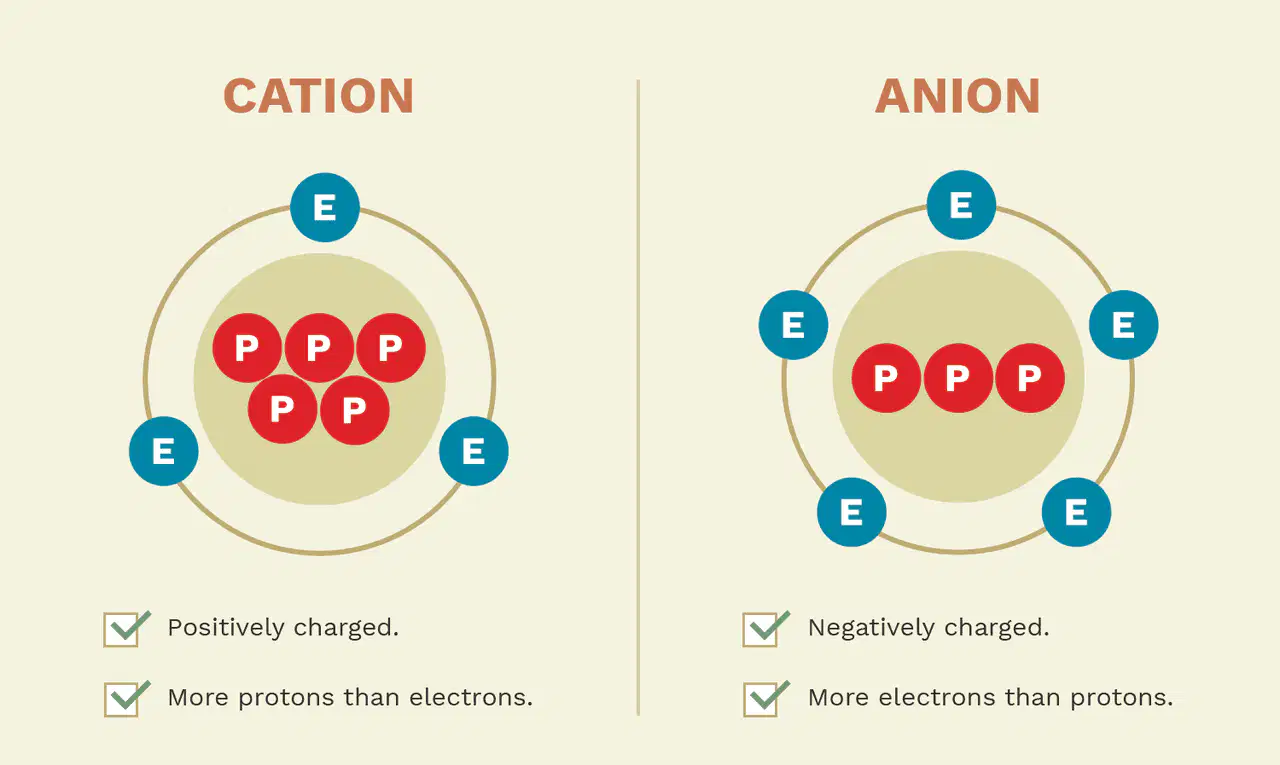
Which of the following statements about anions is true?
(Click the image to make it bigger)
Anions are positively charged ions.
Anions have more protons than electrons.
Anions are negatively charged ions.
Anions cannot form compounds.
How does the number of protons in an ion compare to the number of protons in a neutral atom of the same element?
The number of protons is less in an ion.
The number of protons is more in an ion.
The number of protons is the same in both an ion and a neutral atom.
The number of protons varies unpredictably in an ion.
In a neutral atom, the number of protons is 15. How many electrons does its corresponding anion with a −3 charge have?
12
15
18
20
What's the charge of an aluminum ion?
2-
3-
3+
1+
2+


charge of beryllium ion
-2
-1
+1
+2

Which of the following has a -3 charge?
Boron
Fluorine
Nitrogen
Neon

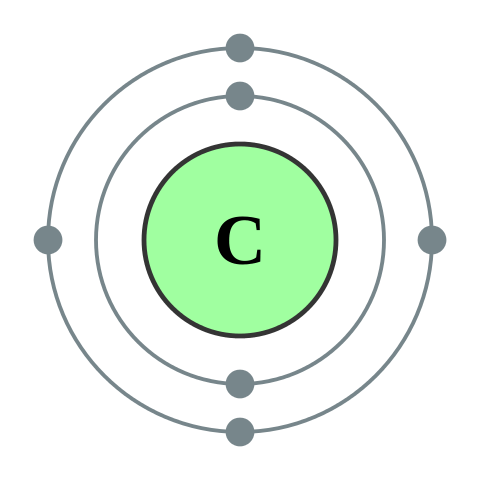
How many valence electrons does carbon have?
4
5
6
7
USE THE PERIODIC TABLE
How many valence electrons does Phosphorus have?
31
5
15
4
Do you think Calcium will gain or lose valence electrons?
Gain
Lose
Do you think Fluorine will gain or lose valence electrons?
Gain
Lose
Do you think Sodium will gain or lose valence electrons?
Gain
Lose
Do you think Sulfur will gain or lose valence electrons?
Gain
Lose
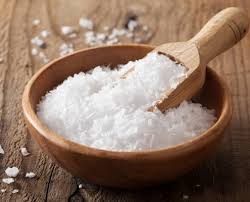
Classify ionic or molecular
LiOH
Ionic
Molecular
What is the name of AlPO4?
Aluminum phosphoxie
Monoaluminum tetraphosphate
Aluminum (III) phosphate
Aluminum phosphate

In the equation shown, what are the reactant(s)?
N2 + H2
NH3
In the equation shown, what are the product(s)?
N2 + H2
NH3
What is the left part of a chemical equation called?
2H2 + O2 ---> 2H2O
Reactants
Yields
Products
Chemical equation
What is the right part of a chemical equation called?
2H2 + O2 ---> 2H2O
Reactants
Yields
Products
Chemical Equation
C2H6 + 5O2 → 2CO2 + 3H2O2
Given this chemical equation, what are the REACTANTS?
C2H6 and 5O2
2CO2 and 3H2O2

The products in this reaction are?
Two solids
One solid and one gas
Three solids and a gas
Two solids and a gas
"When heated, solid mercury(II) oxide decomposes into mercury liquid and oxygen gas." What is the correct formula and physical state for mercury(II) oxide?
Hg2O (s)
HgO (l)
HgO (s)
"Water and sulfur trioxide vapor combine to form sulfuric acid (or hydrogen sulfate solution)." What is/are the reactant(s)?
water
sulfur
sulfur trioxide
hydrogen sulfate
"Solid zinc oxide is produced by combining zinc powder with oxygen gas." What is/are the product(s)?
zinc oxide
zinc
oxygen
What are the 7 elements are always found as diatomics (two bonded together, like X2) when they are in their pure form (not part of a compound)?
Br, I, N, Cl, H, O, F
B, I, N, C, H, O, F
B, R, O, F, In, C, H
Br, I, Ni, C, Ho, F
"Solid zinc oxide is produced by combining zinc powder with oxygen gas." What is the correct skeleton equation for this reaction?
ZnO (s) --> Zn (s) + O2 (g)
ZnO (s) --> Zn + O (g)
Zn (s) + O2 (g) --> ZnO (s)
Zn + O --> ZnO
"Water and sulfur trioxide vapor combine to form sulfuric acid (or hydrogen sulfate solution)." Which is the correct skeleton equation?
H2SO4 (s) --> H2O (l) + S3O (g)
H2O (aq) + SO3 (g) --> H2SO4 (s)
H2O (l) + S3O (v) --> H2SO4 (aq)
H2O (l) + SO3 (g) --> H2SO4 (aq)
Which is the correct formula for "potassium bromide?"
Which is the correct formula for "calcium oxide?"
Which is the correct formula for "calcium nitrate?"
How many different elements are present in H2COCH2
5
4
3
2
Calculate the number of Oxygen atoms in Al(OH)3
1
2
3
4
C3H5(NO3)3
C = 3, H = 5, N = 3, O = 9
C = 3, H = 5, N = 1, O = 9
C = 9, H = 15, N = 3, O = 9
C = 9, H = 15, N = 1, O = 3

