wayground logo

Free Printable Worksheets

Font size

S
M
L
XL
Worksheets

Unit 1 Review

Total questions: 62

Worksheet time: 1hrs 15mins

Name
Class
Date
1.
Where do we read the level of liquid?
a)
The highest point the liquid touches
b)
The bottom of the meniscus
c)
Half way between, we make an educated guess and round it
d)
Somewhere about there
2.
What is the scale on this graduated cylinder?
a)
.1 mL per line
b)
.2 mL per line
c)
.5 mL per line
d)
1 mL per line
3.
What is the volume of the water in this graduated cylinder?
a)
7.6 mL
b)
7.2 mL
c)
6.6 mL
d)
6.8 mL
4.
What is the volume of the water in this graduated cylinder?
a)
8.8 mL
b)
8.6 mL
c)
9.2 mL
d)
9 mL
5.
What is the volume of the water in this graduated cylinder?
a)
18 mL
b)
20.3 mL
c)
10.7 mL
d)
17 mL
6.
What is the volume of the water in this graduated cylinder?
a)
11.5 mL
b)
13 mL
c)
10.3 mL
d)
11 mL
7.
Change from standard form to scientific notation: 12,000,000
a)
12.0  x  107
b)
0.12  x  107
c)
1.2  x  106
d)
1.2  x  107
8.
Change from standard form to scientific notation: 0.004078
a)
4.078  x  10-3
b)
4.078  x  103
c)
40.78  x  10-4
d)
.4078  x  10-2
9.
Which number is correctly written in scientific notation?
a)
8.2 x 10²
b)
82 x 107
c)
3.45 x 94
10.
Which number is correctly written in scientific notation?
a)
5.67 x 10⁵
b)
56.7 x 10³
c)
0.567 x 10⁶
11.
125,678,000: Change to scientific notation
a)
1.25678  x  1012
b)
.125678  x  10-9
c)
12.5678  x  108
d)
1.25678  x  108
12.
Try to change the number back to standard form:  6.79  x  104
a)
679,000
b)
6,790
c)
67,900
d)
6,790,000
13.
Try to change the number back to standard form: 3.97  x  10-2
a)
0.000397
b)
0.0397
c)
0.0000397
d)
0.397
14.

1 mile = 1.6 km.

What conversion factor would be used to convert 3.2 km into miles?

a)

3.2 km1mi\frac{3.2\ km}{1mi}  

b)

1 mi3.2 km\frac{1\ mi}{3.2\ km}  

c)

 1 km1.6 mi\ \frac{1\ km}{1.6\ mi}  

d)

1 mi1.6 km\frac{1\ mi}{1.6\ km}  

e)

1.6 mi1 km\frac{1.6\ mi}{1\ km}  

15.

The base measurement for mass is...

a)

kilogram

b)

liters

c)

grams

d)

meters

16.
15.6 L = ___________ mL
a)
15,600
b)
156,000
c)
1,560,000
d)
15,600,000
17.

The base measurement for mass is...

a)

kilogram

b)

liters

c)

grams

d)

meters

18.
240 cm = ___________ m
a)
2400
b)
24
c)
2.4
d)
0.24
19.
1000 m = ___________ km
a)
100
b)
10
c)
1
d)
0.1
20.
15.6 L = ___________ mL
a)
15,600
b)
156,000
c)
1,560,000
d)
15,600,000
21.
0.57 mL = ___________ L
a)
5.7
b)
0.057
c)
0.0057
d)
0.00057
22.
 330 cm = ___________ m
a)
3,300
b)
33
c)
3.3
d)
0.33
23.
32.9 km = ___________ cm
a)
32,900
b)
329,000
c)
3,290,000
d)
32,900,000
24.
1000 grams = _____ kilograms
a)
0.0001
b)
1,000,000
c)
10
d)
1
25.
Convert 5 cm to mm:
a)
5,000mm
b)
0.5 mm
c)
0.05 mm
d)
50 mm
26.
1000 grams = _____ kilograms
a)
0.0001
b)
1,000,000
c)
10
d)
1
27.

6 kg = _____ g

a)

6

b)

6000

c)

600

d)

.006

28.

What is the basic unit of mass in the metric system?

a)

Liter

b)

Meter

c)

Gram

d)

Kilometer

29.
Which unit is the smallest?  
a)
km
b)
mm
c)
m
d)
cm 
30.
Is 20 g greater than, less than, or equal to 2 kg?
a)
greater than
b)
less than
c)
equal to
31.

900 cm ____ 9000 mm

a)

<

b)

=

c)

>

32.
Which unit is a a measure of volume?
a)
meters
b)
grams
c)
inches
d)
liters
33.

Select the largest unit.

a)

kilogram

b)

centigram

c)

decigram

d)

decagram

34.

Using the conversion chart, as the units move to the left, the decimal place moves to the ____________.

a)

Right

b)

Sometimes to the right, sometimes to the left

c)

Left

d)

The decimal place doesn't change between units

35.
What is the formula for density?
a)
density = mass x volume
b)
density = mass / volume
c)
density = mass + volume
d)
density = mass - volume
36.
Frank has an eraser. It has a mass of 4g, and a volume of 2cm3. What is its density?
a)
8 g/cm3
b)
2 g/cm3
c)
1/2 g/cm3
d)
24 g/cm3
37.

Why do objects sink or float in H2O?

a)

Because their densities are higher or lower than compared to water

b)

Because their densities are using gravity to pull down

c)

Because their densities are heavier or lighter

d)

Because their mass and volumes are equal

38.
An object with which of the following densities will float on water?
a)
0.7 g/cm3
b)
1.2 g/cm3
c)
3.5 g/cm3
d)
11.4 g/cm3
39.
What is the volume of Object X?
a)
10.0 cm3
b)
15.0 cm3
c)
20.0 cm3
d)
25.0 cm3
40.
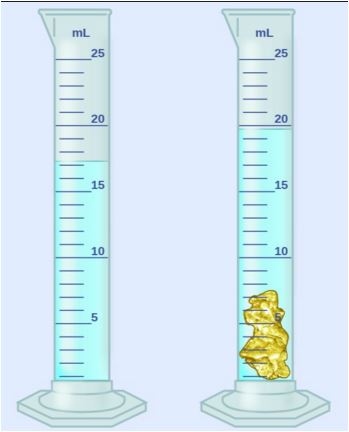
An irregularly shaped piece of gold was lowered into a graduated cylinder holding a volume of water equal to 17 ml. The height of the water rose to 20 ml. If the mass of the gold was 27 g, what was its density?
a)
9 g/mL
b)
10.5 g/mL
c)
6.5 g/mL
d)
8 g/mL
41.

A block has a mass of 20.0 g and a volume of 40.0 cm3. What is its density?

a)

2.0 g/cm3

b)

1.2 g/cm3

c)

0.5 g/cm3

d)

4.0 g/cm3

42.

Jack has a rock. The rock has a mass of 14g and a volume of 2cm3. What is the density of the rock?

a)

9 mL

b)

7 g/cm3

c)

28 g/cm3

d)

1/7 g/cm3

43.

Use the density chart to identify the substance. If the substance has a volume of 5 cm3 and a mass of 52.5.

a)

lead

b)

aluminum

c)

silver

d)

water

44.
In the picture, the mass of the block is 200 g, the dimensions of the block are 6 cm by 4 cm by 5 cm.  What is its density?
a)
1.67g/cm3
b)
13.33 g/cm3
c)
0.60 g/cm3
d)
 24000 g/cm3
45.
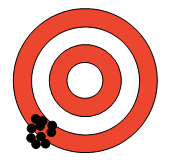
This bullseye demonstrates...
a)
High Accuracy & High Precision
b)
High Accuracy & Low Precision
c)
Low Accuracy & High Precision
d)
Low Accuracy & Low Precision
46.

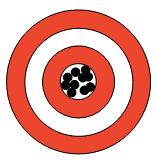
This bullseye demonstrates...

a)

High Accuracy & High Precision

b)

High Accuracy & Low Precision

c)

Low Accuracy & High Precision

d)

Low Accuracy & Low Precision

47.

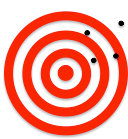
Describe the accuracy and precision of the image

a)

Very accurate and somewhat precise

b)

Very accurate but not precise at all

c)

Not accurate at all but very precise

d)

not accurate and not very precise

48.

A set of data are all close in value to each other, but they are not close to the actual value. This set of data can be described as _________________.

a)

precise

b)

accurate

49.

A set of data are all close to each other, and they are close to the actual value. This set of data can be described as...

a)

accurate

b)

precise

50.

(a)   is a measure of how close measurements come to each other when they are made in the same way.

51.

How close a measurement is to the accepted value is called (a)   .

52.
How many sig figs are there?
100.00
a)
1
b)
3
c)
4
d)
5
53.
How many sig figs are there?
100.00
a)
1
b)
3
c)
4
d)
5
54.
How many sig figs are there?
4004
a)
1
b)
2
c)
3
d)
4
55.
How many sig figs are there?
0.000008
a)
1
b)
2
c)
6
d)
7
56.
How many sig figs are there?
5.00000008
a)
2
b)
6
c)
9
57.
How many sig. fig. are in the number below:
106.00
a)
2
b)
3
c)
4
d)
5
58.
How many sig. fig. are in the number below:
0.056
a)
1
b)
2
c)
3
d)
4
59.
How many sig. fig. are in the number below:
0.678
a)
1
b)
2
c)
3
d)
4
60.
How many sig. fig. are in the number below:
350.540
a)
4
b)
5
c)
6
d)
7
61.
How many sig. fig. are in the number below:
0.007809
a)
3
b)
4
c)
5
d)
6
62.
How many sig. fig. are in the number below:
350.540
a)
4
b)
5
c)
6
d)
7