
 Worksheets
Module 9 Exam Review
Total questions: 57
Worksheet time: 29mins
What is the term for a disturbance that transfers energy through matter or space?
Medium
Wave
Frequency
Amplitude
What is the substance or material that carries a wave?
Crest
Trough
Medium
Period
Which type of wave requires a medium to travel through?
Mechanical wave
Transverse wave
Longitudinal wave
Electromagnetic wave
What type of wave moves perpendicular to the direction of the wave?
Longitudinal wave
Transverse wave
Mechanical wave
Compression wave
Which type of wave moves parallel to the direction of the wave?
Transverse wave
Longitudinal wave
Mechanical wave
Rarefaction wave
What is the highest point of a wave called?
Trough
Crest
Amplitude
Wavelength
What is the lowest point of a wave called?
Crest
Trough
Amplitude
Wavelength
What is the term for the part of a longitudinal wave where the particles are closest together?
Rarefaction
Compression
Crest
Trough
What is the term for the part of a longitudinal wave where the particles are furthest apart?
Compression
Rarefaction
Crest
Trough
What is the distance between two consecutive crests or troughs in a wave?
Frequency
Amplitude
Wavelength
Period
What is the number of waves that pass a point in one second?
Wavelength
Frequency
Amplitude
Period
What is the time it takes for one complete wave to pass a point?
Frequency
Wavelength
Period
Amplitude
What is the maximum distance a wave varies from its rest position?
Wavelength
Frequency
Amplitude
Period
What is the bending of a wave as it moves from one medium to another called?
Diffraction
Refraction
Interference
Resonance
What is the term for the bending of a wave as it passes around a barrier?
Diffraction
Refraction
Interference
Resonance
What is it called when two or more waves overlap and combine to form a new wave?
Diffraction
Refraction
Interference
Resonance
What is a wave that appears to be stationary, produced by the interference of two waves traveling in opposite directions?
Longitudinal wave
Transverse wave
Standing wave
Resonance
What is the point on a standing wave with no displacement called?
Crest
Trough
Node
Antinode
What is the ability of an object to vibrate by absorbing energy at its natural frequency called?
Diffraction
Refraction
Interference
Resonance
What is the highest point of a wave called?
Trough
Crest
Node
Antinode
What is the lowest point of a wave called?
Trough
Crest
Node
Antinode
What is the term for a material through which a wave transfers energy?
Medium
Node
Crest
Trough
What is the measure of how many wavelengths pass a fixed point each second?
Amplitude
Frequency
Wavelength
Resonance
What is the distance between one point on a wave and the nearest point just like it called?
Amplitude
Frequency
Wavelength
Resonance
What is the measure of the energy in a wave?
Amplitude
Frequency
Wavelength
Resonance
What is a repeating disturbance that transfers energy through matter or space?
Node
Wave
Medium
Crest
What is the term for matter moving at right angles to the direction the wave travels?
Longitudinal wave
Transverse wave
Standing wave
Resonance
What is the term for matter moving in the same direction as the wave travels?
Longitudinal wave
Transverse wave
Standing wave
Resonance
What is the term for the spread apart portion of a compressional wave?
Crest
Trough
Rarefaction
Node
What is it called when waves continuously interfere with each other?
Diffraction
Refraction
Interference
Resonance
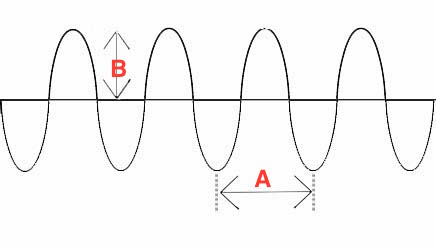
What is the term for the distance a wave travels in a given amount of time?
Wavelength
Speed
Frequency
Amplitude
What is the term for the interference of two waves resulting in a larger amplitude?
Refraction
Destructive interference
Constructive interference
Diffraction
What is the term for the change in direction of a wave when it bounces off a surface?
Interference
Reflection
Diffraction
Refraction
What happens to the energy carried by a water wave?
It disappears
It creates sound
It transfers energy through water
It turns into air
What produces waves?
Friction
A disturbance or vibration
Gravity
Heat
What is the connection between a medium and a mechanical wave?
Mechanical waves can travel without a medium
Mechanical waves need a medium to travel through
Mediums block mechanical waves
Mechanical waves create new mediums
How long would it take a sound wave to travel 9000 m in water, if the speed is 1500 m/s?
2 s
6 s
12 s
15 s
How are the wavelength and frequency of a wave related?
They are unrelated
As frequency increases, wavelength increases
As frequency increases, wavelength decreases
They always stay the same
What is the speed of an ocean wave with a wavelength of 4.0 m and a frequency of 400 Hz?
100 m/s
1600 m/s
0.01 m/s
4.4 m/s
If the speed of a wave doubles and frequency stays the same, what happens to the wavelength?
It halves
It doubles
It stays the same
It becomes zero
Which wave speeds up in water and which slows down when passing from air to water?
Light speeds up, sound slows down
Both speed up
Both slow down
Sound speeds up, light slows down
What happens to wavelength if wave speed decreases but frequency remains constant?
Wavelength increases
Wavelength stays the same
Wavelength decreases
Wavelength becomes infinite
How does wave frequency change if the period increases?
Frequency increases
Frequency stays the same
Frequency decreases
Frequency doubles
How would you shake a rope to make a transverse wave with a shorter wavelength?
Shake it faster
Shake it slower
Shake it with less energy
Shake it sideways
What is the frequency of a water wave with a 0.5 m wavelength and 4 m/s speed?
2 Hz
4.5 Hz
8 Hz
0.125 Hz
A radio wave has a frequency of 96,000,000 Hz and wavelength of 3.1 m. What is its speed?
2.98 × 10⁸ m/s
3.1 m/s
9.6 × 10⁷ m/s
1.2 × 10⁸ m/s
The angle of incidence is equal to:
The angle of the wave
The angle of refraction
Zero
The angle of reflection
How does the diffraction of FM radio waves compare to AM radio waves?
FM waves diffract more
AM waves diffract more
They diffract the same
Neither diffracts
What happens when two waves meet at the same point?
They bounce off each other
They cancel each other completely
Interference occurs
They stop moving
What results when a crest overlaps with a trough or compression overlaps rarefaction?
Constructive interference
Destructive interference
Reflection
Diffraction
What is the effect of constructive and destructive interference on amplitude?
Both increase amplitude
Both decrease amplitude
Constructive increases, destructive decreases amplitude
No change in amplitude
What causes a standing wave to form?
Waves speeding up
Refraction only
Only constructive interference
Two waves of the same frequency and amplitude move in opposite directions and interfere with each other
How does the loudness of sound waves compare between constructive and destructive interference?
Constructive is quieter
Destructive is louder
Constructive is louder
Both are equal
How can one tuning fork’s vibration cause another to vibrate?
Gravity
Resonance
Conduction
Absorption
Sound bending around columns is a result of:
Diffraction
Reflection
Refraction
Absorption
If the angle between the incident and reflected flashlight beam is 40°, what is the angle of incidence?
10°
20°
40°
80°

