
 Worksheets
REVIEW 4-5
Total questions: 35
Worksheet time: 1hrs 6mins
Write/Draw the correct isotopic notation for this atom based on these clues:
Nickel, mass number 58, charge +2

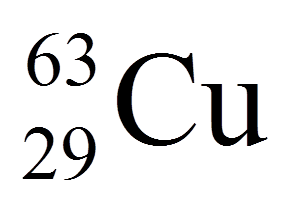


Which subatomic particle is used to identify the atom, as it never changes?
protons
neutrons
electrons

How many electrons are found in the following ion?
3
7
10
14

How many neutrons are in the following isotope?
108
47
61
155

How many electrons does the following have?
2
22
10
12
Rubidium has two common isotopes, 85Rb and 87Rb. If the abundance of 85Rb is 72.2% and the abundance of 87Rb is 27.8%, what is the average atomic mass of rubidium?
85.468 amu
37 amu
85.6 amu
86.4 amu
An unknown element has three isotopes. Given the abundances and relative masses, determine (from the periodic table) which element it is.
Abundances | Relative masses
0.005% | 234.04 amu
0.720% | 235.04 amu
99.275% | 238.05 amu
HINT: You do NOT need to calculate anything here.
Uranium (#92, Atomic Mass: 238.03 amu)
Fluorine (#9, Atomic Mass: 19.00 amu)
Mercury (#89, Atomic Mass: 200.59 amu)
Polonium (#84 209 amu)

1s22s22p63s23p64s23d10

Choose the correct short electronic configuration for iodine.
[Ar]4s24d104p5
[Kr]5s24d105p5
[Xe]5s25d105p5
none of the above
What electron configuration matches an oxygen ion (O2-)?
An aluminium ion (Al3+) would have which electron configuration?
1s2 2s2 2p6 3s2
1s2 2s2 2p6 3s2 3p1
1s2 2s2 2p6 3s2 3p6
1s2 2s2 2p6
How are groups/families organized on the periodic table?
Horizontally
Vertically
Diagonally
From left to right
What is the name given to each horizontal row on the periodic table?
Families
Groups
Periods
Rows
Which is true?
Cations are bigger than Anions
Anions are bigger than Cations
Cations and Anions are the same size.
It depends upon their position on the Periodic Table
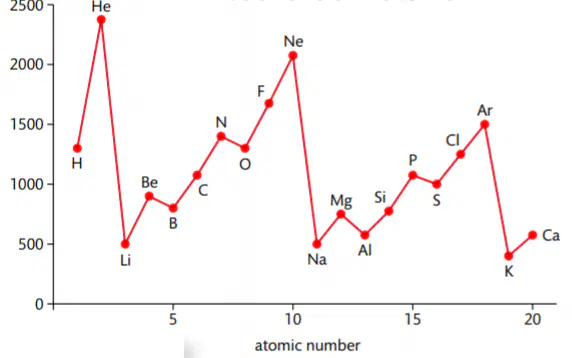
Which physical property of elements is represented by y on the graph below?
Ionization energy
Ionic radius
Atomic radius
Electronegativity
How many valence electrons are every atom trying to obtain?
2
4
6
8
Which of these is correct?


How many valence electrons are in the following configuration?
1s2 2s2 2p6 3s2
6
8
2
12

How many neutrons are in Argon?
18
40
58
22
Circle the location of the valence electrons of this atom. What element includes this atom? (Write the chemical symbol for the element underneath it electron configuration.)


Which of the following is written correctly?
A
B
C
D
What ion would be made from this atom of this element during bonding?
In order to answer this question, draw the Lewis Dot Diagram for the neutral atom AND for the ion that would be created during bonding.


What is the equivalent of the molar mass of an element?
Average atomic mass (from the periodic table)
Atomic number (from the periodic table)
Oxidation number
Valence electrons
What is the derived unit used for molar mass?
mass/density
mass/volume
1 mole of anything is equal to:
6.02
6.02 x 10²³
12
12.602 x 10²³
Which of the following has the most atoms?
1 mole of oxygen
1 mole of carbon
1 mole of iron
These all have the same number of atoms

Which of the following dimensional analysis setups will correctly convert 27.76 g of Li to atoms of Li?
A
B
C
D
(Hint: write out how you would solve the problem first on paper before choosing an answer.)
How would you set up the problem: if you have a sample of 2.50 g of sodium (Na), how many moles of Na do you have?
2.50g Na ×1 g Na22.99 mol Na=
2.50 g Na ×22.99 g Na1 mol Na=
2.50 g Na ×1 mol Na22.99 g Na=
2.50 g Na ×22.99 mol Na1 g Na =

How would you set up this problem: At STP, 2.5 moles of helium gas will have what volume?
2.5 mol He×mol22.4 L
2.5 mol He×22.4 Lmol
2.5 mol He×L6.022 ×1023atoms
2.5 mol He×6.022 ×10²³atomsL

How would you set up this problem to solve it?
An average breath contains 500 mL of gas. Assuming the air is an ideal gas at STP, how many moles of air are pushed out with each breath?
0.500 mL×103mL1L×L6.022×1023mol
0.500 mL×103mL1L×22.4 Lmol
0.500 mL×103mL1L×L22.4 mol

