
 Worksheets
3rd Form Magnets and Statics
Total questions: 47
Worksheet time: 27mins

A positively charged rod is held near the top of a neutral electroscope. What best describes what will happen to the leaves?
the leaves will spread apart and be positive
the leaves will spread apart and be negative
the leaves will stay closed and be positive
the leaves will stay closed and be negative


A negatively charged rod touches the top plate of a neutral electroscope.
Which best represents the distribution of charge on the electroscope.
both the top plate and leaves become positive
both the top plate and leaves become negative
the top plate becomes negative and the leaves become positive
the top plate becomes positive and the leaves become negative
When an object gains electrons it becomes __________
Neutral
Positively charged
Negatively charged
An atom of oxygen has 8 protons and 10 electrons, this means the atom is ____________
positively charged because it has excess electrons
negatively charged because it has excess electrons
positively charged because it has a deficiency of electrons
negatively charged because it has a deficiency of electrons
After a balloon is rubbed against wool, the two objects will ________ each other because they have ___________ charges
attract; like
attract, opposite
repel; like
repel; opposite
Which statement is true of a positively charged object?
Positively charged objects do not contain any electrons.
Positively charged objects do not contain neutrons or electrons.
There is a lack of electrons on a positively charged object.
The protons and the electrons are both positively charged on such objects.
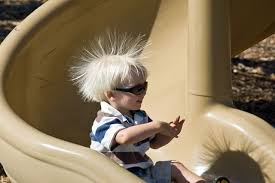
What method of static charging is shown in this picture
Contact
Friction
Grounding
Electron Shifting
Why does the child's hair stick up?
The boy is grounded since he's at the bottom of the slide
He gained a charge from the slide, and since he's not grounded, his hairs have the same charge so they repel one another
He gained a charge from the slide, and since he's not grounded, his hairs have opposite charges so they repel one another
When hair is neutral, some have a positive side and some have negative side, so they will attract to each other, making it stand up
Like charges __________ and opposite charges ________.
attract, repel
attract, attract
repel, attract
repel, repel
What is the name of the particle that is being transferred if an object becomes positive?
Proton
Neutron
Electron
Positron

If you put a magnet with two of the same poles near each other, they...
attract (move closer)
repel (move away)
repel (move closer)
attract (more away)
If you put a magnet with two different poles together, they...
repel (move away)
attract (move closer)
attract (move away)
repel (move closer)
When iron touches a magnet, it becomes a magnet too.
True
False
Magnetic materials that keep their magnetism are know as magnetically........... materials
Soft
Shiny
Hard
Dull
Magnetic materials that lose their magnetism easily are know as magnetically........... materials
Soft
Shiny
Hard
Dull

What is point x known as
(a)
The magnetic elements are
Iron
Nickel
Steel
Cobalt

How would you describe the field in this image
(a)

At which point is the magnetic field the strongest?
A
B
C
D

What is causing this persons hair to stand up and separate?
Electric charges going from the dome to the person's hair are causing the hair to repel each other and separate.
Electric charges going from the person's hair to the dome are causing it to repel.
Their hair is always like that. Always has been.
The wind
What would happen if an atom lost an electron?
It stays the same
It becomes negatively charged
It becomes positively charged

The magnetic _____ around a bar magnet is shown above.
Field
Direction
Flowers
Legs
The Earth itself produces its own magnetic field.
True
False
A permanent magnet is a material that produces a ___________ field without any _____________ magnetic field being present.
electronic, internal
magnetic, internal
magnetic, external
electronic, external
Certain materials respond to magnetic fields by becoming ___________ themselves. _____________ is one of these materials.
magnetic, Plastic
magnetic, Iron
electronic, Iron
magnetic, Wood
A magnet is attracted to following materials :
Steel
plastic
gold
iron
copper
When lines of magnetic field are closer, the strength of magnetic field is ___________________
weaker
stronger
change
neutral
Magnetic field line start from _______________ and end at _____________
north pole, south pole
south pole, north pole
north pole, north pole
south pole, south pole
Choose THREE correct statements about electrostatic charges
Electrical charges are produced through friction
A substance loses an electron become negatively charged
A substances loses and electron becomes positively charged
The repulsion and attraction produce a force
Two same charges attract each other
Only ____________________ can move from one another object to another object when rubbed.
neutron
electron
proton
There are two types of electrical charges :
positive charge
negative charge
neutral
non-moving charge

What is a use of electrostatic charging?
Explosion of dust or fine powder in industry
Electrostatic paint spraying
Lightning charge build up
Spark in operating theatre - explosion of oxygen
What is a danger of electrostatic charging?
Inkjet printers
Refuelling cars or aircraft
Photocopying
Electrostatic removal of smoke from chimneys

