
Font size
 Worksheets
HW - Review for Test 1, Unit 1
Total questions: 47
Worksheet time: 54mins

What type of cell has a nucleus?
eukaryotic
prokaryotic

What type of cell is pictured?
Prokaryotic, because it has a nucleus
Eukaryotic, because it has a nucleus
Prokaryotic, because it does not have a nucleus
Eukaryotic, because it does not have a nucleus
This part is in ALL cells. It is the gel-like substance made of mostly water and contains the other organelles.
The _________ are the power houses of the cell found in both plant and animal cells. They convert food into useful energy (ATP) for the cell.
The outermost structure found in plant cells. It provides protection, structure/ shape, and support.
This is the cell's "control center," which contains DNA and directs the cell's activities.
These structures found in plant cells capture energy from the sun and uses it to produce food.
This structure is a storage area for the cell. It stores food, water, and wastes, and is considerably larger in plant cells.
This structure is a storage area for the cell. It stores food, water, and wastes, and is considerably larger in plant cells.
I am found in ALL cells. I provide the cell with protection, by controlling what comes in and goes out of the cell.

Which structure would be identified as a ribosome?

Structure 3 is
the vacuole
the mitochondria
the nucleus
cell membrane
Structure 6 is
the cell membrane
the cell wall
the cytoplasm
the chloroplast

Organelle 1 is
the cytoplasm
the chromatin
the vacuole
the chloroplast
Structure 6 is
the cytoplasm
the chromatin
the vacuole
the chloroplast
Structure 7 is
the cytoplasm
the chromatin
the vacuole
the chloroplast
Structure 5 is
the cytoplasm
the cell membrane
the cell wall
the stem

What is the name of the structure shown in the diagram? This is where food molecules are broken down to release energy for the cell.

Which of these statements describe a plant cell? Check all that apply. (Hint - there are 2).
Angular/ Rectangular shape
Irregular/ Round shape
Has a cell wall
Does not have a cell wall
Which of these statements describe an animal cell? Check all that apply. (Hint - there are 2).
Angular/ Rectangular shape
Irregular/ Round shape
Has a cell wall
Does not have a cell wall
Which of these statements describe a plant cell? Check all that apply. (Hint - there are 2).
Has chloroplasts
Does not have chloroplasts
Has a large vacuole
Does not have a large vacuole
Which of these statements describe an animal cell? Check all that apply. (Hint - there are 2).
Has chloroplasts
Does not have chloroplasts
Has a large vacuole
Does not have a large vacuole
True or False?
Skin cells have a very different structure and function than brain cells
True
False

Describe the cell shown.
Eukaryote animal cell with no nucleus
Eukaryote animal cell with less cytoplasm
Prokaryote plant cell with a nucleus
Prokaryote bacteria cell with no nucleus
What technology was used to develop cell theory?
Microwaves
Telescopes
Antibiotics
Microscopes

What would happen to someone or something if organelle C malfunctioned?
Their cells would fill up with waste.
They would have little energy to function and they would feel very tired all the time.
Their cells would lose the ability to control protein creation and all cell function would slowly cease.
The plant cells would not have strong support so the stem would be weak and floppy.

An organism made of only one cell is called . . .
Eukaryotic
Monocellular
Multicellular
Unicellular
You should always carry the microscope by the
The ________ of the microscope would show you the MOST zoomed-in image with the SMALLEST field of view.
low power objective lens
medium power objective lens
high power objective lens

To change the image as seen on the left, the (a) was adjusted to reduce light.

What is the red arrow pointing at?
Stage
Base
Arm
Body Tube

Identify # 13 on the microscope diagram.
Stage
Coarse adjustment knob
Fine adjustment knob
Stage clips
Identify # 10 on the microscope diagram.
Stage
Coarse adjustment knob
Fine adjustment knob
Stage clips
Moves the stage slightly to sharpen the image, especially under high power magnification
Coarse focus adjustment knob
Fine focus adjustment knob
light source
diaphragm
Moves stage up and down in large amounts for focusing under scanning and low power; NEVER used with the high power objective lens
Fine focus adjustment knob
Coarse focus adjustment knob
Ocular
Light Source
A student used the high power objective lens with a magnification of 55x to observe some cells. The microscope had an eyepiece magnification of 10X. What was the total magnification of the cells the student was observing under high power?
What is the purpose of the scanning objective lens?
To provide the highest magnification
To provide a wide field of view at low magnification; first lens used to locate the specimen
To focus light on the specimen
To hold the slide in place
When looking through your microscope, you move your slide to the right- It appears

What is number 14?
A letter "e" has been placed on the slide in the proper orientation. How does it appear on the slide when you look through the microscope?


What are the three components of classical cell theory? (Pick 3)
Cells are the basic unit of life
All cells essentially have the same chemical composition
All organisms are composed of one or more cells
All cells come from pre-existing cells
What is the basic structural and functional unit of all living things?
atom
cell
bacteria
animalcules

What is the idea that life can arise form nonliving material?
biogenesis
evolution
spontaneous combustion
spontaneous generation
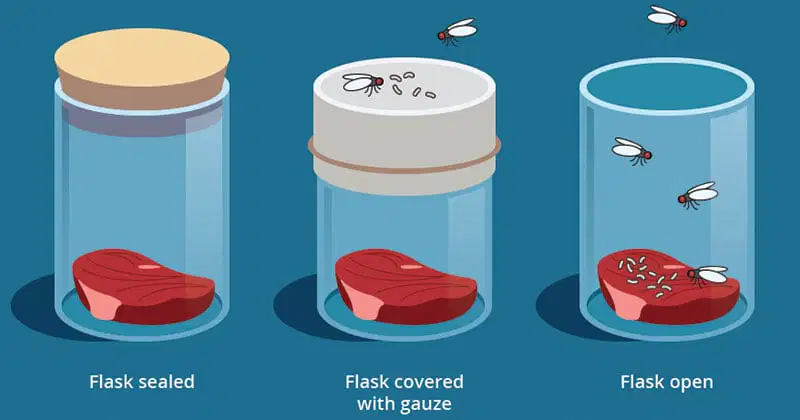
Where did Redi conclude maggots come from?
Maggots came from meat
Maggots are spontaneously generated
Maggots come from flies
Maggots come from the air
How are multi-celled and single-celled organisms different?
What is an organism?
A dead animal
A living thing
A pencil
A shoe

Small structures that perform specialized functions within cells are known as
organelles
tissues
organs
organ systems

