
 Worksheets
PEDU 520: Bones
Total questions: 15
Worksheet time: 10mins
What minerals are found in bone tissue?
Calcium & phosphate
Magnesium & sulfate
Calcium & Iron
Magnesium & Phosphate
Which characteristic is NOT associated with bone tissue?
Ductile
Brittle
Viscoelastic
Elastic
What type of material deforms greatly before failure?
Brittle material
Ductile material
Elastic material
Plastic material
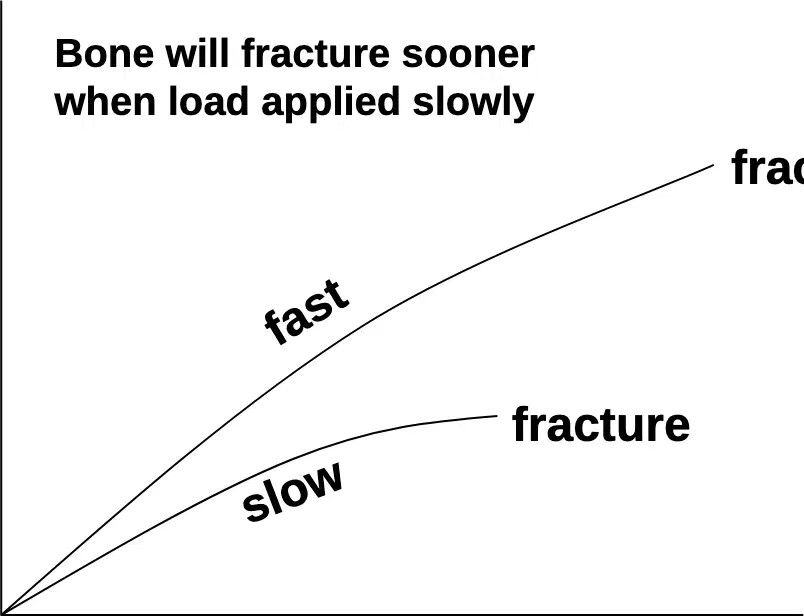
What is the main focus of the diagram provided?
Temperature effects on bone
Rate of load effects on bone
Chemical composition of bone
Bone density variations
Which of the following is part of the axial skeleton?
Femur
Skull
Tibia
Metacarpals
Which bone is located in the wrist?
Carpals
Femur
Tibia
Fibula
Which part of the long bone is responsible for growth in length?
Diaphysis
Metaphysis
Epiphyseal plate
Cortical bone
Causes lengthwise growth of a long bone
Periosteum
Red Bone Marrow
Medullary Cavity
Compact bone
Epiphyseal plate
The presence of an epiphyseal plate indicates that:
The bone is broken.
The bone is dead.
The bone is increasing in diameter.
The bone is lengthening.
The bone is no longer lengthening.
What is the term for the process by which bone is formed, renewed, and repaired?
Ossification
Calcification
Homeostasis
Metabolism
True or False: Bones produce blood cells.
True
False
Which type of bone cell is responsible for breaking down bone tissue?
Osteoblasts
Osteocytes
Osteoclasts
Chondrocytes
Which type of loading is most likely to cause a bone fracture?
Compressive loading
Tensile loading
Shear loading
Axial loading
How does bone adapt to increased mechanical loading over time?
By decreasing bone density
By increasing bone density
By becoming more brittle
By reducing mineral content

