
Font size
 Worksheets
Matter: States, Changes, Properties, Classification & Separation
Total questions: 40
Worksheet time: 27mins

Which of the following statements about the particle theory of matter is incorrect?
All matter is made up of tiny particles.
All substances are made of the same particles.
The particles can move when they are heated.
Particles are held together by strong electrical forces.

State of matter that takes the shape of it's container and has a definite volume.
Solid state
Liquid state
Gas state
Plasma state

State of matter in which materials have a definite shape and volume.
Solid state
Liquid state
Gas state
Plasma state
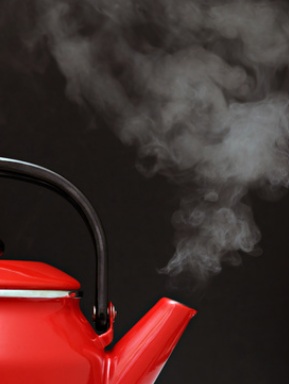
What change of state is taking place in this photograph?
Condensation
Freezing
Vaporization
Melting

The diagram shows the changes in state of water (H2O). What is the process Z called?
Condensation
Freezing
Vaporization
Melting

When a beaker of water is heated its volume increases a little. What is happening to the particles in the liquid?
They are getting bigger.
They are moving slower.
They are moving faster.
They are getting smaller.

When you place a bottle of water in the freezer its volume increases. What is happening to the particles in the liquid?
They are getting bigger.
They are moving slower.
They are moving faster.
They are getting smaller.
What is the change of state of a solid directly to a gas called?
Vaporization
Sublimation
Freezing
Condensation
Which phase has a fixed volume and a fixed shape?
Solid
Liquid
Gas
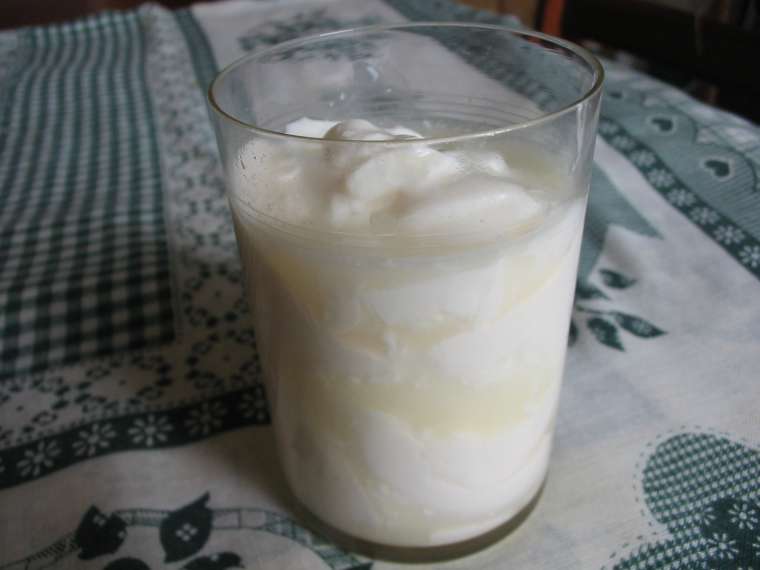
Is milk going sour a physical or chemical change?
Physical
Chemical

The melting point of the sample is
-60 ºC
20 ºC
60 ºC
100 ºC

Describe the substance at letter A.
Solid
Liquid
Melting
Evaporating
What do you call anything that has mass and takes up space?
matter
volume
density
plasma
What type of matter is a physical blend of two or more substances?
Pure substance
Mixture
Element
Compound
This method separates substances due to differences in the sizes of their particles.
Filtration
Evaporation
Distillation
Chromatography
Which method(s) separate substances based on them having different boiling points?
Filtration
Evaporation
Distillation
Chromatography
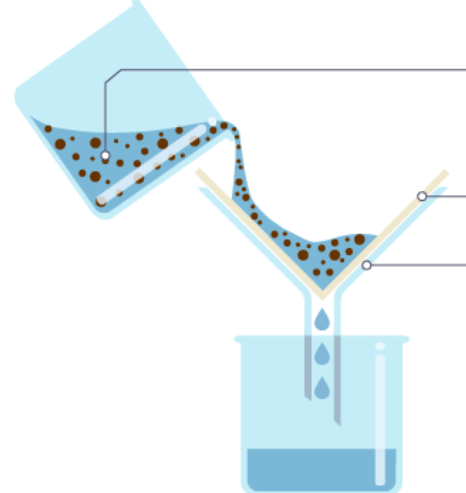
Which method is this a picture of?
Filtration
Evaporation
Distillation
Chromatography
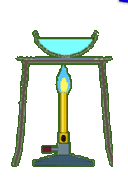
Dyes in a felt-tip pen may be separated by....
Distillation
Decanting
Chromatography
Centrifuge
How are you going to separate salt from salt water solution?
by evaporation process
by decantation process
by using magnet
by sieving

How are you going to separate the iron filings from sulfur powder?
by sieving
by using magnet
by decantation process
by dissolving sulfur to water

How are you going to separated gravels from sand?
by evaporation process
by decantation process
by sieving
by using magnet

Dry ice is solid. When it is left under room temperature it gives off gas. What process is this?
evaporation
distillation
decantation
sublimation
Which of these is a chemical properties of matter?
color
boiling point
melting point
corrosiveness

Which statement below describes the change that brings about by fireworks?
Physical change : fireworks change it shape
Physical change : fireworks emit different colors and energy
Chemical change: fireworks show different sizes of sphere
Chemical change : fireworks emit different colors and energy
In the initial digestion of food inside the mouth, when does chemical change happens?
when food breaks down into small pieces
when saliva reacts and lubricate food
when food is swallowed already
when food is already digested inside the small instestine

