Wayground logo

Free Printable Worksheets

Font size

S
M
L
XL
Worksheets

Muscle Review Day

Total questions: 101

Worksheet time: 3590secs
Name
Class
Date
1.
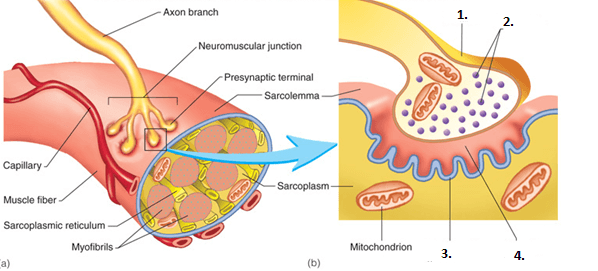
The gap between a neuron and a muscle cell: (#4 in the diagram)
a)

synaptic cleft or synapse

b)
sarcolemma
c)
vesicle
d)
Ca2+ ion
2.
The gap between a neuron and a muscle cell: (#4 in the diagram)
a)

synaptic cleft or synapse

b)
sarcolemma
c)
vesicle
d)
Ca2+ ion
3.
Region where a motor neuron comes in close contact with a muscle cell.
a)
neurotransmitter
b)
muscular dystrophy
c)
muscle tension
d)
neuromuscular junction
4.
The neurotransmitter stored in the axon terminal identified as #3
a)
Acetylcholine
b)
Protein Channel
c)
Calcium Ion (Ca2+)
d)
Syanptic Cleft
5.
The organelle containing actin and myosin identified as #9
a)
ACh
b)
Sarcolemma
c)
Vesicle
d)
Myofibril
6.

The functional unit of a muscle that contracts is ...

a)

sarcomere

b)

motor unit

c)

fascicle

d)

myofibril

7.
Thick filaments are in a myofibril are
a)
ATPase
b)
Sarcoplasmic reticulum
c)
Actin
d)
Myosin
8.
Thin filaments in a myofibril are
a)
Sarcomeres
b)
Sarcoplasm
c)
Actin
d)
Myosin
9.
What two chemicals are necessary for muscle contraction to occur?
a)
Niacin and Potassium
b)
Calcium and ATP
c)
Sodium and Potassium
d)
Ach and Potassium
10.
What is the structure that stores the Calcium in the muscle cell.  
a)
Sarcoplasm
b)
Sarcolemma
c)
Sarcoplasmic Reticulum
d)
Myoglobin
11.
Skeletal Muscle contraction is initiated when the ________ sends a message to the muscle cell.  
a)
Muscle cell
b)
Neuron
c)
Gland
d)
None of the above
12.
The energy needed to perform a muscle contraction comes directly from
a)
ATP
b)
Oxygen
c)
Glucose
d)
Calcium
13.
What is a crossbridge?
a)
Where myosin binds to actin
b)
Where the calcium crosses into the cytoplasm
c)
Where calcium binds with troponin
d)
None of the answers are correct.
14.
___ and ___ are regulatory proteins bound to actin. 
a)
Troponin and tropomyosin
b)
Myosin and actin
c)
Calcium and Oxygen
d)
Glycogen and hemoglobin
15.
Calcium:
a)
causes ATP binding to actin
b)
increases the action potential along the sarcolemma
c)
binds to proteins on myosin
d)
triggers the binding of myosin to actin
16.

___forms a crossbridge with actin.

a)

actin

b)

myosin

c)

calcium

d)

ATP

17.

Which number represents the sarcomere?

a)

1

b)

2

c)

3

d)

4

18.
Muscles are attached to bones by _____.
a)
Ligaments
b)
Tendons
c)
Cartilage
d)
Axons
19.
Another name for a muscle cell.
a)
Fiber
b)
Sacrolemma
c)
Sacromere
d)
Fascicle
20.
Muscles are attached to bones by _____.
a)
Ligaments
b)
Tendons
c)
Cartilage
d)
Axons
21.
Another name for a muscle cell.
a)
Fiber
b)
Sacrolemma
c)
Sacromere
d)
Fascicle
22.
Contractile unit of a muscle.
a)
sarcomere
b)
motor unit
c)
fascicle
d)
myofibril
23.
A bundle of muscle cells.
a)
sarcomere
b)
fiber
c)
fascicle
d)
Tendon
24.
Ribbon like organelle found in muscle cells that have a banded appearance
a)
sarcomere
b)
myofibril
c)
fascicle
d)
actin
25.
Thick filaments are in a myofibril are
a)
ATPase
b)
Sarcoplasmic reticulum
c)
Actin
d)
Myosin
26.
Thin filaments in a myofibril are
a)
Sarcomeres
b)
Sarcoplasm
c)
Actin
d)
Myosin
27.
The plasma membrane of a skeletal muscle cell is called the:
a)
sarcomere
b)
myofilament
c)
sarcolemma
d)
sarcoplasm
28.
The functional unit of the muscle cell is the: 
a)
Sarcomere
b)
Osteon
c)
Myofilament
d)
Muscle fiber
29.
What two chemicals are necessary for muscle contraction to occur?
a)
Niacin and Potassium
b)
Calcium and ATP
c)
Sodium and Potassium
d)
Ach and Potassium
30.
Calcium:
a)
causes ATP binding to actin
b)
increases the action potential along the sarcolemma
c)
binds to proteins on myosin
d)
triggers the binding of myosin to actin
31.
What is a crossbridge?
a)
Where myosin binds to actin
b)
Where the calcium crosses into the cytoplasm
c)
Where calcium binds with troponin
d)
None of the answers are correct.
32.
The Ions that are responsible for removing Troponin from Tropomyosin.
a)
Sodium
b)
Calcium
c)
Potassium
d)
Magnesium
33.
What is the structure that stores the Calcium in the muscle cell.  
a)
Sarcoplasm
b)
Sarcolemma
c)
Sarcoplasmic Reticulum
d)
Myoglobin
34.
Skeletal Muscle contraction is initiated when the ________ sends a message to the muscle cell.  
a)
Muscle cell
b)
Neuron
c)
Gland
d)
None of the above
35.
Involuntary
a)
skeletal
b)
cardiac
c)
smooth
d)
smooth and cardiac
36.
Striated
a)
smooth
b)
cardiac
c)
skeletal
d)
skeletal and cardiac
37.
attached to bones
a)
cardiac
b)
smooth
c)
skeletal
38.
found in heart
a)
smooth
b)
cardiac
c)
skeletal
39.

Explains how the muscle fibers shorten as the actin and myosin filaments pull on each other

a)

threshold stimulus theory

b)

sliding filament theory

c)

neurotransmitter theory

d)

all or none principle

40.

Identify the muscle type

a)

skeletal

b)

smooth

c)

cardiac

41.

Identify the muscle type

a)

cardiac

b)

skeletal

c)

smooth

42.

What is the sliding filament theory?

a)

A description of the shapes of muscles

b)

A theory explaining that lengthening the sarcomeres causes a muscle to move

c)

An explanation for how muscle contraction occurs

d)

A description of how myosin filaments move.

43.

What are these types of muscles called?

a)

Cardiac muscle

b)

Smooth muscle

c)

Striated muscle

44.

What are these types of muscles called?

a)

Cardiac muscle

b)

Smooth muscle

c)

Striated muscle

45.

What are these types of muscles called?

a)

Cardiac muscle

b)

Smooth muscle

c)

Striated muscle

46.
What type of muscle tissue is VOLUNTARILY controlled
a)
Skeletal Only
b)
Skeletal and Cardiac
c)
Smooth and Cardiac
d)
Cardiac Only
47.
What tissue type is this?
a)
Skeletal muscle
b)
Nervous tissue
c)
Adipose tissue
d)
'Specialised' connective tissue
48.

Myofibrils are formed by

a)

Thin filament system

b)

Strong filament system

c)

Light filament system

d)

Thick filament system

49.

The total types of striated muscles is

a)

2

b)

3

c)

1

d)

5

50.
Muscle tissue
a)
Is tissue that functions in lining, covering, and glandular tissue
b)
Is tissue involved in protecting, supporting, and binding together other body tissues
c)
Is tissue that contracts and shortens to produce movement 
d)
Tissue that receives and conducts electrochemical impulses from one part of the body to another
51.
Each muscle fiber is directly surrounded by connective tissue called the 
a)
perimysium
b)
fascia
c)
endomysium
d)
epimysium
52.
Name the connective tissue layer that surrounds a skeletal muscle.
a)
epimysium
b)
perimysium
c)
endomysium
d)
sarcoplasm
53.

Muscle cells can resume their resting length after relaxing. This means that muscle cells are

a)

excitable

b)

extensible

c)

contractile

d)

elastic

54.
Skeletal muscles always work _____.
a)
in groups
b)
in pairs
c)
singly
d)
none of the above
55.
A ______________________ attach bones to each other at joints.
a)
Ligament
b)
Bone
c)
Joint
d)
Cell
56.

The bicep muscle gets its name ____________________.

a)

Because of its shape

b)

Because of its location

c)

Because of the direction of muscle fibers

d)

Because of its tendons of origin

57.

The transverse abdominus muscle gets its name ____________________.

a)

Because of its shape

b)

Because of its location

c)

Because of the direction of muscle fibers

d)

Because of its tendons of origin

58.

The internal oblique muscle gets its name ____________________.

a)

Because of its shape

b)

Because of its location

c)

Because of the direction of muscle fibers

d)

Because of its tendons of origin

59.

The gluteus maximus muscle gets its name ____________________.

a)

Because of its shape

b)

Because of its location

c)

Because of its size

d)

Because of its tendons of origin

60.

The vastus lateralis muscle gets its name ____________________.

a)

Because of its shape

b)

Because of its location

c)

Because of its size

d)

Because of its tendons of origin

61.

Which muscle is the Obliques?

a)
b)
c)
d)
62.

Choose which muscle naming rules are used for (check all that apply):

External oblique

a)

Location of muscle

b)

Direction of muscle fibers

c)

Relative size of the muscle

d)

Action of the muscle

e)

Location of muscle's origin and insertion

63.

Choose which muscle naming rules are used for (check all that apply):

Extensor digitorum longus

a)

Direction of muscle fibers

b)

Location of muscle

c)

Action of muscle

d)

Relative size of the muscle

e)

Shape of the muscle

64.

How many origins does a quadriceps muscle have?

a)

1

b)

2

c)

3

d)

4

65.

How many origins does a triceps muscle have?

a)

1

b)

2

c)

3

d)

4

66.

How many origins does a biceps muscle have?

a)

1

b)

2

c)

3

d)

4

67.

Which type of muscle is the longest in a muscle group?

a)

Maximus

b)

Minimums

c)

Medius

d)

Longus

68.

Which of the following are muscles found in the leg section of the body?

a)

Occipitofrontalis

b)

Abdominal external oblique

c)

Tibialis posterior

d)

Biceps femoris

e)

Biceps brachii

69.

Thick filaments within a myofibril are:

a)

ATPase

b)

Sarcoplasmic reticulum

c)

Actin

d)

Myosin

70.

The contractile unit of a muscle:

a)

sarcomere

b)

motor unit

c)

fascicle

d)

myofibril

71.

Thick filaments within a myofibril are:

a)

ATPase

b)

Sarcoplasmic reticulum

c)

Actin

d)

Myosin

72.

Thin filaments in a myofibril are

a)

Sarcomeres

b)

Sarcoplasm

c)

Actin

d)

Myosin

73.

The energy needed to perform a muscle contraction comes directly from

a)

ATP

b)

Oxygen

c)

Glucose

d)

Calcium

74.

The neurotransmitter stored in the axon terminal identified as #3

a)

Calcium Ion (Ca2+)

b)

Protein Channel

c)

Acetylcholine

d)

Synaptic Cleft

75.
The gap between a neuron and a muscle cell: (#4 in the diagram)
a)

synaptic cleft (synapse)

b)
sarcolemma
c)
vesicle
d)
Ca2+ ion
76.
The plasma membrane of a skeletal muscle cell is called the:
a)
sarcomere
b)
myofilament
c)
sarcolemma
d)
sarcoplasm
77.

The neuron that transmits an impulse from the central nervous system to the muscle is called a:

a)

sensory neuron

b)

motor neuron

78.

Do the lengths of the thick and thin filaments change during contraction?

a)

Yes

b)

No

79.
The organelle that stores ACh in the axon is identified as #4
a)
Motor Neuron
b)
Axon Terminal of Motor Neuron
c)
Sarcolemma
d)
 Vesicle
80.
Skeletal Muscle contraction is initiated when the ________ sends a message to the muscle cell.  
a)
Muscle cell
b)

Motor Neuron

c)
Gland
d)

Cardiac Muscle

81.
What state is the sarcomere in #1
a)
Relaxed
b)
Contracting
c)
Fully Contracted
d)
None of the above
82.
What state is the sarcomere in #2
a)
Relaxed
b)
Contracting
c)
Fully Contracted
d)
None of the above
83.

___are thin filaments.

a)

troponin

b)

tropomyosin

c)

actin

d)

myosin

84.

___are thick filaments.

a)

actin

b)

myosin

c)

troponin

d)

tropomyosin

85.

___are regulatory proteins that cover the myosin binding site on the actin.

a)

troponin-tropomyosin

b)

sarcomere

c)

sarcolemma

d)

sarcoplasmic reticulum

86.

Calcium binds to ___of the troponin-tropomyosin complex.

a)

troponin

b)

tropomyosin

c)

actin

d)

myosin

87.

Calcium is stored in the ___.

a)

sarcoplasm

b)

sarcolemma

c)

sarcoplasmic reticulum

d)

transverse tubules

88.

A ___extends from one Z disc to another Z disc.

a)

Sarcolemma

b)

Neuromuscular junction

c)

Sarcomere

d)

Motor end plate

89.

___gets shorter during contraction.

a)

actin

b)

myosin

c)

troponin-tropomyosin

d)

none of these

90.

___forms a crossbridge with actin.

a)

actin

b)

myosin

c)

calcium

d)

ATP

91.

___provides energy for muscle contraction and relaxation.

a)

cAMP

b)

ADP

c)

ATP

d)

M line

92.

___slides inward during muscle contraction.

a)

actin

b)

myosin

93.

Please select the correct order

a)

1. Muscle cell releases calcium

2. Neurotransmitter releases acetylcholine

3. Sodium & Potassium pump opens

4. Acteylcholine signals cell membrane gates to open

b)

1. Neurotransmitter releases acetylcholine

2. Acteylcholine signals cell membrane gates to open

3. Sodium & Potassium pump opens

4. Muscle cell releases calcium

c)

1. Sodium & Potassium pump opens

2. Acteylcholine signals cell membrane gates to open

3. Muscle cell releases calcium

4. Neurotransmitter releases acetylcholine

d)

1. Neurotransmitter releases acetylcholine

2. Acteylcholine signals cell membrane gates to open

3. Muscle cell releases calcium

4.Sodium & Potassium pump opens

94.

As calcium binds to actin the myosin heads are allowed to bind to the actin forming a cross-bridge and begin to slide over mysoin.

a)

True

b)

False

95.

When ATP binds to the myosin head the myosin head then _____________.

a)

completes a power stroke

b)

attaches to actin

c)

rotates

d)

detaches from actin

96.

Looking at the figure what molecule will allow the myosin head to detach from actin.

a)

ADP

b)

Myosin

c)

ATP

d)

Creatine Phosphate

97.

Looking at the figure which one is a fully contracted muscle?

a)

A

b)

B

c)

C

d)

All are contracted

98.

Actin is the ...

a)

Thick Filament within a Muscle Fibre

b)

Thin Filament within a Muscle Fibre

c)

Protein that covers myosin-binding sites

d)

Molecule that causes muscle contraction

99.

Myosin is the ...

a)

Thin Filament of a muscle fibre

b)

Segment of a muscle fibre

c)

A molecule that changes shape when bound with Calcium Ions

d)

Thick Filament of a muscle fibre

100.

What do we call the simplest part of a muscle that is made up of tiny, parallel threads called?

a)

sarcomere

b)

myofibril

c)

perimysium

d)

Epimysium

101.

What two proteins are needed for muscle contraction in the human body?

a)

tropin & tropymosin

b)

actin $ Calcium

c)

actin & myosin

d)

ATP & Calcium