

wayground logo

Free Printable Worksheets

Font size

S
M
L
XL
Worksheets

1st nine weeks exam review

Total questions: 81

Worksheet time: 2hrs 58mins

Name
Class
Date
1.
Which of these is matter?
a)
energy
b)
air
c)
peace
d)
love
2.
Which of the following below is a chemical property? 
a)
Color
b)
Density
c)
Boiling Point
d)
Reactivity with Acid
3.
Which of the following situations is evidence of chemical change? 
a)
Boiling water produces steam
b)
Adding vinegar to baking soda makes foaming bubbles
c)
Sharpening a pencil
d)
Cutting paper
4.
The fact that sugar can be white is a 
a)
Chemical Property 
b)
Physical Property 
c)
Both A and B
d)
None of the above 
5.
Flammability is a 
a)
Chemical Property 
b)
Physical Property 
c)
Both A and B
d)
None of the above 
6.
Iron's ability to rust when exposed to air is a 
a)
Chemical Property 
b)
Physical Property 
c)
Both A and B
d)
None of the above 
7.
Iron's ability to rust when exposed to air is a 
a)
Chemical Property 
b)
Physical Property 
c)
Both A and B
d)
None of the above 
8.
Density is a 
a)
Chemical Property 
b)
Physical Property 
c)
Both A and B
d)
None of the above
9.
Which one of the following is NOT a physical property of paper? 
a)
It is solid
b)
It is white
c)
It is flammable
d)
It is smooth
10.
An antacids (TUMS) ability to change pH in your stomach is an example of a 
a)
Chemical Property 
b)
Physical Property 
c)
Both A and B 
d)
None of the above 
11.
After blowing out the flame on the candle, James noticed the wick changed from white to black, this is a
a)
Physical Property
b)
Physical Change
c)
Chemical Property 
d)
Chemical Change 
12.
Which example represents a chemical change occurring? 
a)
A blue bike is painted pink
b)
Sand paper is used to smooth wood
c)
When the two chemicals inside an ice pack are mixed it becomes cold 
d)
Paper is ripped into smaller pieces 
13.
In a chemical change
a)
Bonds are not broken
b)
A new substance is formed and bonds are rearranged 
c)
No new substances are formed 
d)
None of the above 
14.
Which of the following is a physical property of vinegar (acetic acid)? 
a)
The liquid is dark and cloudy
b)
The powder is blue
c)
The white powder can rust 
d)
The liquid is clear and has a strong odor
15.

_____ have molecules that are packed together and hardly move.

a)

solids

b)

liquids

c)

gases

d)

plasma

16.

____ have a definite volume and molecules that are spread out and can move past one another.

a)

solids

b)

liquids

c)

gases

d)

plasma

17.

____ have molecules that can spread out far from each other and move quickly.

a)

solids

b)

liquids

c)

gases

d)

plasma

18.

____ keep their size but not their shape.

a)

solids

b)

liquids

c)

gases

d)

plasma

19.

Which phase of matter has a definite volume and definite shape?

a)

solid

b)

liquid

c)

gas

20.

___ is anything that takes up space and has mass.

a)

Density

b)

Weight

c)

Volume

d)

Matter

21.

____ is the amount of space an object takes up.

a)

Matter

b)

Volume

c)

Density

d)

Mass

22.

Which tool would you use to measure the volume of a liquid?

a)

balance

b)

thermometer

c)

ruler

d)

graduated cylinder

23.

Which tool would you use to measure the temperature of a cup of sand?

a)

thermometer

b)

balance

c)

graduated cylinder

d)

ruler

24.

_____ determines whether an object will sink or float in water.

a)

Mass

b)

Weight

c)

Density

d)

Volume

25.

Which property of matter would stay the same after a crayon is melted.

a)

shape

b)

state

c)

texture

d)

mass

26.

Melting means:

a)

The mixture of a liquid with a solid such as salt.

b)

When solid changes into liquid.

27.

Which picture describe something bumpy

a)
b)
c)
d)
28.

Water freezing is an example of a.....

a)

Liquid changing to a solid

b)

Solid changing to a gas

c)

Liquid changing to a gas

29.

Solubility is __________

a)

How dense something is compared with a reference material. Sink or Float

b)

Anything that has mass and takes up space.

c)

How much space something takes up.

d)

Measurement of the ability of a solid to dissolve in a liquid.

30.

Water displacement is __________________

a)

How dense something is compared with a reference material. Sink or Float

b)

Anything that has mass and takes up space.

c)

How much fluid is pushed away when an object is placed in it. We can then know the volume of the object.

d)

Measurement of the ability of a solid to dissolve in a liquid.
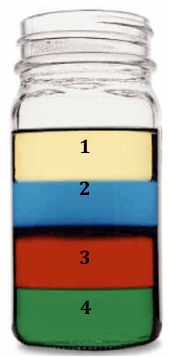
31.
Put the liquids in order from most dense to least dense?
a)
4, 3, 2, 1
b)
1, 2, 3, 4
c)
3, 4, 2, 1, 
d)
4, 3, 1, 2
32.

Which box has a higher density?

a)

A

b)

B

c)

They are the same

33.
What is the formula for density?
a)
density = mass x volume
b)
density = mass / volume
c)
density = mass + volume
d)
density = mass - volume
34.
Frank has a paper clip. It has a mass of 9g and a volume of 3cm3. What is its density?
a)
3 g/cm3
b)
1/3 g/cm3
c)
27 g/cm3
d)
39 g/cm3
35.
A piece of copper has a mass of 89g and a volume of 10 cm3.  What would be the density of the copper?
a)
0.89 g/cm3
b)
89 g/cm3
c)
8.9 g/cm3
d)
890 g/cm3
36.

Calculate the density in the following question: A flower pot has a mass of 95 g and a volume of 92 mL.

a)

1.03 g/mL

b)

0.97 g/mL

c)

1.01 g/mL

d)

0.99 g/mL

37.

An object has a volume of 6 cm3 and a mass of 42 g. What's it's density?

a)

7 g/cm3

b)

48 g/cm3

c)

42 g/cm3

d)

6 g/cm3

38.
Jack has a rock. The rock has a mass of 14g and a volume of 2cm3. What is the density of the rock?
a)
7 mL
b)
7 g/cm3
c)
28 g/cm3
d)
1/7 g/cm3
39.
In the picture, the mass of the block is 200 g, the dimensions of the block are 6 cm by 4 cm by 5 cm.  What is its density?
a)
1.67g/cm3
b)
13.33 g/cm3
c)
0.60 g/cm3
d)
 24000 g/cm3
40.

The amount of water displaced is the same as the volume of the object. What is the VOLUME of the object?

a)
40 mL
b)
65 mL
c)
20 mL
d)
25 mL
41.

An object is is placed into 45 mL of water. The water rises to 48 mL. What is the volume of the object?

a)

3 mL

b)

93mL

c)

8 mL

d)

83 mL

42.
An object's volume was determined through water displacement.  The starting height of the water was 58 mL and the ending height was 65 mL.  What is the density of the object if it has a mass of 47.5 g?
a)
0.39 g/cm3
b)
6.79 g/cm3
c)
67.86 g/cm3
d)
0.15 g/cm3
43.
What is the volume of 150 grams of lead if it has a density of 11.3 g/cm3?
a)
13.3 g
b)
13.3 cm3
c)
.075 g
d)
1695 cm3
44.

The density of a material is 2 g/cm3. The volume is 24 cm3 . What is the mass?

a)
12 grams
b)
48 grams
c)
12 g/cm3
d)
48 g/cm3
45.
What is the mass of a substance with a volume of 72.5 cm3 and a density of 0.94 g/cm3?
a)
68.15 g
b)
77.13 g
c)
62 g
d)
100 g
46.

There are 4 objects listed with their densities. Which of the following will float on water? (SELECT 2)

a)

Object A:

0.7 g/cm3

b)

Object B:

1.2 g/cm3

c)

Object C:

0.25 g/cm3

d)

Object D:

11.4 g/cm3

47.

If an object has a density of 6 g/mL and you put it into water, will it sink or float?  
a)
sink
b)
float
48.
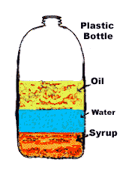
Which liquid is the least dense?
a)
oil
b)
water
c)
syrup 
d)
plastic bottle
49.
What two types of measurements make up DENSITY
a)
Mass and Volume
b)
Temperature and Mass
c)
Grams and Centimeters
d)
Volume and Weight
50.
What units are used to measure mass?
a)
g
b)
cm3
c)
g/cm3
d)
cm3/g
51.
A student knows the mass of an object. What other variable does the student need to know to calculate the object's density?
a)
Color
b)
Weight
c)
Volume
d)
Length
52.

Which units of measurement are used for volume of a liquid?

a)

grams

b)

centimeters

c)

grams/milliliter

d)

milliliter

53.

Which tool in science class might you use to measure the mass of a rock?

a)

electronic scale

b)
bunsen burner
c)
test tube
d)
graduated cylinder
54.
What units are used to measure Density?
a)
cm3/g
b)
g
c)
g/cm3
d)
cm3
55.
The mass of an object ___________________________.
a)
changes, depending on where it is located
b)
changes randomly
c)
changes, depending on temperature
d)
does not change
56.

To find the volume of a cube, ___________.

a)

divide mass by volume

b)

place it on an electronic scale

c)

add length, width and height

d)

multiply length x width x height

57.
The units for Volume are always 
a)
squared
b)
cubed
58.
The metric unit used to measure the volume of a solid objects.
a)
grams
b)
miliLiter
c)
cm3
d)
Liter (L)
59.
What are the 3 states of matter?
a)
ice rock and desk 
b)
solid liquid and gas 
c)
matter volume density
d)
hard soft medium
60.

What is the density of a plastic ball that has a mass of 12g and a volume of 6cm3

a)

2 g/cm3

b)

.5 g/cm3

c)

72 g/cm3

d)

4mL

61.

What is the volume of the block?

a)

150 g/cm3

b)

150 g

c)

150 cm3

62.
In general what is the most dense form of matter?
a)
solid
b)
liquid
c)
gas
63.

What is a suspension?

a)

A mixture of salt and water

b)

A mixture in which particles can be seen and easily separated by settling or filtration

c)

A mixture in which the particles cannot be seen, but can easily be separated

d)

A mixture of sugar and water

64.

What is a solution?

a)

A mixture of water and pepper

b)

A mixture where the properties differ from one part to another

c)

A mixture that has the same properties throughout

d)

A mixture that has 3 different gases mixed together

65.

What is the difference between dilute solution and a concentrated solution?

a)

A dilute solution has more solute dissolved in it then a concentrated solution

b)

A dilute solution can only be made with ionic compounds

c)

A concentrated solution has more solute dissolved in it then a dilute solution

d)

A concentrated solution can only be made with ionic compounds

66.

What is a substance that is dissolved in another substance? 

a)

Solution

b)

Solvent

c)

Solute

d)

Compound

67.

What is the term for a mixture where one substance is evenly distributed within another?

a)

Suspension

b)

Colloid

c)

Solution

d)

Emulsion

68.

Which of the following is a characteristic of a solvent?

a)

It is always a liquid

b)

It dissolves other substances

c)

It is always a solid

d)

It cannot be separated

69.

In a saltwater solution, what is the role of water?

a)

Solute

b)

Solvent

c)

Solution

d)

Compound

70.

Which of the following is an example of a solvent?

a)

sugar

b)

salt

c)

copper sulphate

d)

water

71.
The universal solvent is ______. 
a)
sodium 
b)
acid 
c)
water 
d)
wind 
72.
A measure of the amount of solute in a given amount of solvent or solution is...
a)
saturated
b)
solubility
c)
concentration
d)
miscible
73.

What kind of mixture is shown in the picture?

a)

Homogeneous

b)

Heterogeneous

74.

What kind of mixture is shown in the picture?

a)

Homogeneous

b)

Heterogeneous

75.

What does it mean if a substance is described as "insoluble" in water?

a)

It can dissolve in water at any temperature

b)

It cannot dissolve in water

c)

It can only dissolve in water at high temperatures

d)

It can only dissolve in water at low temperatures

76.

The following are mixed together: Kool-Aid Powder, sugar, and water

Identify the solvent in this scenario.

a)

water

b)

powder

c)

sugar

d)

powder and sugar

e)

There is no solvent.

77.

When a certain amount of solvent CANNOT hold any more solute it is called a ________ solution.

a)

Diluted

b)

Saturated

c)

basic

d)

complete

78.

What does it mean to be "Soluble" ?

a)

Capable of being a solid.

b)

To have soul.

c)

Capable of being dissolved.

d)

Able to turn into a gas when heated.

79.
A saturated solution is one that....
a)
contains the maximum amount of dissolved solute.
b)
contains less solute than a saturated solution.
c)
contains more solute than a saturated solution.
d)
is the amount of a substance required to form a saturated solution.
80.

Saltwater is an example of a...

a)

compound

b)

element

c)

heterogeneous mixture

d)

solution

81.

Which substances are insoluble in water? (choose TWO answers)

a)

sand

b)

salt

c)

sugar

d)

flour
