
 Worksheets
APES Unit 3
Total questions: 52
Worksheet time: 34mins
What growth model has an J-shaped curve?
Logistic
Exponential
What growth model has an S-shaped curve?
Logistic
Exponential
When a population has unlimited resources, and it continues to grow to its FULL LIVING POTENTIAL, it is called
Peak
Top shelf
Resource controlled limit
Biotic potential
factors that affect a population depending on its size
- these include food, predation, parasitism, and disease
Density-Dependent factor
Density-Independent factors
affect all populations similarly regardless of population size. Examples include: natural disasters, rapid climate changes (drought or floods), and human activity and disturbances
Density-Dependent factors
Density-Independent factors
Describes how many individuals of different ages make up a population
Age Structure
Age Layout
The youths collation
Age Spread
Which population has the greatest potential for rapid growth?
Populations with a large number of middle aged individuals
Older populations
Populations with large numbers of young offspring
None of these
Population pyramids measure:
Age and Gender
Gender and Race
Age and Race
Land size

What age groups does the bottom of a population pyramid represent?
The elderly
The working adults
The children
Males

What growth rate does this population pyramid represent?
Rapid Growth
Slow Growth
Negative Growth
Zero Growth
Lower birth rate
More developed
Less developed

Is this country Developed or Developing?
Developed
Developing
Which of the following are density dependent factors?
competition for resources
predation
disease
natural disasters
Which of the following are examples of a density independent factors?
forest fire
seasonal cycles
storms
disease
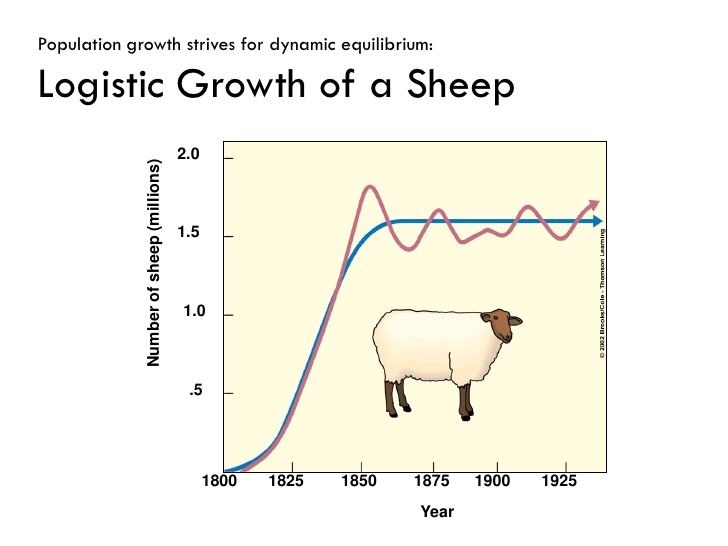

What factor describes when populations decrease because animals are moving out of a population?
Emigration
Limiting Factors
Immigration
Exponential Growth


Tracks organisms that tend to live long lives (low death rate and high survivorship rate); toward the end of their life expectancies, however, there is a dramatic increase in the death rate.
Type I
Type II
Type III
Type IV
Describes organisms with a high death rate (or low survivorship rate) immediately following birth. Examples include bacteria, fishes, and invertebrates.
Type I
Type II
Type III
Type IV
These organisms typically live in unstable, unpredictable environments & are able to reproduce rapidly (exponentially). They do not take care of their young & are subject to predation.
k-strategist
r-strategist
m-strategist
s-strategist
These organisms occupy stable environments, are larger in size and have longer life expectancies. They produce, during their life spans, fewer offspring, but place a greater investment in each.
k-strategist
r-strategist
m-strategist
s-strategist
Click density dependent factor(s).
competition for resources
predator-prey relationships
parasitism and disease
weather
Click density independent factor(s).
competition for resources
predator-prey relationships
parasitism and disease
weather, natural disaster and man made disturbances

A pattern of survival over time in which there is high survival throughout most of the life span, but then individuals start to die in large numbers as they approach old age.
Type i survivorship
Type ii survivorship
Type iii survivorship

A pattern of survival over time in which there is a relatively constant decline in survivorship throughout most of the life span.
Type ii survivorship
Type i survivorship
Type iii survivorship

A pattern of survival over time in which there is low survivorship early in life with few individuals reaching adulthood.
Type III survivorship
Type II survivorship
Type I survivorship
A generalist species is a species that generally has a wide range of things in their diets as well as a relatively large area of habitat.
Generalists
Specialist
Organisms adapted to narrow habitats, limited food resources, or other specific environmental conditions.
Specialist
Generalist
In 2004 China's CBR was 11.8 the CDR was 6.3. what is the growth rate for China in 2004?
0.38%
0.49%
0.55%
0.68%
Which of the following is most typically associated with the transition form a rural to an urbanized society?
Reduced birth rates
Reduced need for sewage-treatment facilities
Increased rates of population growth
Increased air quality in urban areas
Increased stabilization of microclimate in urban areas.
High birthrate and high death rate means the total population is low
stage 1
stage 2
stage 3
stage 4
stage 5
Which describes the birth and death rate of Stage 3 of the DTM?
The death rate is decreasing and birth rate remains high
Both the death and birth rate are high
The death rate is low but the birth rate is high
Both the birth rate and death rate are decreasing
Which describes the birth and death rate of Stage 2 of the DTM?
The death rate is decreasing and birth rate remains high
Both the death and birth rate are high
The death rate is low but the birth rate is high
Both the birth rate and death rate are decreasing

In Stage 1, the birth rate is...
High
Falling
Low

In Stage 1, the death rate is...
High
Falling
Low

In Stage 2, the Total Population is...
Growing Slowly
Growing Quickly
Not Growing

In Stage 3, the Birth Rate is...
High
Dropping quickly
Low

In Stage 4, the Death rate is...
High
Rising
Low

In Stage 4, the Total Population is...
Growing Quickly
Leveling Out
Decreasing Quickly

What stage is this country in?
Stage 1
Stage 2
Stage 3

Which correctly describes the term demographic transition?
The transition from low birth rates and death rates to high birth rates and death rates as a country develops.
The transition from high birth rates and death rates to low birth rates and death rates as a country develops.
The transition from high birth rates to low death rates as a country develops.
The transition from low birth rates to high death rates as a country develops.

A population is...
All members of one species in one area
All members of all species that live in one area
All of the living and nonliving things in an area
None of these

Which describes the birth and death rate of Stage 1 of the demographic transition model?
The death rate is high but the birth rate is low
Both the death and birth rate are high
The death rate is low but the birth rate is high
Both the death and birth rate are low

Countries undergoing rapid populations growth include which of the following?
I only
II only
III only
II and III
I, II, and III
A metropolitan area of 100,000 people has 2,000 births, 500 deaths, 200 emigrants, and 100 imigranats. Calculate the population growth rate.
1.2 percent
1.4 percent
1.6 percent
1.8 percent

