
 Worksheets
Unit 2 Review
Total questions: 92
Worksheet time: 5hrs 36mins
In a chemistry class, Sophia is trying to determine which element has the greater electronegativity:
Cl or Al?
Cl
Al
In a chemistry class, Luna is curious about the elements. She asks, "Which of the following will have a higher electronegativity than arsenic (As)?"
Carbon (C)
Neon (Ne)
Antimony (Sb)
Germanium (Ge)
If a potassium atom lost one electron, what would be the symbol for that ion?


Lily is conducting an experiment to measure various properties of elements. What property is being measured in this diagram?
Density
Ionization Energy
Atomic Radius
Atomic Mass
Abigail is studying the concept of ionization energy in her chemistry class. She learns that ionization energy is...
the energy required to add an electron to a specific atom
how much energy it takes to remove an electron from an atom
the energy required to shield the outer electrons from the nucleus
a measure of the ability of an atom to attract electrons
As Evelyn studies the periodic table, she notices that as she moves from left to right, atoms tend to get smaller because, ______________.
the atoms have more mass.
the atoms have less mass
the atoms have more protons.
the atoms have less electrons.
David is studying the periodic table in his chemistry class. Which statement correctly and completely identifies a trend?
Atomic radius decreases across a period and increases down a group.
Electronegativity decreases across a period and decreases down a group.
Ionization energy increases across a period and increases down a group.
Ionic radius increases across a period and increases down a group.
In a chemistry class, Benjamin is learning about the concept of "an atom's tendency to attract electrons to itself when it is chemically combined with another element". What term describes this concept?
electronation
electron affinity
electronegativity
electrolysis
In a chemistry class, William is curious about the concept of energy. He asks, "What term is used to describe 'The energy required to remove an electron from gaseous atoms'?"
excitation energy
ionization energy
polarization energy
electrolytic energy
In a science class, Oliver is learning about the properties of atoms. What term is used to describe "A measure of the size of an atom"?
chemical reactivity
atomic radius
energy levels
orbit

As Mia studies the properties of elements in group 16, she notices that as she considers the atoms of these elements in order from top to bottom, the electronegativity of each successive element....
decreases
increases
remains the same
none of the above
In a chemistry class, Noah learns that atoms that have a high electronegativity, _______________.
give up their electrons more easily.
hold on to their electrons more tightly.
have more electron shells.
In a chemistry class, Jackson is learning about electronegativity. He wonders if it is...
how good an atom is at attracting electrons
the ability of an atom to lose electrons
the energy required to remove an electron from a specific atom
how easy it is to make friends.

In a chemistry class, Zoe is curious about which of the following elements will have a higher ionization energy than arsenic (As).
Gallium (Ga)
Neon (Ne)
Antimony (Sb)
Germanium (Ge)

In a chemistry class, David is curious about the elements and asks, "Which of the following will have a lower ionization energy than Scandium (Sc)?"
Helium (He)
Titanium (Ti)
Calcium (Ca)
Magnesium (Mg)
Abigail is studying the concept of ionization energy in her chemistry class. She learns that ionization energy is...
the energy required to add an electron to a specific atom
how much energy it takes to remove an electron from an atom
the energy required to shield the outer electrons from the nucleus
a measure of the ability of an atom to attract electrons
In a chemistry class, Abigail is curious about the periodic table and asks, "Which periodic group has the smallest atomic radius?"
Alkali metals
Halogens
Noble Gases
Transition metals

In a science class, Henry is curious about the atom with the largest atomic radius in Group 18 -
Ar
He
Kr
Rn

In a science class, Sophia is curious about which atom has the largest atomic radius. She asks her classmates for their opinions.
potassium
rubidium
francium
cesium

As Aria moves down the periodic table, she notices that atoms get bigger. This is because ____________.
The atoms have more mass.
The atoms have more protons.
The atoms have more energy levels
The atoms have more nuetrons
Rohan is studying the concept of Atomic Radius in his chemistry class. He learns that Atomic Radius is...
the relative size of the atom's nucleus
the relative size of the atom's electron cloud
the energy required to shield the outer electrons from the nucleus
a measure of the ability of an atom to attract electrons

1 The diagram shows one period of the Periodic Table.
Which two elements form acidic oxides?
carbon and lithium
carbon and neon
carbon and nitrogen
nitrogen and neon

In the outline of the Periodic Table below, some elements are shown as numbers.
Which two numbers are metals in the same period?
1 and 2
1 and 7
3 and 5
5 and 6
In the Periodic Table, how does the metallic character of the elements vary from left to right across a period?
It decreases.
It increase
It increases then decreases.
It stays the same.

A
B
C
D

The atoms along the staircase are called
metals
nonmetals
metalloids
noble gases

The yellow atoms are called
metals
nonmetals
metalloids
noble gases
The majority of elements on the periodic table are
man made.
nonmetals.
metals.
gases.
Good conductor of heat and electricity
Metal
Nonmetal
All the elements on the right side of the periodic table are called..
Metals
Metalloid
Nonmetals
Which noble gas is found in signs or light displays?
Krypton
Helium
Argon
Neon

Metalloids can be described as...
same as nonmetals
bad conductors
characteristics of metals and nonmetals
same as metals

Evelyn is studying the Periodic Table in her chemistry class. She learns that the vertical (up and down) columns in the Periodic Table are called
groups
towers
periods
atomic numbers
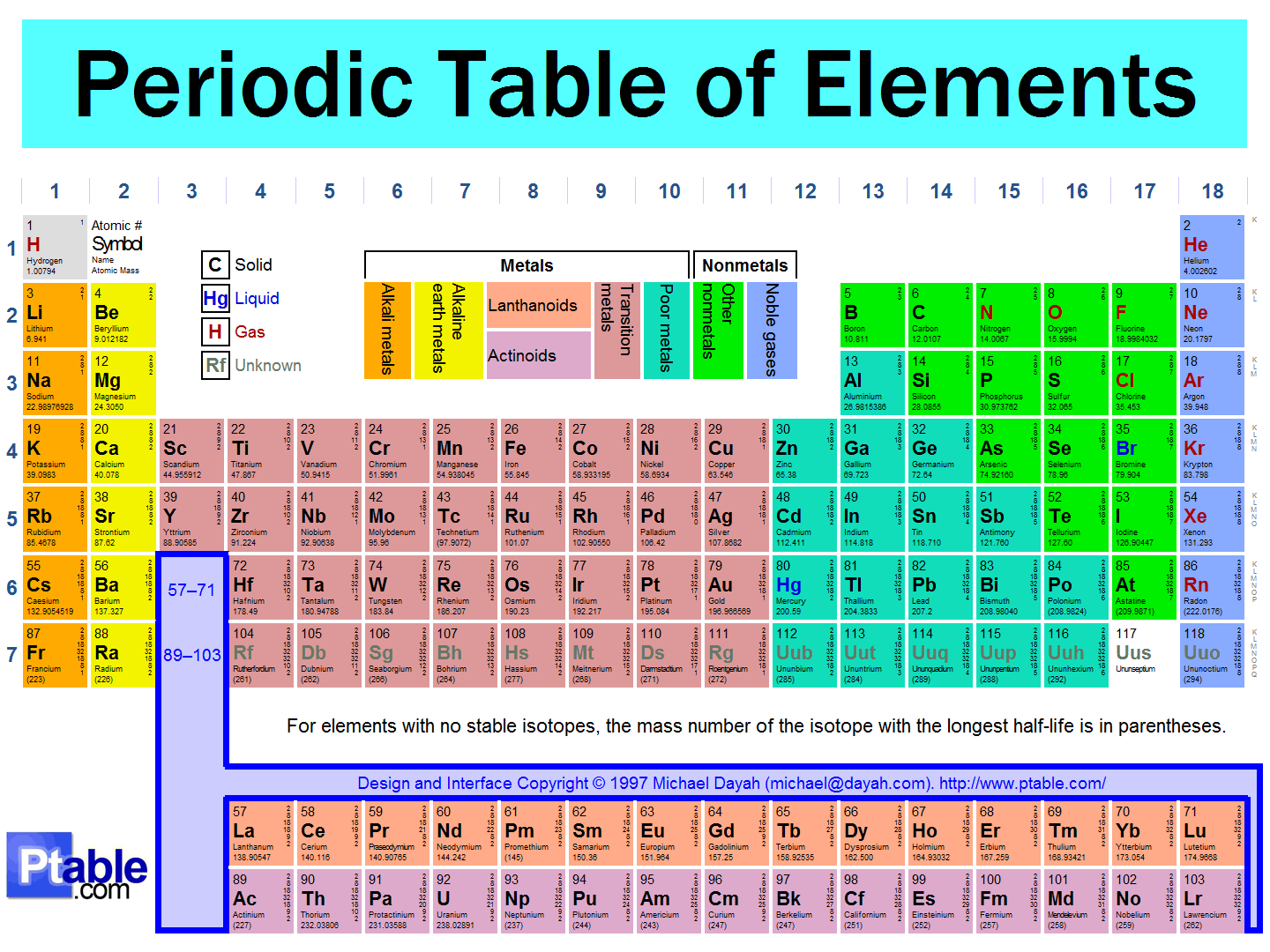
In a science class, Grace asked her classmates about the horizontal (side to side) rows in the Periodic Table. What are these rows called?
groups
families
periods
atomic numbers
Lily is conducting an experiment in her chemistry lab. She discovers that Iron is a good conductor, malleable and magnetic. What type of element is Iron?
Metal
Nonmetal
Metalloid
Grace is studying the properties of metals in her chemistry class. She learns that most metals are solid at room temperature.
False
True
Isla is studying the properties of matter in her science class. She learns that the word “luster” refers to which property of matter?
The ability to conduct electrical or thermal energy
Capable of being drawn out into thin wires
The way a surface appears when it reflects light
Suitable for being shaped by beating or rolling

Nora is trying to shape a piece of metal by striking it with a hammer. What property of the metal allows it to change shape when struck?
luster
malleable
brittleness
ductile
Mia is studying the properties of different materials in her chemistry class. All of the following would classify an element as a metal except?
Dull
Luster
Malleable
Ductile
In a science class, Mia is learning about the properties of metals. She asks her classmates, "Which of the following is NOT a characteristic of most metals?"
Brittle
Good conductor
Ductile
Malleable
In a science class, Hannah learned that metalloids are weak conductors of heat and electricity.
TRUE
FALSE
In a science class, Lily is learning about the properties of metals. She asks her classmates, "Which of the following properties refers to the ability of metals to be drawn into wires?"
A. malleability
B. compressibility
C. ductility
D. luster
How many significant figures does the following number have: 0.002040?
6
4
3
2
John is a scientist and he recorded a measurement as 0.998005 in his experiment. How many significant figures does this measurement have?
9
10
6
5
Determine the number of significant figures in 10 L.
4
3
2
1
Determine the number of significant figures in 13410000 m.
4
3
2
1
Calculate 5.50 cm + 5.5 cm and give your answer with the correct number of significant figures.
11 cm
11.0 cm
11.00 cm
11.000 cm
Express 23400 in proper scientific notation.
2.34 x 10⁴
2.3 x 10³
2.30 x 10⁵
2.34 x 10³
What is 78.5 rounded to one significant figure?
79
78.5
70
80
Calculate 1.23 m x 0.89 m and give your answer with the appropriate number of significant figures.
1.0 m2
1.1 m2
1.0947 m2
1.09 m2
Solve. Round using SigFig math rules.
103 cm x 11 cm
11 cm2
1100 cm2
1130 cm2
1133 cm2
A set of data are all close in value to each other, but they are not close to the actual value. This set of data can be described as _________________.
precise
accurate
Accuracy means
the measurements are close to each other
the measurement is close to the true value
the measurements are close to each other
the measurements are close to each other and the true value.
Four instruments give the following masses (shown in parentheses) for the same object. The object’s acceptable mass value is 5.20 g. Which instrument is the most precise?
Instrument A (5.201 g)
Instrument B (5.20 g)
Instrument C (5.201 g)
Instrument D (4.91263 g)
The lines on a ruler designate how ___________ the ruler can be in a measurement.
accurate
calibrated
standard
precise
The standard unit of measuring mass is
pounds
kilograms
meters
liters
The metric standard of measuring volume is
ounces
Kelvins
liters
meters squared
The prefix kilo means
100
1000
1/10
1,000,000
1. Explain the difference between accuracy and precision.
You measure the mass of an object five times: [10.0 g, 10.1 g, 10.0 g, 10.2 g, 10.0 g]. The true mass is 10.0 g. Analyze the results.
a) Accurate but not precise
b) Precise but not accurate
c) Both accurate and precise
d) Neither accurate nor precise
2. Why is it important to report measurement uncertainty?
You measure a length as 25.4 cm with an uncertainty of ±0.3 cm. How does this affect the interpretation of your results?
a) It doesn't affect the interpretation.
b) It means the true length is likely between 25.1 cm and 25.7 cm.
c) It indicates the measurement is unreliable.
d) It shows that the measurement is precise.
3. How can systematic errors affect measurement accuracy?
A thermometer consistently reads 2°C higher than the actual temperature. How does this impact your results?
a) It introduces a random error.
b) It leads to results that are inconsistent.
c) It introduces a systematic error, leading to inaccurate results.
d) It has no impact on the results.
4. Identify sources of random errors.
You weigh an object multiple times and get [100.1 g, 100.3 g, 100.2 g, 100.4 g]. What could cause the variations?
a) Systematic errors
b) Calibration errors
c) Random errors
d) No errors
5. Describe how precision is measured.
You measure a liquid’s volume: [12.01 mL, 12.02 mL, 12.00 mL, 12.03 mL]. How precise are your measurements?
a) Very precise
b) Not precise
c) Moderately precise
d) No precision
6. Accurate and precise measurements.
You take three measurements: [25.0 g, 25.1 g, 24.9 g]. The true value is 25.0 g. Are these measurements accurate, precise, or both?
a) Accurate but not precise
b) Precise but not accurate
d) Neither accurate nor precise
c) Both accurate and precise
7. Improving precision in measurements.
You measure a quantity three times: [50.0 mL, 49.9 mL, 50.1 mL]. Suggest ways to improve precision.
a) Use a different measurement tool.
b) Ensure consistent techniques.
c) Measure only once.
d) Use a smaller sample size.

How many electrons go in the first shell (ring) ?
6
8
4
2

This is a Bohr Diagram of Aluminum. How many valence electrons does Aluminum have?
3
4
5
How many valence electrons does Tin (Sn) have?
8
7
5
4
How many valence electrons does Lithium (Li) have?
8
1
5
2
How many valence electrons does Bromine (Br) have?
5
6
7
8
Which of these is incorrect?


Name this element.
Neon
Magnesium
Sodium
Manganese

What is this element?
Beryllium (atomic #4)
Boron (atomic #5)
Carbon (atomic #6)
Nitrogen (atomic #7)
The outermost energy level is called the
Appearance shell
Ultimate shell
Electron shell
Valence shell

Which element is this?
Nickel
Neon
Sodium
Nitrogen
Which two particles are attracted to each other?
Two neutrons
A proton and an electron
Two protons
An electron and a neutron
A repulsive force exists between which two particles?
Two neutrons
An electron and a neutron
An electron and a proton
Two protons
As two oppositely charged particles approach each other, what happens to the electrical force between them?
The attractive force increases
The magnitude of the electric force decreases
The repulsive force increases
The magnitude of their charges increases
Which of the following correctly places the elements of Group 7 in order of INCREASING electronegativity?
F, Cl, Br, I
Cl, F, Br, I
I, Br, Cl, F
Br, Cl, I, F
As you move DOWN a group, there are _______ electrons and energy levels leading to a greater shielding effect and a ________ electronegativity value.
more, higher
more, lower
less, higher
less, lower
When you move left across the table, the radius ____. When you move down the table, the radius ____.
Increases, Decreases
Decreases, Increases
Increases, Increases
Decreases, Decreases
Why does shielding effect increase going down the group?
More protons are present
More electrons are present
Less shells are present
None of the above

How does electron shielding affect the overall size of the atom?
makes the nucleus stronger
makes the atom larger
makes the atom smaller
makes the atom nuetral
If a potassium atom lost one electron, it becomes an ion. What would be the symbol for that ion?
Ions are formed when atoms gain or lose ___.
electrons
protons
neutrons
atomic mass
Which statement is true?
Cations are negatively charged ions.
Anions are positively charged ions.
Cations are positively charged electrons.
Anions are negatively charged ions.

