
 Worksheets
Bio I CP Unit 2 Test Review - Chemistry of Life
Total questions: 31
Worksheet time: 16mins
Name
Class
Date
1.
What determines the atomic number of an atom?
a)
the number of electrons in the outermost energy level
b)
the number of protons in the nucleus
c)
arrangement of neutrons in the nucleus
d)
total number of energy shells
2.
Why is a helium atom (atomic number 2) more stable than a hydrogen atom (atomic number 1)?
a)
eight electrons completely fill its outermost electron shell
b)
two electrons completely fill its outermost electron shell
c)
the outermost electron shell is half empty
3.
Which of the following factors is the most important when deciding if an atom will bond?
a)
an atom is the smallest particle of an element
b)
a molecule is the smallest unit of a compound
c)
how many electrons are in the valence shell
4.
For an atom to achieve maximum stability and become chemically unreactive what must occur?
a)
sharing of electron pairs is necessary
b)
it must be inert
c)
its outermost energy shell must be filled with electrons
d)
ionization is required
5.
An atom's nucleus is composed of
a)
protons and electrons
b)
protons
c)
neutrons
d)
protons and neutrons
6.
Sodium (Na), atomic number 11, has a tendency to lose an electron in the presence of chlorine. After losing the electron, Na will have ___ PROTONS in its nucleus.
a)
10
b)
22
c)
11
d)
12
7.
How does one explain the formation of ions?
a)
gain or loss of electrons
b)
sharing of protons
c)
gain or loss of protons
d)
sharing of electrons
8.
Phosphorous has an atomic number of 15, so what will the distribution of electrons be
a)
first level, second level and third level will have 5 electrons each
b)
the first level will have 2, the second will have 13
c)
the first level will have 2, the second will have 8, and the third will have 5
d)
arrangement cannot be determined from atomic number
9.
Polar covalent bonds form when
a)
an acid and base are combined
b)
more than one pair of electrons is shared
c)
electrons are shared unequally between atoms
d)
ions are formed
10.
The hydrogen bond between two water molecules arises because water is
a)
a liquid
b)
nonpolar
c)
hydrophobic
d)
polar
11.
Your friend does a belly flop in the pool. The stinging pain he feels is most likely due to the
a)
surface tension of water
b)
pH of water
c)
hydrophobicity of your friends skin
d)
the fact that water is a good solvent
12.
An element has eight protons, nine neutrons, and eight electrons. Its atomic number and atomic mass, respectively, are _______.
a)
8 and 16
b)
8 and 17
c)
9 and 16
d)
9 and 17
13.
The polarity of a water molecule occurs because of _______.
a)
ionization
b)
covalent bonding
c)
the unequal sharing of electrons between the hydrogen and oxygen atoms of a water molecule
14.
A bond where electrons are shared unequally
a)
nonpolar covalent
b)
hydrogen bond
c)
polar covalent
d)
covalent ionic
15.
How do we calculate the number of neutrons?
a)
add atomic number and mass number
b)
subtract atomic number from the mass number
c)
add the mass number to the other number
d)
just round it
16.
Bond where electrons are transferred from one atom to another
a)
nonpolar covalent
b)
polar covalent
c)
ionic
d)
hydrogen bond
17.
In an atom with the same number of electrons and protons, the electrical charge is
a)
neutral
b)
positive
c)
negative
18.
Two solutions, A and B, are tested for pH. Solution A indicates a pH of 2. Solution B indicates a pH of 7. You conclude that
a)
both solutions are acidic.
b)
solution A is basic; solution B is neutral.
c)
solution A is acidic; solution B is neutral.
19.
Atoms bond with other atoms to form compounds because
a)
bonding makes an element more pure
b)
bonding helps atoms become more stable.
c)
the nuclei of atoms are attracted to each other.
20.
A solution of water and lemon juice would be ______________________.
a)
acidic
b)
basic
c)
neutral
21.
Which one is NOT soluble in water?
a)
salt
b)
sugar
c)
iced tea mix
d)
oil
22.
On a hot day, it would feel cooler at
a)
the beach
b)
the desert
c)
inland, away from the beach
23.
Dogs can pant to cool themselves off because
a)
evaporative cooling
b)
the hottest, fastest moving water molecules escape off the surface
c)
water has an ability to absorb heat and when the sweat leaves, so does heat
d)
all of these
24.
Cohesion refers to water molecules
a)
repelling due to similar forces and charges
b)
sticking to other objects
c)
sticking to each other
25.
Ice floats and insulates water beneath it. This is because
a)
water is less dense in solid form
b)
water has a special property to turn to ice
c)
ice is more dense which makes it float
26.
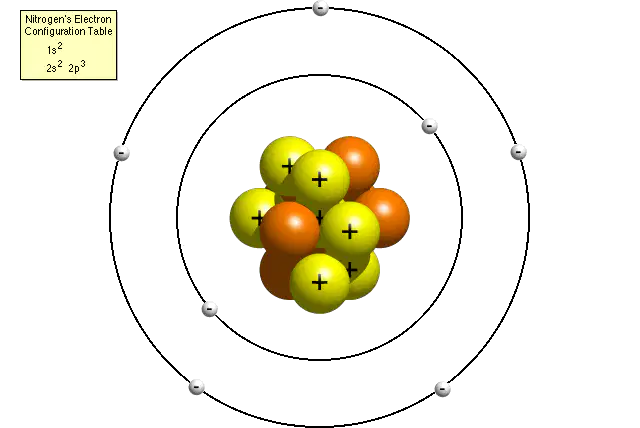
This figure represents a model of a(n)
a)
element
b)
atom
c)
compound
27.
A(n) ______________________ is the smallest unit of matter that cannot be broken down by chemical means.
a)
compound
b)
mixture
c)
atom
28.
The electrons in the outermost energy level are
a)
positively charged
b)
covalent electrons
c)
valence electrons
29.
In covalent bonds, electrons are shared between atoms
a)
true
b)
false
30.
Which of the following compounds are formed from covalent bonding?
a)
Table salt (NaCl)
b)
water (H2O)
31.
Which of the following is a molecule formed from ionic bonding?
a)
Table salt (NaCl)
b)
water (H2O)
100 %

