
 Worksheets
Aquatic Ecosystems Review
Total questions: 28
Worksheet time: 14mins
Name
Class
Date
1.

This animal is an example of
a)
benthos
b)
plankton
c)
nekton
d)
decomposer
2.
__________ would be a benthos organism.
a)
shark
b)
sea turtle
c)
coral
d)
sting ray
3.
Which of the following is an example of a MARINE ecosystem?
a)
Lake
b)
Coral Reef
c)
River
d)
Swamp
4.
Which of the following is an example of a FRESHWATER ecosystem?
a)
Lake
b)
Stream
c)
Pond
d)
All of the Above
5.
Most plants and animals can be found in the __________ zone of a lake where there is sunlight.
a)
benthic
b)
littoral
c)
nekton
d)
plankton
6.
Why are wetlands important?
a)
they control flooding by absorbing water
b)
they filter pollutants from water
c)
they are home to many species of plants and animals
d)
ALL of the answer choices are correct
7.
Which is NOT a chemical or physical factor that affects where aquatic organisms live?
a)
precipitation
b)
temperature
c)
oxygen
d)
sunlight
8.
__________ are very productive because they contain many nutrients which come from rivers and oceans.
a)
salt marshes
b)
coral reef
c)
estuaries
d)
mangrove swamps
9.
Which of the following groups of aquatic organisms are dependent on the sun to produce food for themselves?
a)
nekton
b)
zooplankton
c)
benthos
d)
phytoplankton
10.
Aquatic ecosystems are divided into _____ and ____.
a)
salt water, marine water
b)
marine water, freshwater
c)
oceans, lakes
d)
swamps, marshes
11.
Which of the following scenarios would be a good environment for coral to grow in?
a)
warm, fresh water
b)
clear, salty water
c)
muddy, warm water
d)
clear, fresh water
12.
Most freshwater wetlands in America are found in the _____________
a)
northeast (NE)
b)
northwest (NW)
c)
southeast (SE)
d)
southwest (SW)
13.
What is a way humans impact rivers and streams?
a)
Disposing of sewage
b)
Runoff of pesticides from land
c)
Disposal of waste
d)
All of the Above
14.
What is a way humans impact estuaries?
a)
Places to dump waste
b)
Used as building sites
c)
Used as ports for ships
d)
All of the Above
15.

Which aquatic ecosystem is shown in the image below?
a)
marsh
b)
swamp
c)
ocean
d)
mountain stream
16.
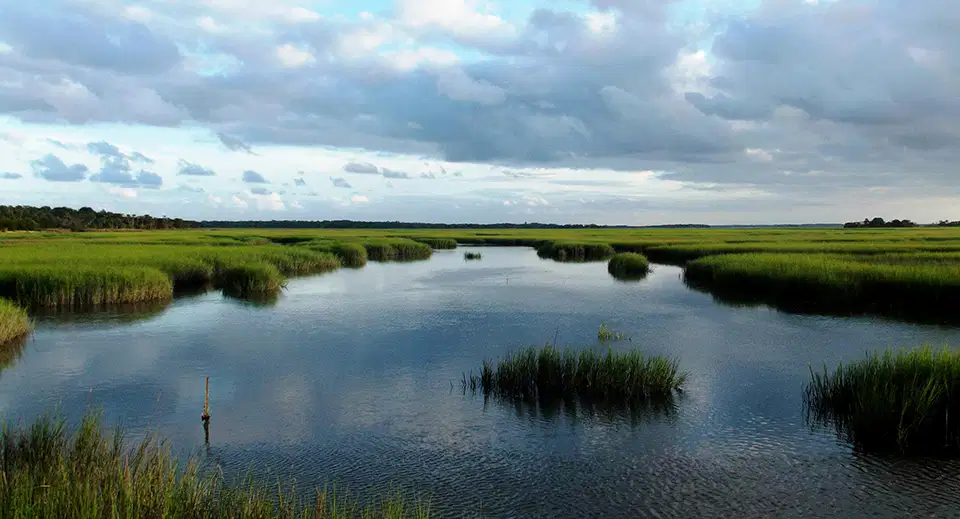
Which aquatic ecosystem is shown in the image below?
a)
marsh
b)
swamp
c)
ocean
d)
mountain stream
17.

This picture represents which marine ecosystem? (hint: it protects the mainland)
a)
barrier island
b)
mangrove swamp
c)
open ocean
d)
marsh
18.
Where is the Chattahoochee River located?
a)
California
b)
Montana
c)
Mexico
d)
Georgia
19.
Why are mangroves important?
a)
Help protect the coastline from erosion
b)
Provide a homes for animal species
c)
All of these
d)
None of these
20.
Georgia has barrier islands that protect the mainland such as Jekyll Island and Cumberland Island.
a)
True
b)
False
21.
Eutrophication of water systems is only caused by human activity and NEVER happens naturally.
a)
True
b)
False
22.
Wetlands were previously considered to be wastelands that provided breeding grounds for insects.
a)
True
b)
False
23.
Coral reefs grow very fast and can repair themselves very quickly.
a)
True
b)
False
24.
Wetlands can be freshwater or marine.
a)
True
b)
False
25.
Why is most of the ocean life found living in the shallow waters? Give 2 examples and explain why they are in the shallow waters.
4 lines
26.
How are Coral Reefs being destroyed? Give 2 examples and explain how those examples are causing the destruction.
4 lines
27.
What are the organisms called that float freely in the water? What is the difference between them?
4 lines
28.
Would you rather swim in freshwater or salt water? Write 4 sentences explaining your choice.
4 lines
100 %

