wayground logo

Free Printable Worksheets

NEW

Font size

S
M
L
XL
Worksheets

Unit 2

Total questions: 40

Worksheet time: 41mins
Name
Class
Date
1.

The vertical (up and down) columns in the Periodic Table are called

a)

groups

b)

towers

c)

periods

d)

atomic numbers

2.
The Modern Periodic Table of Elements is arranged by
a)
atomic mass
b)
atomic number
c)
valence electrons
d)
number of isotopes
3.
Which group of the periodic table is composed of inert (not reactive)  gases?
a)
alkali metals
b)
alkaline earth metals
c)
halogens
d)
noble gases
4.
Which is an alkali metal?
a)
Magnesium
b)
Iron
c)
Sodium
d)
Europium
5.
Which is a halogen?
a)
Helium
b)
Chlorine
c)
Oxygen
d)
Neptune
6.
Elements in a ..................have similar chemical properties.  
a)
period
b)
group
c)
row
7.

I am a metal


I am in group 2


I am in period 6


I am…

a)

Mo

b)

Re

c)

S

d)

Ba

8.

I am a nonmetal


I am in period 2


I am in group 16/6A

a)

Ba

b)

Si

c)

Ba

d)

O

9.

Which element does this Bohr model represent?

a)

Aluminum

b)

Silicon

c)

Magnesium

d)

Cobalt

10.

What is the mass of this atom?

a)

9

b)

10

c)

19

d)

28

11.

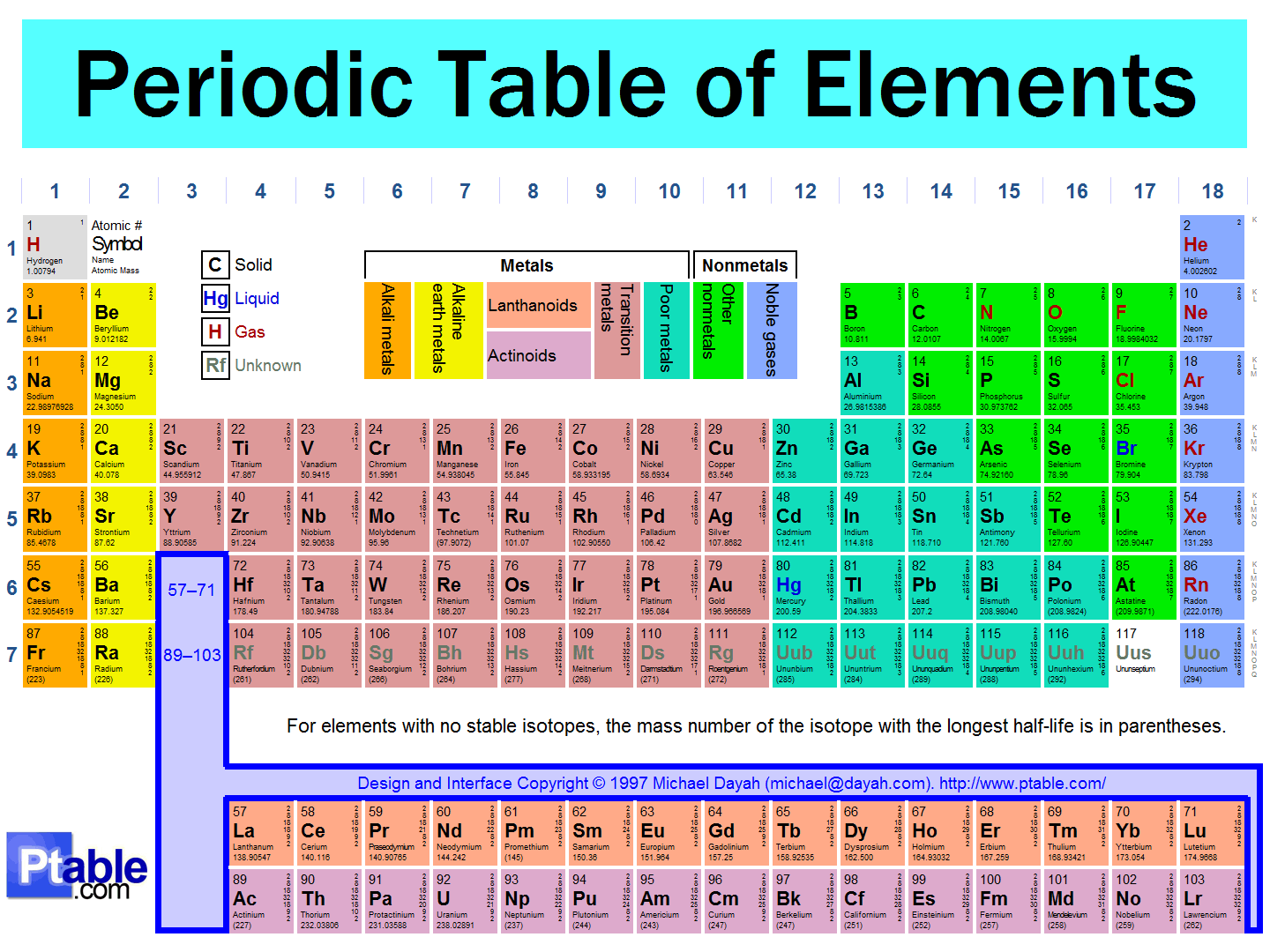
What is the atomic number of this element?

a)

17

b)

18

c)

35

d)

35.453

12.
Electronegativity __________ from left to right within a period and __________ from top to bottom within a group.
a)
decreases, increases 
b)
increases, increases
c)
increases, decreases 
d)
stays the same, increases
13.
Which has the greater Electronegativity: 
N or C?
a)
C
b)
N
14.
Electronegativity is...
a)
the ability of an atom to attract/ accept electrons
b)
the ability of an atom to lose electrons
c)
the energy required to remove an electron from a specific atom
d)
how easy it is to make friends. 
15.
The energy required to remove electrons is the definition of: 
a)
Electronegativity
b)
Atomic Number
c)
Atomic Radius
d)
Ionization
16.
The atom with the largest atomic radius in Group 18 is - 
a)
Ar
b)
He
c)
Kr
d)
Rn
17.
Which atom has the largest atomic radius?
a)
potassium
b)
rubidium 
c)
francium
d)
cesium
18.

An electron transitions from n = 6 to n = 3. Which wavelength is released?

a)

410 nm

b)

1875 nm

c)

1282 nm

d)

1094 nm

19.

What color visible light is released when an electron transitions from n = 3 to n = 2?

a)

Red

b)

Blue

c)

Violet

d)

Green

20.

An electron in n=4 has more _______ than an electron in n=2

a)

Stability

b)

Energy

c)

Spin

d)

Wave nature

21.
The tendency of an atom to attract electrons and acquire a negative charge
a)
electronegativity
b)
charge
c)
bonding ability
d)
electron configuration
22.
The minimum energy required to remove an electron from the ground state of an atom
a)
electron configuration
b)
energy levels
c)
ionization energy
d)
ionic bond
23.
Which is larger:
P or P-3
a)
P
b)
P-3
c)
both are same size
24.

What is the name of group B?

a)

Alkaline Earth Metals

b)

Halogen Group

c)

Boron Group

d)

Oxygen group

25.

What is the name of group D?

a)

Carbon Group

b)

Oxygen Goup

c)

Transition Metals

d)

Nitrogen Group

26.

What is the name of group I?

a)

Boron Group

b)

Carbon Group

c)

Nitrogen Group

d)

Noble Gases

27.

What is the name of group F?

a)

Transition Elements

b)

Oxygen Group

c)

Carbon Group

d)

Nitrogen Group

28.

What is the name of group H?

a)

Carbon Group

b)

Alkaline Metals

c)

Boron Groups

d)

Nitrogen Group

29.
Which of these is a property of metals?
a)
It's malleable
b)
It can't conduct electricity
c)
They are used in food
d)
It's very brittle
30.
Which of these is a property of metals?
a)
It's malleable
b)
It can't conduct electricity
c)
They are used in food
d)
It's very brittle
31.
Name group 18 on the periodic table.
a)
alkali metals
b)
alkaline earth metals
c)
transition metals
d)
noble gases
32.
Name groups 3 - 12 on the periodic table.
a)
noble gases
b)
halogens
c)
metalloids
d)
transition metals
33.
Elements in the same ________ are more chemically similar.
a)
group
b)
period
c)
club
d)
table
34.
The majority of elements on the periodic table are
a)
man made.
b)
nonmetals.
c)
metals.
d)
gases.
35.
Which elements have the most similar chemical properties?
a)
K and Na
b)
K and Ca
c)
K and Cl
d)
K and S
36.
The atoms along the staircase are called 
a)
metals
b)
nonmetals
c)
metalloids
d)
noble gases
37.
What is an ion?
a)
A Charged Atom
b)
A Large Atom
c)
A Small Atom
d)
A Cute Atom
38.
What is an isotope? 
a)
A charged atom
b)
An atom with different amounts of neutrons
c)
An atom with different amounts of protons
d)
A neutral atom
39.
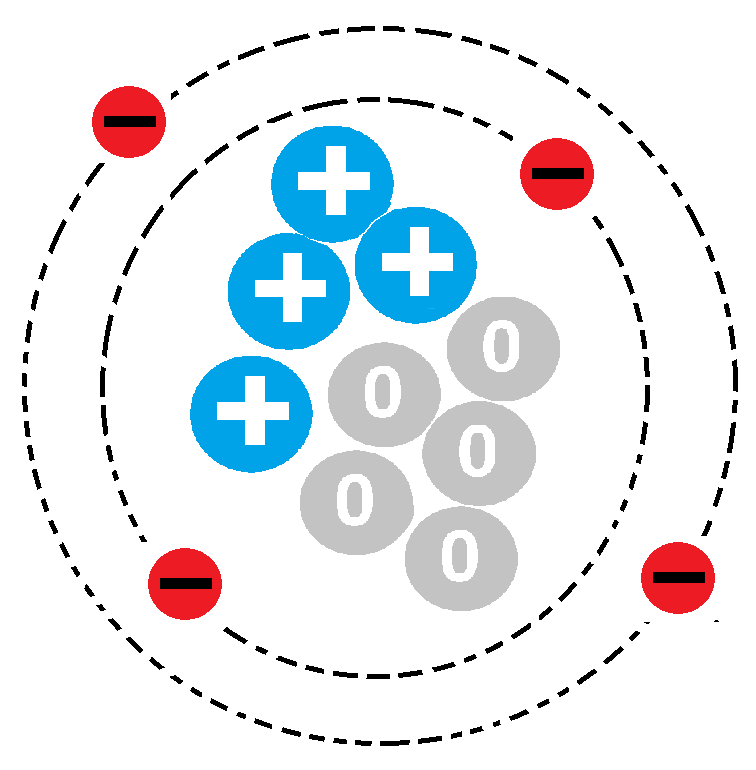
What is the atomic number of this atom?
a)
4
b)
5
c)
9
d)
none of the above
40.

What is the nuclear symbol for the atom shown in the image?

a)

4Be

b)

4He

c)

2He

d)

2Be