
 Worksheets
Everyday Communications Skills
Total questions: 81
Worksheet time: 1hrs 14mins
Apa yang dimaksud dengan mendengarkan kritis?
Hanya mendengar kata-kata yang diucapkan
Memahami, menganalisis, dan mengevaluasi informasi
Mengabaikan konteks pembicaraan
Mendengarkan tanpa memberikan perhatian
Apa manfaat dari mendengarkan secara kritis?
Mengabaikan pendapat orang lain
Membuat keputusan yang salah
Menjadi pendengar pasif
Mencegah kesalahpahaman
Apa yang dimaksud dengan aktif mendengarkan?
Memberi perhatian penuh pada pembicara
Mendengarkan sambil melakukan hal lain
Hanya mendengarkan tanpa merespons
Mengabaikan nada suara pembicara
Apa tujuan dari parafrase dalam mendengarkan kritis?
Mengulang informasi dengan kata-kata sendiri
Mengabaikan informasi yang disampaikan
Membuat kesimpulan tanpa mendengar
Menyampaikan pendapat pribadi
Apa yang harus dilakukan setelah mendengar informasi?
Mengevaluasi kredibilitas sumber
Mengabaikan isi pesan
Menyimpulkan tanpa analisis
Mendengarkan tanpa berpikir
Apa yang dimaksud dengan kredibilitas dalam komunikasi?
Hanya berbicara tentang diri sendiri
Mengabaikan pendapat orang lain
Landasan utama dalam membangun kepercayaan
Kemampuan untuk berbicara tanpa henti
Apa yang dapat meningkatkan kredibilitas seseorang?
Mengabaikan kebutuhan orang lain
Keahlian dan hubungan yang baik
Banyak berbicara tanpa mendengarkan
Hanya memiliki pendidikan formal
Apa yang harus dilakukan saat membuka percakapan?
Mengabaikan kontak mata
Perkenalkan diri dengan jelas
Bicara tanpa tujuan
Menggunakan bahasa yang rumit
Apa yang dimaksud dengan mempertahankan percakapan?
Menjaga agar percakapan tetap mengalir
Menghentikan pembicaraan secara tiba-tiba
Mengabaikan umpan balik
Berbicara tanpa mendengarkan
Apa yang harus dilakukan untuk menunjukkan bahwa Anda mendengarkan?
Mengalihkan perhatian
Mengabaikan apa yang dikatakan
Memberikan umpan balik yang relevan
Berbicara lebih keras
Apa yang dapat membantu membuat poin Anda lebih hidup?
Berbicara tanpa struktur
Menggunakan jargon yang rumit
Cerita dan contoh konkret
Mengabaikan audiens
Apa yang harus dilakukan untuk menyesuaikan emosi audiens?
Hanya fokus pada fakta
Mengabaikan perasaan mereka
Berbicara tanpa empati
Memahami keadaan emosional mereka
Apa yang dimaksud dengan seni percakapan?
Kemampuan untuk berbicara tanpa henti
Mengabaikan pendapat orang lain
Hanya mendengarkan
Interaksi yang efektif dan menyenangkan
Apa yang harus dilakukan saat mengajukan pertanyaan?
Mengabaikan jawaban
Mengajukan pertanyaan tertutup
Berbicara tanpa henti
Menggali informasi lebih dalam
Apa yang sebaiknya dilakukan saat menutup percakapan?
Menyerang lawan bicara
Mengubah topik
Menyimpulkan poin utama
Mengabaikan poin utama
Mengapa penting untuk menawarkan tindak lanjut setelah percakapan?
Untuk mengalihkan perhatian
Untuk menutup percakapan dengan cepat
Untuk menunjukkan komitmen untuk melanjutkan percakapan
Untuk menghindari komunikasi lebih lanjut
Apa yang sebaiknya diakhiri dengan catatan positif?
Percakapan yang tidak diinginkan
Percakapan yang menyenangkan
Percakapan yang menegangkan
Percakapan yang tidak penting
Apa yang dimaksud dengan komunikasi dalam situasi sosial?
Interaksi yang melibatkan pertukaran informasi
Hanya berbicara tentang cuaca
Menghindari percakapan
Berbicara tanpa tujuan
Apa yang harus dilakukan untuk mengurangi ketegangan dalam percakapan?
Menyalahkan pihak lain
Mengubah topik pembicaraan
Menghargai hubungan yang ada
Mengabaikan perasaan lawan bicara
Apa yang penting untuk dilakukan sebelum memasuki percakapan?
Meningkatkan kesadaran diri
Bersikap acuh tak acuh
Mengabaikan emosi
Mempersiapkan argumen yang kuat
Apa yang sebaiknya dilakukan saat menghadapi percakapan tak terduga?
Menghindari percakapan
Berlatih dan mempersiapkan diri
Bersikap defensif
Menyerah pada situasi
Apa yang harus dilakukan untuk menyampaikan pesan dengan sopan?
Menggunakan bahasa yang kasar
Bersikap agresif
Menggunakan bahasa yang tenang dan terukur
Mengabaikan perasaan orang lain
Apa yang dimaksud dengan mendengarkan dengan aktif?
Hanya mendengar tanpa merespons
Mendengarkan dan memberikan umpan balik
Mengabaikan apa yang dikatakan
Berbicara lebih banyak daripada mendengarkan
Apa yang sebaiknya dilakukan setelah percakapan?
Mengulangi kesalahan yang sama
Menyerah pada situasi
Refleksi dan tindak lanjut
Mengabaikan hasil percakapan
Apa yang harus dilakukan untuk mengendalikan emosi selama percakapan?
Menyatakan semua emosi tanpa filter
Bersikap defensif
Mengabaikan emosi
Mengelola reaksi dan tetap fokus
Apa yang sebaiknya dilakukan untuk mengurangi kesalahpahaman?
Mengabaikan niat kita
Menyatakan niat kita kembali
Bersikap acuh tak acuh
Mengubah topik pembicaraan
Apa yang dimaksud dengan pengakuan tanggung jawab dalam percakapan?
Menyerah pada situasi
Menghindari masalah
Mengakui kesalahan atau tanggung jawab sendiri
Menyalahkan orang lain
Apa yang sebaiknya dilakukan saat memberikan umpan balik negatif?
Menyalahkan pihak lain
Bersikap agresif
Menggunakan keterampilan khusus
Mengabaikan perasaan orang lain
Apa yang harus dilakukan untuk menjaga kejelasan dalam percakapan?
Menyatakan kembali niat dengan jelas
Menggunakan bahasa yang ambigu
Mengabaikan apa yang dikatakan
Bersikap defensif
As future teachers:
It is important to create an environment that is comfortable for students to discuss difficult issues.
At the end of class, always be sure to deliver your opinion on a topic, as you will most likely be correct.
Ask your students to divide the class on their opinions and then you can teach to each side of the class.
Allow students to talk however they please, as this will best facilitate expression.
According to 100% of students, who is the coolest teacher in town?
Mr. Pachan
Miss Bliss
Professor Albus Dumbledore
Miss Krabappel
When discussing:
It is important to speak louder than the person whom you are talking to.
Remember that you are only trying to convince the other person of your side of the discussion.
You are allowed to disagree, but do it in a way that gives others the same right.
Be stern and stand your ground. Do not change your opinion.
According to the 10 rules for a good conversation:
It is important to look like you know what the speaker is talking about, don't say you don't know.
Use close-ended questions to continue the conversation.
Always equate your experiences, if they speak of something, make sure you tell a similar story.
Try not to repeat yourself, as it can come off as condescending or boring.
With regards to the Taxonomy:
We can create HOTs without the use of LOTs
We must first use LOTs and then build these thoughts and ideas into HOTs
The chart can be used in any order, as the skills do not connect.
The ability to use one 'level' of thinking at a time occurs.
According to Bloom's Taxonomy, Remember and Understand are examples of:
Lower Order Thinking
Higher Order Thinking
Using, Implementing
Organizing, Structuring, outlining
CALP Stands for:
Common Academic Language Practice
Correct Analyzation of Linguistic Properties
Cognitive Academic Language Proficiency
Cognitive Allegiance of Linguistically Prepared
Academic English:
Is the language that is necessary for success in school.
Is language that is used in everyday life.
Based on knowledge of a particular subject
Can only be achieved at a university.

Which expression is used for Clarifying Questions?
"I'm sorry, could you repeat your question, please?"
"Well, actually, I'd prefer not to discuss that today."
"If you don't mind, could we discuss that on another occasion?"
"Sorry, I don't know that off the top of my head."

Which expression is used for Avoiding Giving an Answer?
"If I could just rephrase your question. You'd like to know..."
"I'm afraid that's not really what we're discussing today."
"Does that answer your question?"
"So, in other words, you would like to know whether..."

Which expression is used for Admitting You Don't Know?
"I'm afraid I'm not in a position to answer that question at the moment."
"Sorry, that's not my field. But I'm sure Peter Bott from Sales could answer your question."
"Can we get back to this point a bit later?"
"Perhaps we could go over this after the presentation."

Which expression is used for Postponing Questions?
"If you don't mind, I'll deal with/come back to this point later in my presentation."
"Would you mind waiting until the question and answer session at the end?"
"I'd prefer to answer your question in the course of my presentation."
"So, now I'd like to return to what we were discussing earlier."

Which expression is used for Summarizing after Interruptions?
"Before we go on, let me briefly summarize the points we've discussed."
"So, if I understood you correctly, you would like to know whether..."
"Sorry, I don't know the answer to your question, but I'll try to find out for you."
"So, now I'd like to return to what we were discussing earlier."

Which expressions are used for Clarifying Questions? (2 answers)
"So, if I understood you correctly, you would like to know whether..."
"Sorry, I don't know the answer to your question, but I'll try to find out for you."
"If I could just rephrase your question. You'd like to know..."
"Can we get back to this point a bit later?"
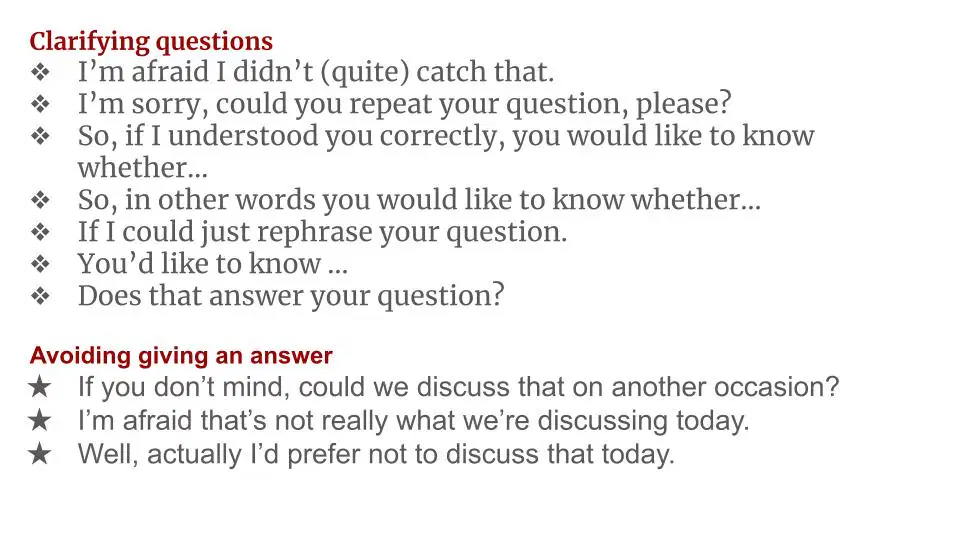
Which expressions are used for Avoiding Giving an Answer? (2 answers)
"I'm afraid I didn't quite catch that."
"Well, actually, I'd prefer not to discuss that today."
"If you don't mind, could we discuss that on another occasion?"
"Sorry, that's not my field. But I'm sure Peter Bott from Sales could answer your question."
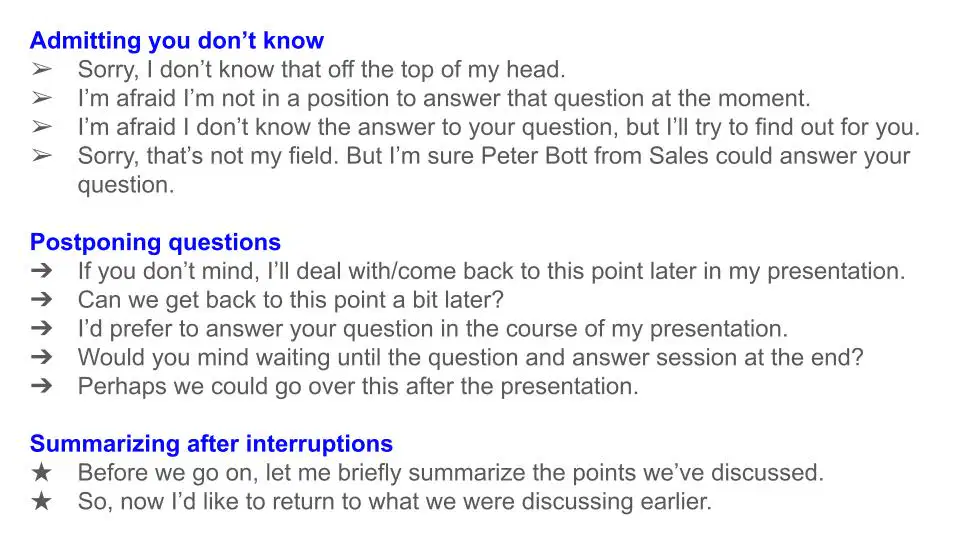
Which expression is used for Admitting You Don't Know?
"I'm afraid I'm not in a position to answer that question at the moment."
"Perhaps we could go over this after the presentation."
"I'm afraid I didn't quite catch that."
"Does that answer your question?"
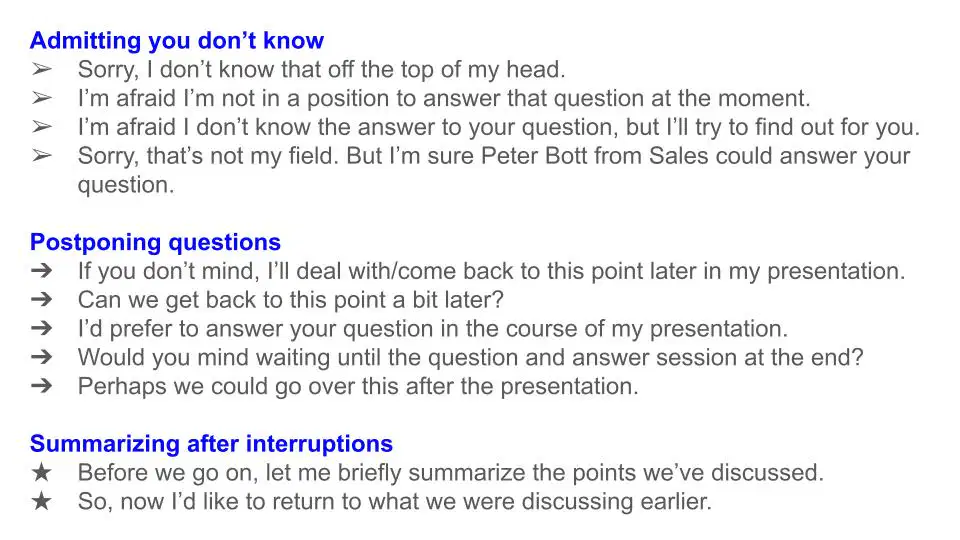
Which expression is used for Postponing Questions?
"If you don't mind, I'll deal with/come back to this point later in my presentation."
"So, in other words, you would like to know whether..."
"Can we get back to this point a bit later?"
"I'd prefer to answer your question in the course of my presentation."
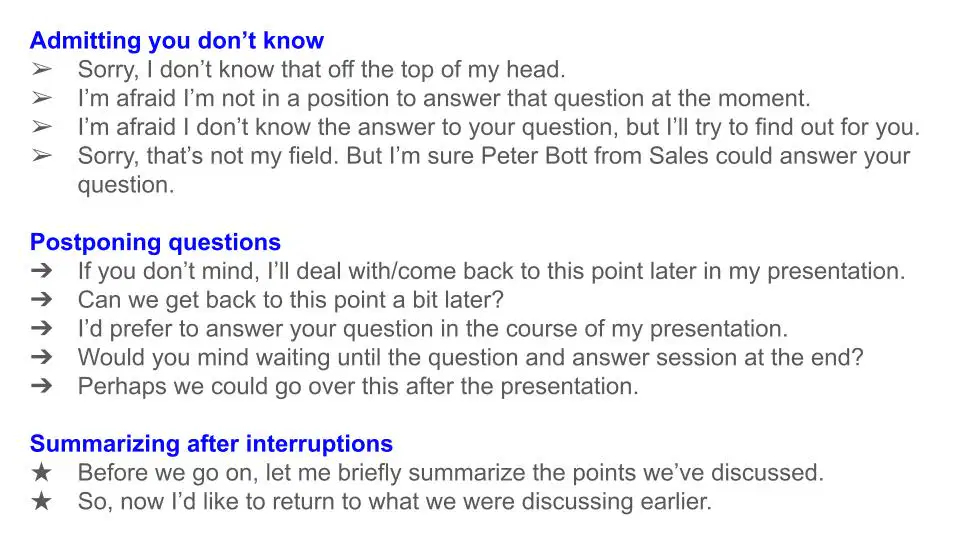
Which expression is used for Summarizing after Interruptions?
"Before we go on, let me briefly summarize the points we've discussed."
"So, if I understood you correctly, you would like to know whether..."
"Well, actually, I'd prefer not to discuss that today."
"If you don't mind, could we discuss that on another occasion?"

When is it NOT appropriate to shake hands with someone?
In the middle of a presentation
Upon meeting someone for the first time
At the start of an interview
After a meeting to show agreement

When shaking hands, you should always:
Wear heavy cologne or perfume
Make eye contact
Make sure your hand is sweaty
Shake repeatedly until the person begs you to stop

communicating non-verbally through conscious or unconscious gestures and movements is called?
Attitude
Gratitude
Sign Language
Body Language

A statement that a situation is unsatisfactory or unacceptable
Character
Complaint
Compliment
Cover letter

Building a relationship with a customer is called:
Friendship
Chatting
Rapport
Dating

Includes gestures, facial expressions, and body positions
Feedback
Verbal Communication
Dance
Non-Verbal Communication

The use of sounds and words to express yourself
Non-Verbal Communication
Customer Service
Interpretive Dance
Verbal Communication

We communicate by:
Speech (Telephone call, conversations, etc)
Visuals (Body language, facial expressions)
Writing (Letter, emails, newsletters, etc)
All of the above

Which of the following is NOT an example of proper telephone etiquette in the workplace?
Helping the caller even if it isn't your job
Identifying yourself and your company when answering a call
Rushing the caller to get off the phone
Answering the phone before the third ring

Which of the following is an example of a professional email address?
justinbeiberismyhero@mail.com
George.Washington@mail.com
ilovedogs@mail.com
What.What@mail.com

A good, active listener…
Remains quiet while listening
Interrupts the speaker
Answers his/her cell phone during the presentation
Makes fun of the speaker

A good, clear speaker…
Understands what he/she wants to say
Considers the audience and the setting
Checks to assure understanding, and listens to responses
All of the above

True or False: Communication skills are vital to individuals and businesses
True
False

Good customer service is the ability of an organisation to constantly and consistently exceed:
The speed of sound
The customer's expectations
The rainfall in South America
Their competitor's sales

All of the following are examples of active listening, EXCEPT:
Showing interest in the message
Staring out the window
Making eye contact with the messenger
Not interrupting the messenger

In order to comprehend a message, you must be:
In the conference room
Wearing a suit or dress
Using a telephone
Actively listening

Which is NOT important in effective communication?
Wearing a red tie
Making eye contact
Using appropriate body language
Using the appropriate tone
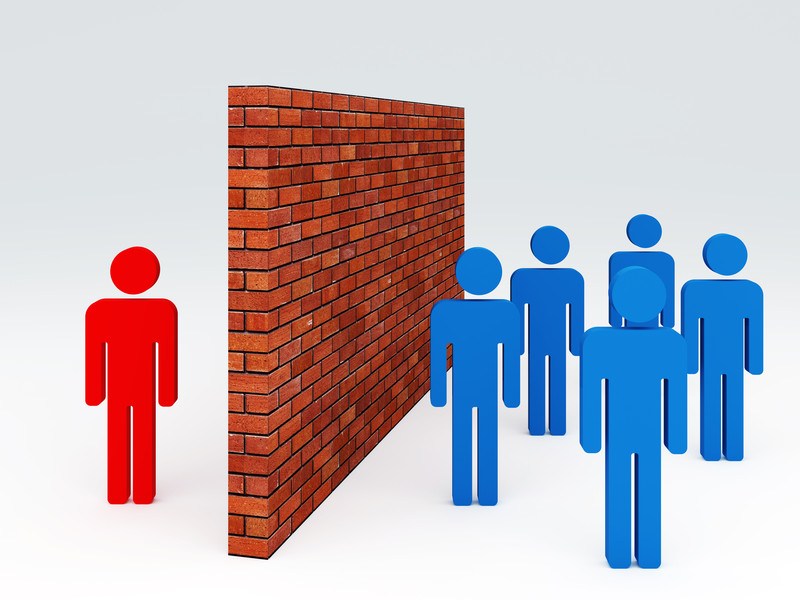
Which of the following is a barrier to communication?
Message is not clear
Not listening
Lack of language skills
All of the above

An example of non-verbal communication is:
Sleeping
Face-to-face conversation
Telephone conversation
Eye Contact

An example of verbal communication is:
Phone conversation
Posture
Eye contact
Writing an email

Two types of communication are:
Verbs and Nouns
Verbal and information
Verbal and non-verbal
Happy and sad

