
 Worksheets
PRE-TEST 3 STATES OF MATTER & CHEMICAL EQUILIBRIUM
Total questions: 52
Worksheet time: 1hrs 18mins
What assumptions are made for the ideal gas equation?
There is no attraction between the molecules of the gas.
The volume occupied by the molecules is negligible.
Both of the mentioned.
None of the mentioned.
The following statements are assumptions of the kinetic theory of gases EXCEPT
Average kinetic energy of gas molecules is inversely proportional to the absolute temperature.
The intermolecular forces between gas molecules are negligible.
The molecules undergoes elastic collisions with one another.
The volume of the atoms or molecules is negligible.

Suppose you have two gases numbered 1 and 2.
Which equation represents make the most sense to calculate the total pressure exerted by both gases?
Multiply their pressures :
Ptotal = P1 × P2
Divide their pressures :
Ptotal = P1 ÷ P2
Add their pressures :
Ptotal = P1 + P2
Subtract their pressures :
Ptotal = P1 – P2
Average their pressure :
Ptotal = (P1 + P2)/2
The van der Waals equation is a modification of ideal gas equation. Which of the following is accounted for the modification?
Volume and Pressure.
Number of mole and Temperature.
Position of the particles and kinetic energy.
Surface area and density
A substance that flows quickly has __________.
low viscosity
high viscosity
Which of the following liquids is viscous?
honey
water
soy sauce
cooking oil
"The measure of the resistance to the flow of a liquid"
This statement is explain about __________ of liquids
compressibility
viscosity
surface tension
diffusion
What is the cause of the surface to TIGHTEN like an ELASTIC FILM?
equal
intermolecular force
balanced intermolecular force
unbalanced intermolecular force

Which model represents a LOWER Vapor Pressure?
A
B
Factors affecting vapour pressure:
i. Strength/type of attractive forces between liquid molecules
ii. Temperature
iii. Molecular mass
iv. Size of liquid molecules
i and ii only
ii and iv only
i, ii and iii
i, ii, iii and iv
Which substance has the weakest intermolecular forces?
Substance A, boiling point of 75 °C
Substance B, boiling point of 105 °C
Substance C, boiling point of 25 °C
Substance d, boiling point of 45 °C

According to the reference table, what is the boiling point of ethanoic acid at 80 kPa?
28 oC
100oC
111oC
125oC

Which liquid has the highest vapor pressure at 75oC?
ethanoic acid
ethanol
propanone
water

At which temperature is the vapor pressure of ethanol equal to the vapor pressure of propanone at 35oC?
35oC
60oC
82oC
95oC
Which is the correct statement for vapour pressure?
Pressure exerted by the vapour molecules at equilibrium with its solid in a closed container
Pressure exerted by the vapour molecules at equilibrium with its liquid in an opened container
Pressure exerted by the vapour molecule at equilibrium with its liquid in closed container
Pressure exerted by vapour molecule at equilibrium with its vapour in a closed container
Why does a gas with a lower vapor pressure have a higher boiling point?
the molecules need more energy to break free of their attractions to other molecules and change phase from liquid to gas
the forces of attraction between the molecules are strong
the substance has low volatility
all of the answers are correct
Diamond cannot conduct electricity because
diamond has the structure of a giant covalent molecule
its carbon atoms form single covalent bonds
all of its valence electrons are used in forming covalent bonds
it has a higher melting point

What are the forces acting on A and B?
Both A and B are covalent bonds
A is covalent bond, B is van der Waals
Both A and B are van der Waals forces
A is van der Waals, B is covalent bond
This type of solid forms a regular repeating
three-dimensional structure called a crystal lattice. What type of solid is this?
amorphous
crystalline
glass
diamond
Which statement describe about characteristic of crystalline solid?
formed when liquid cooled rapidly
occupy random position
no orderly structure
arranged in a define and orderly arrangement

If the substance is originally at the temperature and pressure of point D, what changes must occur to reach the triple point?
increase both temperature and pressure
decrease both temperature and pressure
increase temperature, decrease pressure
increase pressure, decrease temperature
How many phases exist at triple point?
1
2
3
4


Describe phase changes that occurs at letter B?
Liquid to solid
Liquid, solid-liquid equilibrium to solid
Solid to liquid
Vapour to liquid

The pressure is increased on a sample of water at 0 °C from 0 mmHg to 800 mmHg. In order, what changes occur?
Deposition then melting
Sublimation then melting
Condensation then freezing
Deposition then freezing
Water exists as a _____________ at 3 mmHg and 50 °C.
Solid
Liquid
Gas
Supercritical fluid
Which of the following is true for a chemical reaction at equilibrium?
Only the forward reaction stops
Both the forward and reverse reactions stop
The rates of the forward and reverse reactions are equal
The rate constants, K, for the forward and reverse reactions are equal
Which of the following are equal for a chemical system at equilibrium?
The concentrations of reactants and products are equal
The rate constants for the forward and reverse reactions are equal.
The rate of the forward and reverse reaction as the equilibrium is achieved are equal.
The time that a particular atom or molecule spends as a reactant and product are equal
When equilibrium is achieved, the concentrations of products will ...
Change continually because reversibility
Change because there are no more reactants
Not change because the limiting reagent is gone
Not change because the forward and reverse rates are equal


Around what time does the reaction reach equilibrium?
25 min
45 min
70 min
80 min

At what time on the graph will the reaction reach equilibrium?
t1
t2
t3
t4

This graph shows how an equilibrium forming.
The balanced equation is H2(g) + I2(g) ⟺ 2HI(g).
WHICH GRAPH shows the same equilibrium forming from *pure* hydrogen iodide?


The Kc expression for the reaction is...
Heterogeneous equilibria refer to
chemical equilibrium in which all the reactants and products are in different phases.
chemical equilibrium in which all the reactants and products are in same phases.
chemical equilibrium in which all the rate of forward reaction is equal to the rate of reverse reaction.
chemical equilibrium in which all the rate of forward reaction is greater than the rate of reverse reaction.
Homogeneous equilibria refer to
chemical equilibrium in which all the reactants and products are in different phases.
chemical equilibrium in which all the reactants and products are in same phases.
chemical equilibrium in which all the rate of forward reaction is equal to the rate of reverse reaction.
chemical equilibrium in which all the rate of forward reaction is greater than the rate of reverse reaction.
All the systems below are homogeneous equilibria EXCEPT
2PCl3 (g) + O2 (g) ⇌ 2POCl3 (g )
FeO (s) + CO (g ) ⇌ Fe(s) + CO2 (g )
Ag+ (aq) + Fe2+ (aq) ⇌ Ag (s) + Fe3+ (aq)
N2O4 (g) ⇌ 2NO2 (g)
Which of the following statements is the BEST explains the heterogeneous equilibria?
Concentration of solid and pure liquids are excluded from expression of K
Concentration of solid and pure liquids are included from expression of K
Concentration of reactants and products are the same
Reactants and products are in same phase
All the systems below are homogeneous equilibria EXCEPT
2PCl3 (g) + O2 (g) ⇌ 2POCl3 (g )
FeO (s) + CO (g ) ⇌ Fe(s) + CO2 (g )
Ag+ (aq) + Fe2+ (aq) ⇌ Ag (s) + Fe3+ (aq)
N2O4 (g) ⇌ 2NO2 (g)

For the graph, choose the CORRECT statement.
The rate of reaction slowly increase
The systems never reach equilibrium
At equilibrium, more NO2 is present than N2O4.
At start of reaction, only NO2 was present.

The following reaction aA + bB produce cC + dD.
The realtion that determine the equilibirum constant, Kc is known as
Law of active mass.
Law of mass action.
Law of chemical reactions.
Law of conservation of mass.


From the reaction, choose the CORRECT equilibrium constant, Kp.


For the reaction, choose the CORRECT equilibrium constant, Kc.


Figure show an experiment to study viscosity of different types of motor oil. Arrange the test tube according to increasing viscosity.
P<Q<R<S
S<R<Q<P
Q<<R<S<P
S<R<Q<P
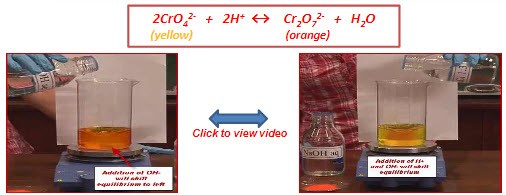
2CrO42- + 2H+→Cr2O72- + H2O
What will happen when OH- ions are added to the system? HINT: They remove the H+ ions.
Position of equilibrium will shift to right and become more orange
Position of equilibrium will shift to left and become more yellow
Position of equilibrium will shift to right and become more yellow
OH- ions will not react, and thus no change is seen.
2SO2(g) + O2(g) ⇌ 2SO3(g) + Heat
Using a catalyst
shift equilibrium right
shift equilibrium left
increase the rate of reaction
have no change
Le Chatelier's Principle states when a chemical system is _______ it reattains ________ by undergoing a net reaction that reduces the effect of the disturbance. From the list below, select the respective words that are missing.
disturb, equilibrium
pressure, net
pressure, equilibrium
pressure, rest

Which of the following reaction will shift its equilibrium position to the right when the volume of the container is decreased?
A
B
C
D

