wayground logo

Free Printable Worksheets

Font size

S
M
L
XL
Worksheets

Planets and Density

Total questions: 63

Worksheet time: 3hrs 3mins

Name
Class
Date
1.
What is the formula for density?
a)
density = mass x volume
b)
density = mass / volume
c)
density = mass + volume
d)
density = mass - volume
2.
Frank has an eraser. It has a mass of 4g, and a volume of 2cm3. What is its density?
a)
8 g/cm3
b)
2 g/cm3
c)
1/2 g/cm3
d)
24 g/cm3
3.
What is the volume of Object X?
a)
10.0 cm3
b)
15.0 cm3
c)
20.0 cm3
d)
25.0 cm3
4.
What two types of measurements make up DENSITY
a)
Mass and Volume
b)
Temperature and Mass
c)
Grams and Centimeters
d)
Volume and Weight
5.
Jack has a rock. The rock has a mass of 14 g and a volume of 2 cm3. What is the density of the rock?
a)
7 mL
b)
7 g/cm3
c)
28 g/cm3
d)
1/7 g/cm3
6.
Frank has an eraser. It has a mass of 4 g, and a volume of 2 cm3. What is its density?
a)
8 g/cm3
b)
2 g/cm3
c)
1/2 g/cm3
d)
24 g/cm3
7.
What units can be used to express density?
a)

g/cm^3

b)
grams
c)
millimeters
d)
milliliters
8.
What units are used to measure mass?
a)
g
b)
cm3
c)
g/cm3
d)
cm3/g
9.
Which box has a greater density?  
a)
Box A
b)
Box B
10.
What is the volume of the rock?
a)
30cm3
b)
10cm3
c)
40cm3
d)
20cm3
11.
Water displacement is used to find what?
a)
Density
b)
Mass
c)
Volume
d)
Weight
12.
What is the density of a plastic ball that has a volume of 6cm3 and a mass of 12g? 
a)
2g/cm3
b)
.5g/cm3
c)
72g/cm3
d)
4mL
13.

An irregularly shaped rock was lowered into a graduated cylinder holding a volume of water equal to 50 ml. The height of the water rose to 75 ml. If the mass of the stone was 250 g, what was its density?

a)

15 g/mL

b)

3.3 g/mL

c)

10 g/mL

d)

20 g/mL

14.
Which of the substance below has a mass of 50 grams and a volume of 10 mL?
Density = Mass/Volume
a)
Gold = 19.3 g/mL
b)
Aluminum = 2.7 g/mL
c)
Water = 1 g/mL
d)
Pyrite = 5 g/mL
15.

What is the density of the sphere, if its mass is 50 g?

a)

40 grmL\frac{40\ gr}{mL}  

b)

65mLg\frac{65mL}{g}  

c)

2 gcm3\frac{2\ g}{cm^3}  

d)

25gmL\frac{25g}{mL}  

16.

In this image, the VOLUME of A is _____ the volume of B

a)

equal to

b)

greater than

c)

less than

17.

Which ones can be units for density?

(Multiple responses)

a)

g/ mL

b)

g

c)

gcm3\frac{g}{cm^3}  

d)

cm4cm^4  

18.

What is the FINAL Volume?

a)

5 mL

b)

10 mL

c)

15 mL

d)

14 mL

19.

What is the INITIAL Volume?

a)

100 mL

b)

150 mL

c)

180 mL

d)

30 mL

20.

What is the FINAL volume in the graduated cylinder

a)

150 mL

b)

170 mL

c)

180 mL

d)

190 mL

21.

What is the volume of the seeds (object) in the graduated cylinder?

a)

4 mL

b)

5 mL

c)

14 ml

d)

15 mL

22.

What is the FINAL Volume of the water in the graduated cylinder?

a)

23 mL

b)

10 mL

c)

5 mL

d)

2 mL

23.

If the INITIAL Volume was 130 mL, how much did the water get displaced up to 142 mL?

a)

18 mL

b)

15 mL

c)

14 mL

d)

12 mL

24.

What is the volume of the rock (object)?

a)

23 mL

b)

10 mL

c)

5 mL

d)

3 mL

25.

What is the FINAL Volume of the graduated cylinder shown?

a)

140 mL

b)

142 mL

c)

144 mL

d)

146 mL

26.

What is the INITIAL Volume in the graduated cylinder?

a)

20 mL

b)

22 mL

c)

23 mL

d)

24 mL

27.

What is the volume in this graduated cylinder?

a)

13 mL

b)

15 mL

c)

18 mL

d)

11 mL

28.

What is the volume of the Object inside the AFTER graduated cylinder?

a)

20 mL

b)

22 mL

c)

25 mL

d)

27 mL

29.

What units are used to measure volume? TWO answers

a)

mL

b)

g

c)

g/cm3

d)

cm3

30.
Jupiter, Saturn, Uranus, & Neptune
a)
Inner planets
b)
Outer planets
c)
Both
d)
Earth
31.

Which group of planets are denser?

a)

inner

b)

outer

32.
Small diameter
a)
Inner planets
b)
Outer planets
c)
Both
d)
Jupiter
33.
All of the outer planets--
a)
have many moons
b)
are small
c)
have a short orbit around the Sun
d)
are rocky
34.
Solid, rocky surface
a)
Inner planets
b)
Outer planets
c)
Both
d)
Saturn
35.
Hydrogen and Helium make up the _______.
a)
Inner Planets 
b)
Gas gaints
c)
Middle Planets 
d)
Terrestrial Planets 
36.

Which group of planets are colder?

a)

inner

b)

outer

37.

Which group of planets are smaller?

a)

inner

b)

outer

38.

Which group of planets have shorter years?

a)

inner

b)

outer

39.
What are the Inner Planets?
a)
Mercury, Mars, Earth, and Venus
b)
Earth, the Moon, Mars
c)
Neptune, Pluto, Earth
d)
:)
40.
All the inner planets are
a)
Jovian planets because they are made up of gases.
b)
Terrestrial planets because they are rocky.
41.
What is NOT a common characteristic of the outer planets?
a)
Gaseous
b)
Giant
c)
Rings
d)
Smaller than Earth
42.
What is a common characteristic of the inner planets?
a)
Large
b)
Gaseous
c)
Rings
d)
Rocky Surface
43.
The order of the planets is:
a)
Mars,Venus,Earth,
Mercury,Saturn
Jupiter, Uranus, Neptune
b)
Earth,Venus,Mars
Jupiter, Neptune,
Mercury,Saturn,
Uranus
c)
Mercury,Venus,Earth
Mars,Jupiter,
Saturn,Uranus
Neptune
44.
All of the following planets have rings, EXCEPT--
a)
Saturn
b)
Venus
c)
Uranus
d)
Neptune
45.
Part of the Milky Way
a)
Inner planets
b)
Outer planets
c)
Both
46.
Thick atmosphere
a)
Inner planets
b)
Outer planets
c)
 Both
d)
Mercury
47.
The asteroid belt can be found between which two planets?
a)
Earth and Mars
b)
Venus and Earth
c)
Saturn and Uranus
d)
Mars and Jupiter
48.
Located between the inner and outer planets.
a)
Sun
b)
Asteroid belt
c)
Uranus
d)
Moons
49.

The Sun is made of...

a)

Water and Ice

b)

Hydrogen

c)

Magnesium

d)

Hydrogen and Helium

50.

All Jovian Planets have rings.

a)

True

b)

False

51.
6. Graph #1 confirms that material is not evenly mixed throughout the solar system. True or False?
a)
True
b)
False
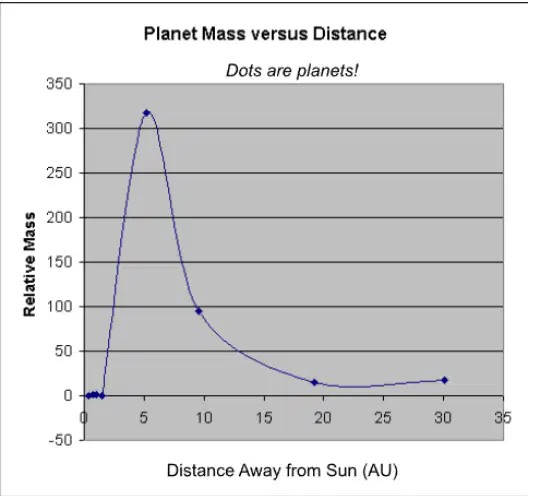
52.
8. What quantities are being compared on Graph #2? (If there are x- and y- axes, what do they represent?)
a)
x-relative mass, y-distance away from sun (AU)
b)
x-distance away from sun (AU), y-relative mass
c)
x- density (g/cm3), y-objects in our solar system (planets)
d)
x- objects in our solar system (planets), y-density (g/cm3)
53.
7. Which observation from Graph #2 is TRUE?
a)
The planet that has the highest relative mass is 30 AU away from the sun.
b)
The planets that are less than 5 AU away from the sun have a lower relative mass.
c)
The planets that are more than 5 AU away from the sun have a lower relative mass.
d)
The planets that are closer to the sun have a high relative mass.
54.
10. What is the CONNECTION or RELATIONSHIP between the 2 graphs?
a)
Planets that are closer to the sun have a lower density and they have a lower relative mass. This is due to their smaller size. D=M/V
b)
Planets that are closer to the sun have a lower density, however, they have a higher relative mass. This is due to their smaller size. D=M/V
c)
Planets that are closer to the sun have a higher density, however, they have a lower relative mass. This is due to their smaller size. D=M/V
d)
Planets that are closer to the sun have a higher density and they have a higher relative mass. This is due to their smaller size. D=M/V
55.
What kind of surface do the terrestrial planets have?
a)
Rocky
b)
Gaseous
c)
Slippery
d)
Shiny
56.
Which is TRUE about the inner planets?
a)
They have shorter orbits than the outer planets.
b)
They have more gases than the outer planets.
c)
They spin 10x faster than the outer planets.
d)
They formed before the outer planets.
57.
Which of the following is a function of the sun? (multiple correct answers, select one)
a)
Hold the planets in their orbit
b)
Provide energy
c)
Provide heat
d)
Protect the planets from asteroids
58.
How does the sun hold the planets in their orbit?
a)
It has a lot of mass so it's gravity is really strong.
b)
It has very little mass so it's gravity is really strong.
c)
It has a lot of mass so it's gravity is really weak.
d)
It has very little mass so it's gravity is really weak.
59.
How many planets are there?
a)
8
b)
9
c)
10
d)
12
60.
What planet in the Solar system has the lowest average temperature?
a)
Uranus
b)
Neptune
c)
Mars
d)
Saturn
61.
If you were going to make a scale model of the Solar system what planet should be the largest?
a)
Jupiter
b)
Saturn
c)
Earth
d)
Uranus
62.
Which planet in the Solar system has the greatest average temperature?
a)
Mercury
b)
Venus
c)
Earth
d)
Jupiter
63.
If you were to make a scale model of the Solar system what planets in the solar system should be most similar in size?
a)
Earth and Venus
b)
Mars and Mercury
c)
Uranus and Neptune
d)
Jupiter and Saturn