
 Worksheets
Radioactivity Mega Mix
Total questions: 93
Worksheet time: 32mins

Look at the diagram of an atom of a common element. What is the atomic number?
3
4
7
10

Look at the diagram of an atom of a common element. What is the mass number?
3
4
7
10
Two isotopes of the same element have
the same number of protons but different numbers of neutrons
the same number of protons but different numbers of electrons
the same number of neutrons but different numbers of protons
the same number of electrons but different numbers of protons
A radioactive isotope is a substance that
will eventually gain electrons through bonding
will become stable by cooling down
is unstable and will 'decay' by losing particles
is not found naturally on the Earth

Which of the above best describes the words 'contamination' and irradiation'?
A
B
C
D
Which type(s) of radiation is the most ionising?
alpha
beta
gamma
alpha and beta
beta and gamma
Which type(s) of radiation is a fast moving electron?
alpha
beta
gamma
alpha and beta
beta and gamma
Which type(s) of radiation can pass through paper?
alpha
beta
gamma
alpha and beta
beta and gamma

When Uranium decays it emits an alpha particle, forming an isotope of Thorium. Which of the above decay equations is correct?
A
B
C
D
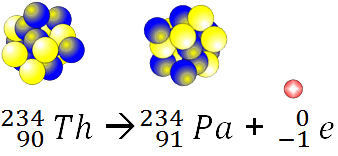
What change takes place to an atom during beta decay?
A proton changes into a neutron
A proton changes into an electron
An electron changes into a neutron
A neutron changes into a proton

In the above decay equation, what are the missing numbers x and y?
A
B
C
D
The half-life of a substance is
the amount of substance left after it has decayed
the time it takes for half of the isotope to decay
the time it takes for half the mass to have radiated away
the mass of half of the isotope after decaying
The activity of an isotope is
the number of particles/rays emitted per second
the same as the half-life in seconds
the amount of radiation emitted over the lifespan of the isotope
the amount of heat generated per second

Which of the above graphs shows how the activity of a sample varies with time?
A
B
C
D
A sample of 16 g of radioactive substance X has a half-life of 2 hours. What percentage of the sample is left after 6 hours?
none
12.5 %
25 %
33.3 %

Which of the following half-lives would be most suitable for a medical tracer used in a patient?
3 minutes
3 hours
3 days
3 years
Nuclear fusion occurs in Hydrogen nuclei in the Sun. A hydrogen nuclei consists of a single proton. Fusion requires very high temperatures and high speeds of nuclei to make them fuse together because...
the nuclei bounce off each other at low speeds
protons repel each other as they are positively charged
the protons are too massive to fuse easily
the protons decay easily at low temperatures
geiger muller tube

Americium - 241 has a half life of 400 years. If a sample contains 24 grams starts to decay, after how long will 3 grams be left?
400 yrs
800 yrs
1200 yrs
1600 yrs

A radioactive source emits radiation that can pass through a sheet of paper but not through thick aluminium. What does this show about the radiation?
It is alpha-particles.
It is beta-particles.
It is gamma-rays.
It is a mixture of alpha-particles and gamma-rays

Which line in the table describes the nature of an alpha-particle and a gamma-ray?
A
B
C
D

A radioactive nucleus R decays with the emission of a β-particle as shown:
Which equation is correct?
x = p
y = q
p = x – 1
q = y – 1

How many nucleons are in a nucleus of ?
19
20
39
58

The equation shows the decay of the nuclide X:
What are the values of P and Q ?
A
B
C
D
Which type of radiation has the greatest ionising effect?
α-particles
β-particles
γ-rays
all have the same ionising effect

An unstable nucleus has 145 neutrons and 92 protons. It emits a β-particle.
How many neutrons and protons does the nucleus have after emitting the β-particle?
A
B
C
D
Which particles are found in the nucleus of an atom?
neutrons and protons only
neutrons only
protons and electrons only
protons, electrons and neutrons

A Geiger counter detects radiation from radioactive sources.
A radioactive source is inside a thick aluminium container as shown:
Which type of radiation from this source is being detected?
α-particles
β-particles
γ-rays
radio waves

Which line in the table describes the nature of an α-particle and of a γ-ray?
A
B
C
D
A radioactive isotope has a half-life of 2 minutes. What can be deduced from this statement?
After 2 minutes, half of the isotope remains.
After 1 minute, half of the isotope remains.
After 4 minutes, half of the isotope remains.
After 4 minutes, none of the isotope remains.
A detector is used to measure the count-rate near a radioactive source. The reading is 4000
counts per minute. After 30 minutes the count-rate has fallen to 500 counts per minute.
What is the half-life of the radioactive source? You may ignore the effects of background
radiation.
3 minutes
5 minutes
6 minutes
10 minutes
A freshly made sample of radioactive material gives a count rate of 8000 counts per minute. After
20 days, it gives a count rate of 500 counts per minute.
What is the half-life of the material?
4.0 days
5.0 days
20 days
80 days
What occurs in the decay of a radioactive nucleus?
The nucleus absorbs another nucleus.
The nucleus absorbs at least one form of radiation.
The nucleus always splits into two equal fragments.
The nucleus emits at least one form of radiation.

A student investigates a radioactive source that emits only alpha-particles. Without any source
nearby, the detector shows a low reading. The source and thick cardboard are placed near the detector, as shown:
What is the reading on the detector now, and why?
A
B
C
D

In nuclear ……1……, hydrogen nuclei ……2…… to form helium nuclei, releasing energy.
Which words correctly complete gaps 1 and 2?
A
B
C
D

Ra decays with a half-life of 1600 s.
Rn decays with a half-life of 52 s.
Po decays with a half-life of 9.1 s.
Pb decays with a half-life of 10.6 h.
The changing count rate for one of these radioactive nuclides is shown in the graph.
From the half-life shown by the graph, which was the decaying radioactive nuclide?
Ra
Rn
Po
Pb
The unit of activity is...
Becquerel
Seconds
Metres
Sievert
The atomic number indicates how many...are found in the nucleus of an atom.
Neutrons
Protons
Electrons
Quarks
The most penetrating form of nuclear radiation is...
alpha
beta
gamma
heat
Which best describes the structure of a beta particle?
helium nucleus
slow moving proton
fast moving electron
high frequency light wave

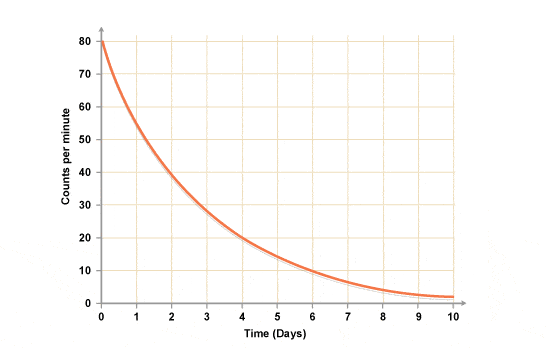
What is the half-life of this radioactive substance?
5700 years
11400 years
17100 years
22800 years
The overall charge on an alpha particle is...
-1
0
+1
+2
The overall charge on a gamma ray is...
-1
0
+1
+2
The most ionising form of nuclear radiation is...
alpha
beta
gamma
infrared
Carbon-12 has an atomic number of 6 and a mass number of 12. How many electrons would be found in a neutral atom of carbon-12?
6
12
18
24
A radioactive source has an initial activity of 200kBq and a half-life of 15 days. How many days would it take for the activity to fall to 25kBq?
15
30
45
60

A
B
C
D
A radioactive source emits radiation that can pass through a sheet of paper but not through thick aluminium. What does this show about the radiation?
It is alpha-particles.
It is beta-particles.
It is gamma-rays.
It is a mixture of alpha-particles and gamma-rays
How many nucleons are in a nucleus of ?
19
20
39
58
The equation shows the decay of the nuclide X:
What are the values of P and Q ?
A
B
C
D
A Geiger counter detects radiation from radioactive sources.
A radioactive source is inside a thick aluminium container as shown:
Which type of radiation from this source is being detected?
α-particles
β-particles
γ-rays
radio waves
A radioactive isotope has a half-life of 2 minutes. What can be deduced from this statement?
After 2 minutes, half of the isotope remains.
After 1 minute, half of the isotope remains.
After 4 minutes, half of the isotope remains.
After 4 minutes, none of the isotope remains.
A detector is used to measure the count-rate near a radioactive source. The reading is 4000
counts per minute. After 30 minutes the count-rate has fallen to 500 counts per minute.
What is the half-life of the radioactive source? You may ignore the effects of background
radiation.
3 minutes
5 minutes
6 minutes
10 minutes
Two isotopes of the same element have
the same number of protons but different numbers of neutrons
the same number of protons but different numbers of electrons
the same number of neutrons but different numbers of protons
the same number of electrons but different numbers of protons
When Uranium decays it emits an alpha particle, forming an isotope of Thorium. Which of the above decay equations is correct?
A
B
C
D
What form of radiation should a medical tracer emit?
alpha
beta
gamma
any of these
Which line in the table describes the nature of an alpha-particle and a gamma-ray?
A
B
C
D
A radioactive nucleus R decays with the emission of a β-particle as shown:
Which equation is correct?
x = p
y = q
p = x – 1
q = y – 1
The equation shows the decay of the nuclide X:
What are the values of P and Q ?
A
B
C
D
Which type of radiation has the greatest ionising effect?
α-particles
β-particles
γ-rays
all have the same ionising effect
Which particles are found in the nucleus of an atom?
neutrons and protons only
neutrons only
protons and electrons only
protons, electrons and neutrons
A Geiger counter detects radiation from radioactive sources.
A radioactive source is inside a thick aluminium container as shown:
Which type of radiation from this source is being detected?
α-particles
β-particles
γ-rays
radio waves
A radioactive isotope has a half-life of 2 minutes. What can be deduced from this statement?
After 2 minutes, half of the isotope remains.
After 1 minute, half of the isotope remains.
After 4 minutes, half of the isotope remains.
After 4 minutes, none of the isotope remains.
A detector is used to measure the count-rate near a radioactive source. The reading is 4000
counts per minute. After 30 minutes the count-rate has fallen to 500 counts per minute.
What is the half-life of the radioactive source? You may ignore the effects of background
radiation.
3 minutes
5 minutes
6 minutes
10 minutes
The half-life of a radioisotope is 2400 years. The activity of a sample is 720 counts /s.
How long will it take for the activity to fall to 90 counts /s?
300 years
2400 years
7200 years
19 200 years
What occurs in the decay of a radioactive nucleus?
The nucleus absorbs another nucleus.
The nucleus absorbs at least one form of radiation.
The nucleus always splits into two equal fragments.
The nucleus emits at least one form of radiation.
A student investigates a radioactive source that emits only alpha-particles. Without any source
nearby, the detector shows a low reading. The source and thick cardboard are placed near the detector, as shown:
What is the reading on the detector now, and why?
A
B
C
D
In nuclear ……1……, hydrogen nuclei ……2…… to form helium nuclei, releasing energy.
Which words correctly complete gaps 1 and 2?
A
B
C
D
How many nucleons are in a nucleus of ?
19
20
39
58
Compared with β-particles and γ-rays, α-particles
are the only type of radiation to carry a charge.
have the greatest ionising effect.
have the greatest penetrating effect.
have the smallest mass.

The diagram shows a box used for storing radioactive sources.
Which material is best for lining the box to prevent the escape of most radioactive emissions?
aluminium
copper
lead
steel

The count rate from a radioactive isotope is recorded every hour. The count rate is corrected forbackground radiation.
The table shows the readings.
What estimate of the half-life of the isotope can be obtained from the readings in the table?
between 1 and 2 hours
between 2 and 3 hours
between 3 and 4 hours
between 4 and 5 hours
The half-life of a radioactive substance is 10 minutes. A sample of the radioactive substancecontains 2000 nuclei.
How many radioactive nuclei were in the sample half an hour earlier?
250
4000
6000
16 000

A radiation detector is placed close to a source of β-particles.
Aluminium sheets of increasing thickness are placed between the source and the detector.
Eventually a sheet which is 2.0 cm thick is used. The reading on the detector decreases, but does not fall to zero.
Why does the reading not fall to zero?
Some of the β-particles go round the edges of the sheet.
The detector is too close to the source.
There is always some background radiation.
The sheet can never be thick enough to absorb all the β-particles

A radioactive nucleus emits a β-particle.
What happens to the proton number (atomic number) of the nucleus?
It stays the same.
It increases by 1.
It decreases by 2.
It decreases by 4.
A scientist needs to use a source of γ-rays as safely as possible.
Which action will not reduce the amount of radiation that reaches the scientist?
keeping the distance between the source and the scientist as large as possible
keeping the temperature of the source as low as possible
keeping the time for which the scientist uses the source as small as possible
placing a lead screen between the scientist and the source

The arrangement shown is used to check whether the flour inside a cardboard packet is above a certain level. If it is above this level, the flour absorbs the radiation from the source so that it doesn’t reach the detector.
Which type of radiation is suitable to use?
α-particles only
β-particles only
either α-particles or β-particles
γ-rays only
Which of these is a use of alpha radiation?
Sterilising food
Smoke detectors
Monitoring paper thickness
Industrial tracers
Nuclear fission happens when a uranium-235 nucleus is hit by a ……….....……… and splits into two smaller …………….....…. .
neutron
electron
proton
atom
nuclei
When a uranium-235 nucleus undergoes fission, it releases two or three …………......…… and energy.
protons
daughter nuclei
neutrons
atoms
What is the role of the control rods
absorb excess neutrons
move thermal energy away from the rods
slow down neutrons
prevent irradiation of workers
What is the role of the moderator
absrob excess neutrons
repel neutrons
slow down neutrons
speed up neutrons
What is the role of the shielding
absrob excess neutrons
move thermal energy away from the rods
slow down neutrons
prevent irradiation of workers

