wayground logo

Free Printable Worksheets

Font size

S
M
L
XL
Worksheets

Canada's Appalachian Region

Total questions: 84

Worksheet time: 49mins

Name
Class
Date
1.
The hot, plastic-like layer of Earth, made of magma. 
a)
Inner Core
b)
Mantle
c)
Crust
d)
Outer Core
2.
The hot, liquid layer of Earth, made of iron and nickel.
a)
Inner Core
b)
Mantle
c)
Crust
d)
Outer Core
3.
The dense, solid center of Earth, made of iron and nickel.
a)
Inner Core
b)
Mantle
c)
Crust
d)
Outer Core
4.
What happens in a liquid or gas when the warmer parts rise and the cooler parts sink.
a)
Subduction
b)
Erosion
c)
Deposition
d)
Convection
5.
A break in the rock created by pressure and movement in the rock. 
a)
Fault
b)
Mid-Ocean Ridge
c)
Ocean Trench
d)
Focus
6.
A wide volcano with gentle slopes that has been formed by quiet, runny lava flows.
a)
Composite Volcano
b)
Shield Volcano
c)
Fissure Volcano
d)
Cinder-Cone Volcano
7.
A smaller, narrow volcano with steep slopes that has been formed by explosive eruptions.
a)
Composite Volcano
b)
Shield Volcano
c)
Fissure Volcano
d)
Cinder-Cone Volcano
8.
A moderate-sized volcano, has been formed by the alternating of lava flows and explosive eruptions
a)
Composite Volcano
b)
Shield Volcano
c)
Fissure Volcano
d)
Cinder-Cone Volcano
9.
The cooler, outer rocky shell of Earth.
a)
Inner Core
b)
Mantle
c)
Crust
d)
Outer Core
10.
Scientists hypothesize that a super continent existed 200 million years ago.  This continent is called
a)
America
b)
Super Earth
c)
Pangea
d)
Eurasia
11.
Convergent Plate Movement can create
a)
Rifts
b)
Mountains
c)
Ocean Ridges
d)
Radiation
12.
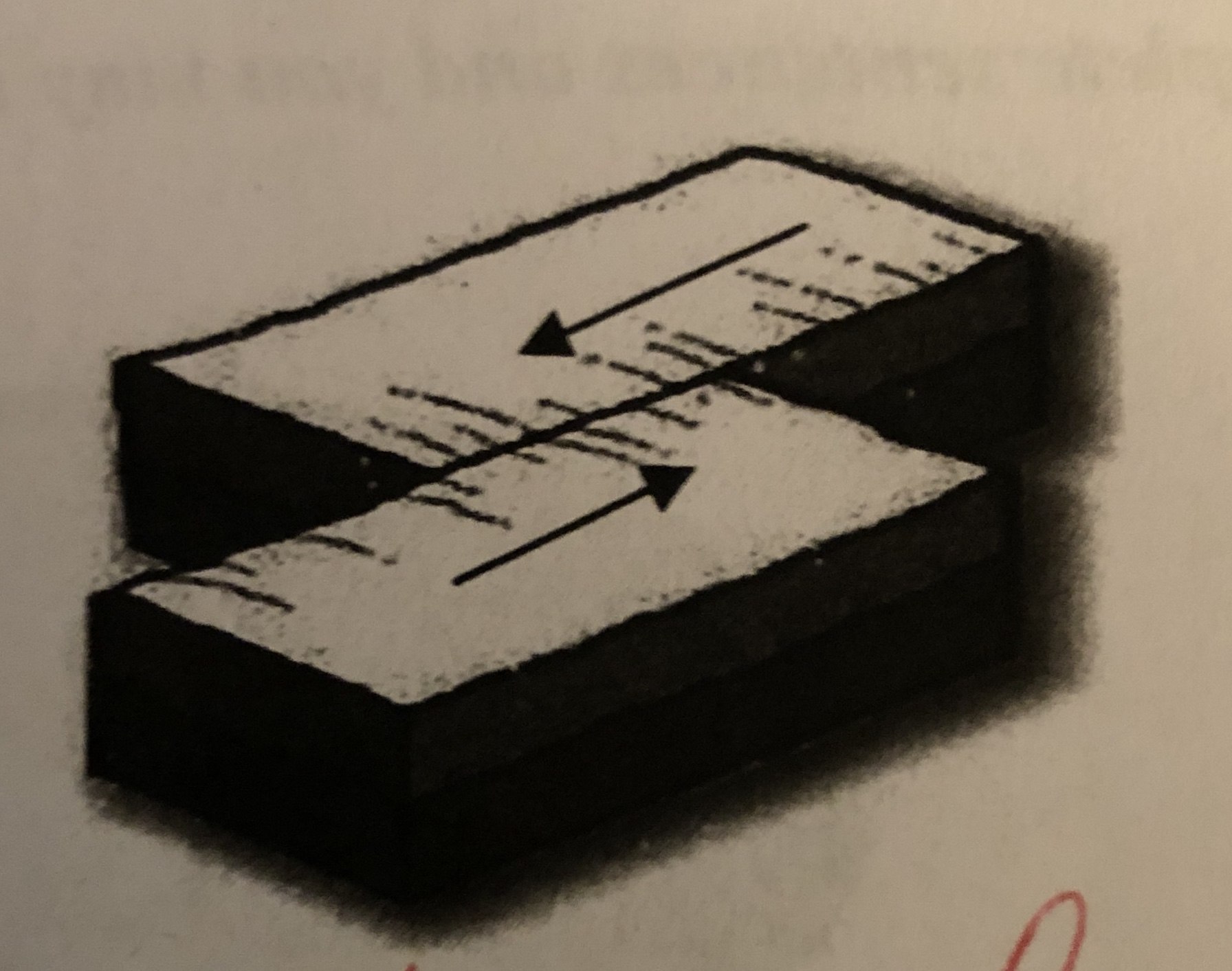
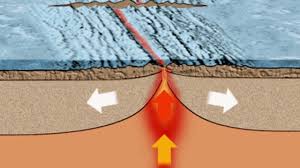
Name the boundary
a)
convergent boundary
b)
divergent boundary
c)
transform boundary
d)
sergent boundary
13.
Name the boundary
a)
convergent boundary
b)
divergent boundary
c)
transform boundary
d)
sergent boundary
14.
What was Wegener's hypothesis called?
a)
The Pangea 
b)
Moving Continents 
c)
The Continental Drift
d)
Techtonic Plates
15.
Which piece of evidence did Wegener use to prove continental drift?
a)
The shape of the continents
b)
Similar fossils found on separate continents
c)
Tree fossils found in odd places
d)
All of the above
16.

What type of boundary is this?

a)

convergent

b)

divergent

c)

transform

17.

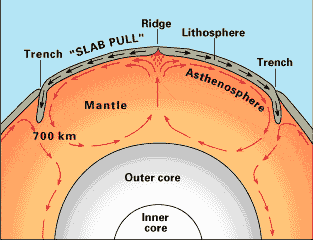
What is the source of energy that drives plate movement?

a)

the subducton of the sea floor

b)

the different densities of the oceanic and crustal plates

c)

convection currents in the asthenosphere

d)

the friction force between the plates that move past each other

18.
Pangaea was an ancient supercontinent made up of...
a)
America, Greenland, and Europe.
b)
Antarctica, India, and America.
c)
all of Earth’s continents.
d)
South Africa, India, Australia, and South America.
19.
Earth's crust is broken up into several large rocky pieces called ...
a)
plates
b)
faults
c)
fossils
d)
puzzle pieces
20.
A German scientist Alfred Wegener was the first to hypothesize that ...........
a)
Continents were once joined
b)
The sea floor is spreading
c)
Continents are moving
d)
The Earth's magnetic pole flips
21.

The place where two plates meet.

a)

plate boundary

b)

tectonic plate

c)

asthenosphere

d)

crust

22.

The process by which oceanic crust sinks beneath a deep-ocean trench and back into the mantle at a convergent plate boundary.

a)

stressing

b)

seafloor spreading

c)

subduction

d)

shearing

23.

What is the area around the Pacific Ocean called where you find many volcanoes and earthquakes?

a)

Ring of Destruction

b)

Ring of Fire

c)

Great Pacific Garbage Patch

d)

Bermuda Triangle

24.

What is the name of plate #8?

a)

African Plate

b)

Pacific Plate

c)

North American Plate

d)

Eurasian Plate

25.

Which statement best describes the movement of Earth’s plates?

a)

The plates are constantly moving.

b)

The plates stayed in one place for millions of years but are moving now.

c)

There is no evidence that plates ever moved.

d)

The plates moved for millions of years but have now stopped.

26.

Which statement best describes the movement of Earth’s plates?

a)

The plates are constantly moving.

b)

The plates stayed in one place for millions of years but are moving now.

c)

There is no evidence that plates ever moved.

d)

The plates moved for millions of years but have now stopped.

27.
An opening through which the lava flows is called:
a)
crater
b)
caldera
c)
vent
d)
pipe
28.

A bowl shaped area that may form at the top of a volcano around the central vent

a)

crater

b)

vent

c)

tube

d)

leftovers

29.

Where are volcanoes most likely to form?

a)

along plate boundaries

b)

near the center of continents

c)

near water

d)

on the moon

30.
As magma rises towards the surface it collects in a 'room' called a _____ _____ . 
a)
magma chamber
b)
side vent
c)
main vent
d)
lava chamber
31.

When magma flows out of the volcano it is called

a)

air

b)

water

c)

egg shells

d)

lava

32.

Melted rock inside the Earth is called

a)

magma.

b)

water.

c)

fire.

d)

surface.

33.

What happens in a Convection Current?

a)

Cold Magma moves left, hot magma moves right

b)

Hot magma moves left, and cold magma moves right

c)

Hot magma rises, cold magma lowers

d)

Hot Magma lowers, cold magma rises

34.

When did Pangea exist?

a)

10,000 years ago

b)

65 million years ago

c)

about 200 to 300 million years ago

d)

no one knows how long ago Pangea existed

35.
Where have Glossopteris fossils been found?
a)

India

b)

Australia

c)

Antarctica

d)

All of them

e)

South America

36.
What two specific continents fit together most noticeably?
a)
Africa and North America
b)
South America and Europe
c)
South America and Africa
d)
Antartica and Africa
37.

In sea-floor spreading, molten material rises from the mantle and erupts creating new crust.

a)

along the edges of all the continents.

b)

along mid-ocean ridges.

c)

in deep-ocean trenches.

d)

at the north and south poles.

38.
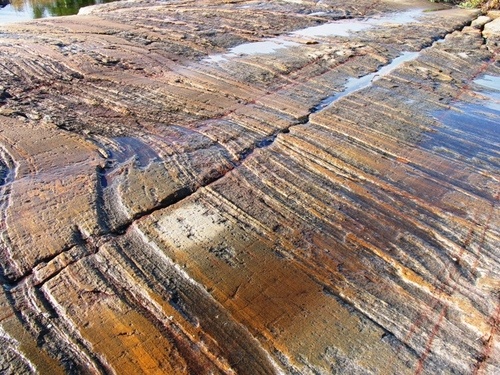
This is a picture of glacier scars found in Africa.  What are these evidence for?
a)
Africa has always been near the equator
b)
Africa was once in an area of the Earth that had a very cold climate
c)
The continents have not moved
d)
sea floor spreading
39.
What are the two main types of original rock found beneath the St. Lawrence Lowlands?
a)
Granite and basalt
b)
Sandstone and limestone
c)
Marble and slate
d)
Quartzite and shale
40.
What is the primary reason for the St. Lawrence Lowlands' humid continental climate?
a)
Proximity to the Atlantic Ocean
b)
Influence of the Gulf Stream
c)
Moderation by the St. Lawrence River and Great Lakes
d)
Presence of large mountain ranges
41.
What is the main reason for the clearing of forests in the St. Lawrence Lowlands?
a)
Urbanization and population growth
b)
Logging and timber harvesting
c)
Natural forest fires and disease
d)
Agriculture and farming
42.
What is the primary reason for the St. Lawrence Lowlands' flat terrain?
a)
Volcanic activity
b)
Erosion by rivers
c)
Glacial activity
d)
Tectonic plate movement
43.
What is the typical range of precipitation in the St. Lawrence Lowlands?
a)
10 to 20 inches
b)
30 to 42 inches
c)
50 to 60 inches
d)
70 to 80 inches
44.
What type of forest is found in areas with clay soils in the St. Lawrence Lowlands?
a)
Wetland forests
b)
Pine forests
c)
Deciduous forests
d)
Coniferous forests
45.
What is the main reason for the high population density on the Canadian side of the St. Lawrence Lowlands?
a)
Abundant natural resources
b)
Favorable climate
c)
Presence of major cities
d)
Government policies
46.
Based on the information provided, what can you conclude about the impact of the St. Lawrence River on the St. Lawrence Lowlands' climate?
a)
The river makes the climate colder and drier.
b)
The river has no significant impact on the climate.
c)
The river moderates temperatures and makes the climate more humid.
d)
The river causes the climate to be more extreme.
47.
What can be inferred about the relationship between the St. Lawrence Lowlands' soil types and the types of forests that grow there?
a)
Soil type has no influence on forest types.
b)
All soil types support the same types of trees.
c)
Different soil types support different types of trees.
d)
Soil type only affects the height of the trees.
48.
Based on the text, what is the most likely reason why the St. Lawrence Lowlands is considered a major transportation hub?
a)
The region has a large population and many industries.
b)
The St. Lawrence River provides a natural waterway for transportation.
c)
The region has a well-developed network of roads and highways.
d)
The region has a large number of airports.
49.
What are the three main types of trees that grow in the St. Lawrence Lowlands on clay soils?
4 lines
50.
What are two major cities located in the St. Lawrence Lowlands?
4 lines
51.
What are three industries that contribute to the St. Lawrence Lowlands' reputation as the "Manufacturing Heart" of Canada?
4 lines
52.
What is the average height of the mountains in the Canadian Appalachians?
a)
1,000 feet
b)
3,000 feet
c)
5,000 feet
d)
7,000 feet
53.
What is the primary type of rock found in the Canadian Appalachians?
a)
Granite
b)
Sedimentary rock
c)
Igneous rock
d)
Metamorphic rock
54.
What is the average annual precipitation in the Appalachian Uplands?
a)
500-700 mm
b)
900-1300 mm
c)
1500-2000 mm
d)
2500-3000 mm
55.
What is the name of the region that stretches along the coast of New Brunswick and Nova Scotia, encompassing Prince Edward Island and Îles-de-la-Madeleine?
a)
The Newfoundland Highlands
b)
The Maritime Plain
c)
The Cape Breton Highlands
d)
The Annapolis Lowlands
56.
What is the approximate mean annual temperature in the Appalachian Uplands?
a)
-10°C
b)
3.5°C
c)
10°C
d)
15°C
57.
What is the primary reason for the Appalachian Mountains' gentler slopes today?
a)
Volcanic activity
b)
Earthquakes
c)
Glacial erosion
d)
Erosion over millions of years
58.
What is the name of the Canadian portion of the Appalachian Mountain range?
a)
The Appalachian Uplands
b)
The Rocky Mountains
c)
The Alps
d)
The Canadian Shield
59.
Based on the information provided, what can you conclude about the relationship between the height of the Appalachian Mountains and their age?
a)
The mountains are younger and taller than the Alps and the Rocky Mountains.
b)
The mountains are older and shorter than the Alps and the Rocky Mountains.
c)
The mountains are the same age and height as the Alps and the Rocky Mountains.
d)
There is no relationship between the age and height of the mountains.
60.
What can you infer about the impact of the Appalachian Mountains on the surrounding environment based on the text?
a)
The mountains have a minimal impact on the surrounding environment.
b)
The mountains have a significant impact on the surrounding environment, creating diverse landscapes and habitats.
c)
The mountains have a negative impact on the surrounding environment due to coal mining.
d)
The mountains have a negative impact on the surrounding environment due to climate change.
61.
What evidence suggests that the Appalachian Mountains were once much taller than they are today?
a)
The mountains are composed primarily of marine sedimentary rocks and volcanic rocks.
b)
The mountains are a popular destination for outdoor recreation.
c)
The mountains have been gradually worn down by erosion over millions of years.
d)
The mountains are home to a rich diversity of plant and animal life.
62.
What are the two main types of forests found in the Appalachian Uplands?
4 lines
63.
What are some of the challenges facing the Appalachian Uplands?
4 lines
64.
What are some of the popular outdoor activities in the Appalachian Uplands?
4 lines
65.

Western Cordillera is known as one of Canada's:

a)

lowlands

b)

highlands

c)

wetlands

d)

plains

66.

The landform region is the oldest in Canada with erroded 'mountains' and igneous rock

a)

Apallachians

b)

Western Cordillera

c)

Innuitian Mountains

d)

Canadian Shield

67.

Where we live in Canada (i.e. Kitchener) is best described as

a)

Canadian Shield

b)

Lowlands

c)

Highlands

d)

all of the above

68.

Most people live in this region:

a)

Western Cordillera

b)

Great Lakes - St. Lawrence

c)

Canadian Shield

d)

Interior Plains

69.

This Region lacks much topography

a)

Canadian Shield

b)

Appalachians

c)

Interior Plains

d)

All of the above

70.

Which province is NOT home to the Appalachians?

a)

PEI

b)

Nova Scotia

c)

Alberta

d)

New Brunswick

71.

BC, Yukon, and parts of Alberta and Northwest Territories are all located in this region, which region is it?

a)

Appalachian

b)

Interior Plains

c)

Cordillera

d)

Canadian Shield

72.

Which region is characterized by being void of trees due to the presence of permafrost?

a)

Canadian Shield

b)

Interior Plains

c)

Cordillera

d)

Arctic

73.

Which physiographic region is the smallest in size?

a)

Hudson Bay Lowlands

b)

Canadian Shield

c)

Arctic

d)

Great Lakes - St. Lawrence Lowlands

74.

The largest physiographic region in Canada is the _________.

a)

Cordillera

b)

Canadian Shield

c)

Arctic

d)

Interior Plains

75.

Q. This rock started as molten magma but transformed after a volcano erupted. What type of rock is this?

a)

Sedimentary

b)

Igneous

c)

Metamorphic

76.

This rock was another type of rock that was heated and compressed over time. What type of rock is this?

a)

Sedimentary

b)

Igneous

c)

Metamorphic

77.

Q. This rock was formed by smaller pieces of rock that settled at the bottom of a lake millions of years ago. What type of rock is this?

a)

Sedimentary

b)

Igneous

c)

Metamorphic

78.

Q. The process when rocks break into smaller pieces due to exposure to natural elements is called

a)

erosion

b)

weathering

c)

sediments

79.

Q. The process by which metamorphic rocks are formed...

a)

heat and pressure

b)

erosion and deposition

c)

melting and cooling

80.

What do we call the material that comes from rocks that have been broken down into smaller pieces. This usually results from weathering.

a)

texture

b)

weathering

c)

sediment

d)

erosion

81.

Q. What causes igneous rocks to form

a)

pressure

b)

cooling magma and lava

c)

compaction

d)

cementation

82.

Name of the impression of a plant or animal, in the soil, that existed in the past

a)

diamond

b)

hardness

c)

fossil

83.

2 types of Igneous Rocks mentioned in the presentation

a)

Classic & Thermochemical

b)

Exclusive & Inconclusive

c)

Intrusive & Extrusive

d)

Clastic & Chemical

84.

Which type of Igneous Rock takes longer to cool?

a)

Intrusive

b)

Extrusive