wayground logo

Free Printable Worksheets

Font size

S
M
L
XL
Worksheets

Unit 1 Quiz #2: Properties of Water and Elements of Life

Total questions: 36

Worksheet time: 48mins

Name
Class
Date
1.

Carbohydrates are organic compounds that composed of carbon, hydrogen, & oxygen.


a)

True

b)

False

2.
Functional groups are chemical groups attached to a carbon skeleton that participate in chemical reactions.
a)

True

b)

False

3.

Matter is anything that takes up space and has mass.  Compounds are substances that cannot be broken down into other substances by chemical reactions.


a)

True

b)

False

4.
A water molecule has hydrogen bonds between the oxygen and both hydrogen.
a)

True

b)

False

5.
Which best describes the phenomenon seen in the picture to the right?
a)
Water has a high surface tension, which keeps the ice on the surface of the water
b)
The partial charges of water repel molecules from each other, which creates space between molecules, thus resulting in ice being less dense than water
c)
Hydrogen bonds stabilize the structure of water keeping molecules separate from each, thus resulting in ice being less dense than water
d)
When ice begins to form it takes on a crystalline structure due to the bonding between water. This crystalline structure allows for ice to be denser than water, which allows it to float.
6.
Which of the following functional groups represents a carboxyl group?
a)
-OH
b)
-CH3
c)
-C=O
d)
-COOH
7.
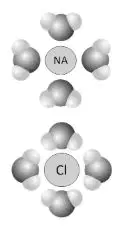
Which best describes the phenomenon seen in the picture to the right?
a)
When NaCl is added to water, the partially negative oxygen in water will interact with the negative sodium and the partially positive hydrogen will interact with the negative chlorine, which pulls apart, or dissolves, NaCl
b)
When NaCl is added to water, the partially negative oxygen in water will interact with the positive sodium and the partially positive hydrogen will interact with the negative chlorine, which pulls apart, or dissolves, NaCl
c)
When NaCl is added to water, the partially negative oxygen in water will interact with the negative sodium and the partially positive hydrogen will interact with the positive chlorine, which pulls apart, or dissolves, NaCl
d)
When NaCl is added to water, the partially positive oxygen in water will interact with the positive sodium and the partially negative hydrogen will interact with the negative chlorine, which pulls apart, or dissolves, NaCl
8.
Which of the following is responsible for the adhesive properties of water?
a)
Hydrogen bonds between water molecules and other types of molecules
b)
Hydrogen bonds between the oxygen of one water molecule and a hydrogen of another water molecule
c)
Covalent bonds between water molecules and other types of molecules
d)
Covalent bonds between the oxygen of one water molecule and a hydrogen of another water molecule
9.
Along with carbon, _______________________ is an important element for building proteins and ____________________________
4 lines
10.
____________________ are the repeating units that make up _____________________.
4 lines
11.
A ________________________ reaction bonds two monomers with the_______________ of ____________.
4 lines
12.
The ____________________________ states that elements will gain, lose, or share electrons to complete their valence shell to become stable.
4 lines
13.
Identify the elements that make up nearly all living matter (essential elements).
4 lines
14.
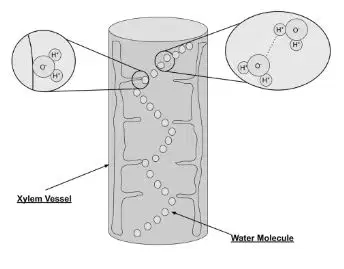
The image below depicts water molecules in the xylem tissue of a plant. Identify and discuss the properties of water that are responsible for the movement of water through the xylem from the roots to leaves of plants.
4 lines
15.
Describe the properties of carbon that make it such a versatile element.
4 lines
16.
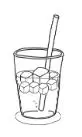
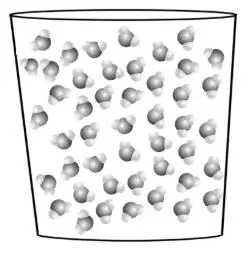
The image below represents a cup of water. a) Describe how the bonds the surface water molecules form are different from the rest of the water molecules. b) Identify the types of bond formed represented by your arrows in part (a). c) Describe surface tension. d) Identify and describe any two properties of water and how that property of water directly benefits an organism.
4 lines
17.

H2OH_2O  is a ________ molecule.

a)

polar

b)

nonpolar

c)

ionic

d)

metallic

18.
Hydrophilic technically means...
a)
water-hating
b)
water-loving
19.

What is the area of chemistry that is the study of chemical processes that take place in organism called?

a)

Inorganic Chemistry

b)

Biochemistry

c)

Analytical Chemistry

d)

Physical Chemistry

20.

Which type of bond is primarily responsible for the unique properties of water?

a)

Ionic bond

b)

Covalent bond

c)

Hydrogen bond

d)

Metallic bond

21.

What is the primary function of carbohydrates in living organisms?

a)

Structural support

b)

Energy storage

c)

Genetic information

d)

Enzyme catalysis

22.

Which of the following is a characteristic of a polar molecule?

a)

Equal distribution of charge

b)

Unequal distribution of charge

c)

No charge

d)

Metallic bonding

23.
Classify the compound based on the functional group present.
a)
aldehyde
b)
ketone
c)
carboxylic acid
d)
ester
24.

What is the functional group on the molecule represented below?

a)

alcohol

b)

amine

c)

carboxyl

d)

ester

25.

What is the functional group of the molecule shown below?

a)

alcohol

b)

amine

c)

carboxyl

d)

ester

26.

What is the functional group in ethers?

a)

-COOH

b)

-CHO

c)

-O-

d)

-NH2

27.
The -OH group is responsible for the reactions that alcohols undergo.
a)
True
b)
False
28.
Bubbles form when two or more substances are combined ...
a)
Chemical Change
b)
Physical Change
29.

What is the shape of a protein?

a)

chains

b)

folded chains

c)

rings

d)

honeycomb

30.

How many levels of protein structure are there?

a)
4
b)

3

c)
5
d)

2

31.
Is one nitrogen and two hydrogen atoms bonded to a carbon atom
a)
primary structure
b)
polypeptide
c)
amine group
d)
protein gel
32.
Attractions between water molecules are called
a)
Covalent bonds
b)
Ionic bonds
c)
Polar bonds
d)
Hydrogen bonds
33.

Which characteristic of water molecules directly contributes to the remarkable "water walking" success of the aquatic insects pictured?

a)

hydrogen bonds

b)

capillary action

c)

nonpolar covalent bonds

d)

ionic bonds

34.

The ability of water molecules to stick to each other, creating surface tension is called:

a)

Cohesion

b)

Adhesion

c)

Insulation

d)

Ph

35.
When water molecules stick easily to other water molecules, this is called what?
a)
cohesion
b)
adhesion
c)
solution
d)
polar molecule
36.
What word describes when water is attracted to other substances?
a)
cohesion
b)
adhesion
c)
capillary action
d)
surface tension