
 Worksheets
Project Priority Matrix
Total questions: 13
Worksheet time: 13mins
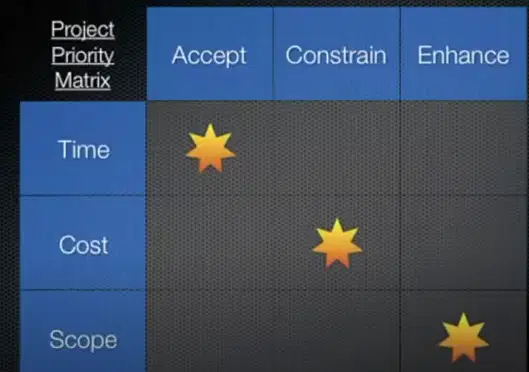
What is the most constrained factor for the client in the given project?
Time
Scope
Cost
Quality
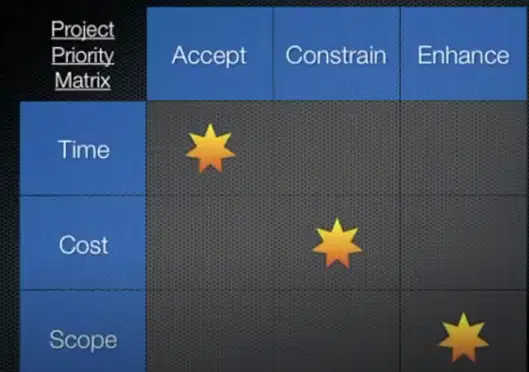
What does it mean when clients want to "enhance" the scope?
Reduce the scope of the project
Keep the scope unchanged
Add more features or improve specifications
Decrease the quality of deliverables
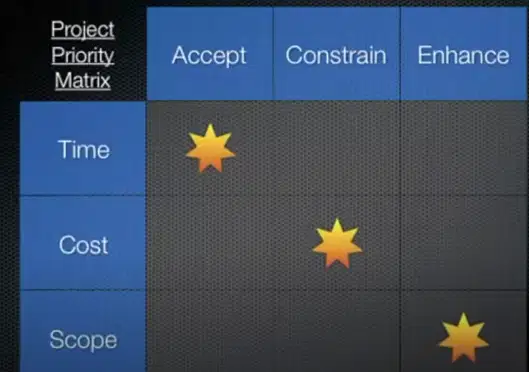
In this project’s priority matrix, what trade-off are the clients willing to accept?
Increased time for completion in exchange for enhanced scope
Increased cost for reduced time
Decreased quality for reduced cost
Increased time in exchange for lower costs
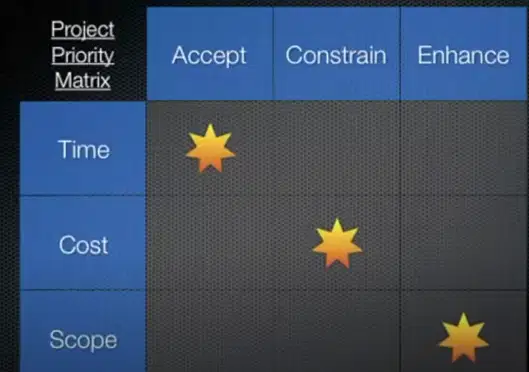
Why might clients prefer to enhance the scope even if it leads to a longer project timeline?
Because the project has a fixed end date
To improve project deliverables without increasing costs
To reduce project costs
To shorten the project timeline
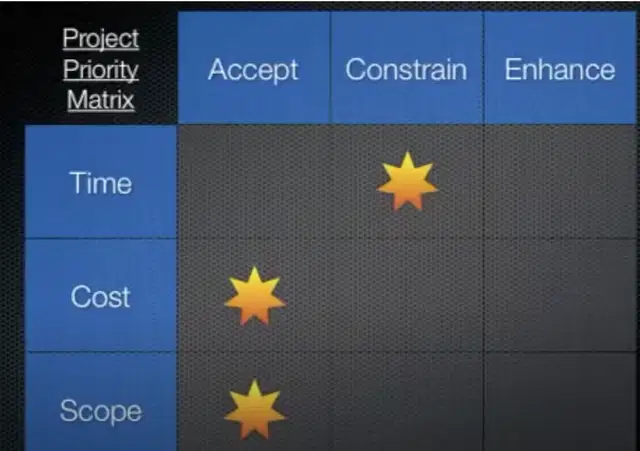
According to the project priority matrix, which project factor is strictly controlled and cannot be altered, even if it means sacrificing other aspects of the project?
Time
Cost
Scope
Quality
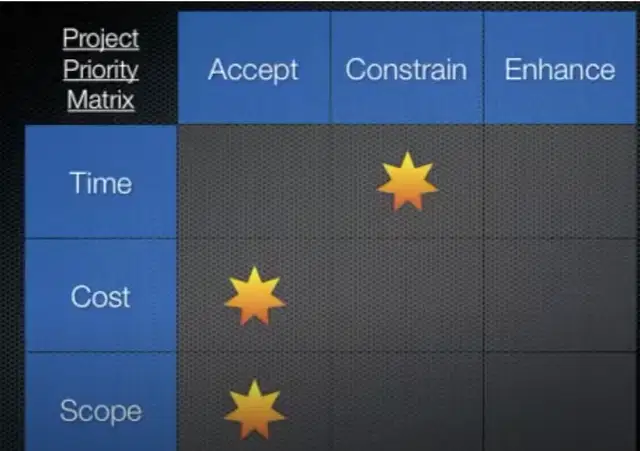
What approach is the project team taking toward cost management, and how could this impact other aspects like scope and time?
Cost is accepted, so budget increases are allowed if the client adds funds to the project.
Cost is enhanced, meaning extra funds will be allocated to ensure higher quality.
Cost is constrained, meaning the project must stay within the defined budget, possibly sacrificing scope or time.
Cost is flexible, meaning it can fluctuate based on project needs.
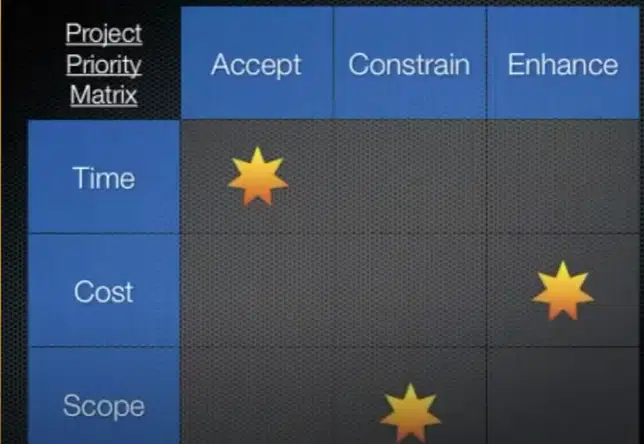
What does it mean for the project team to "accept" time in this priority matrix? How might this influence the project’s schedule?
The project must stay on schedule with no flexibility.
Time can be flexible, meaning the project may experience delays if necessary to accommodate other priorities.
Time must be reduced to meet tight deadlines.
Time is not a factor in this project.
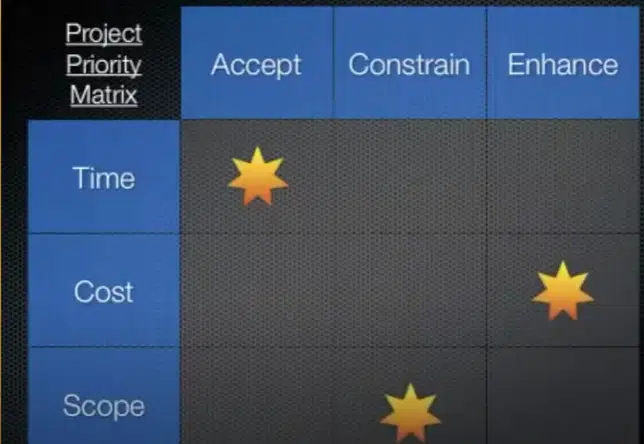
What approach is taken toward cost management in this matrix, and what are the implications for the project?
cost can increase if needed.
the project must stay within budget, even at the expense of time or scope.
extra budget can be allocated to improve other project aspects.
cost is not a consideration
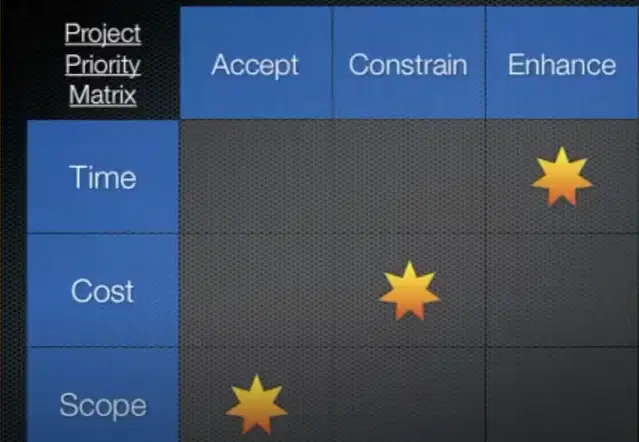
What does it mean for time to be "enhanced" in this project priority matrix, and how might it affect project scheduling?
Time must be strictly adhered to, with no flexibility.
The project team will aim to complete the project earlier than planned.
The project team is flexible with deadlines and can accept delays.
Time can be extended to improve the scope.
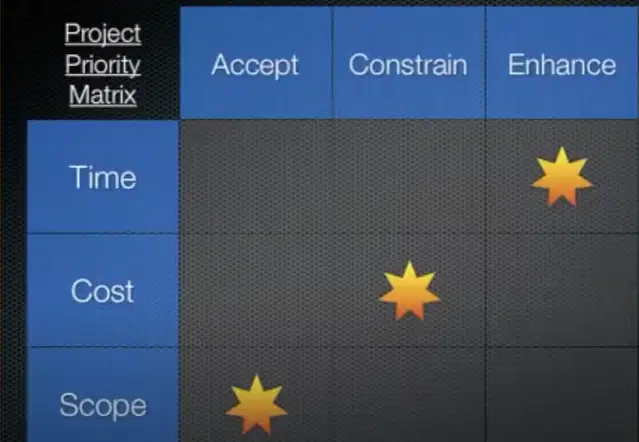
What does it mean for cost to be constrained in this matrix, and how does this impact the project budget?
The project budget is flexible and can be increased if necessary.
The project team must stay within a strict budget, and any cost overruns are unacceptable.
The project team has no restrictions on spending
Cost can be reduced to meet other priorities.
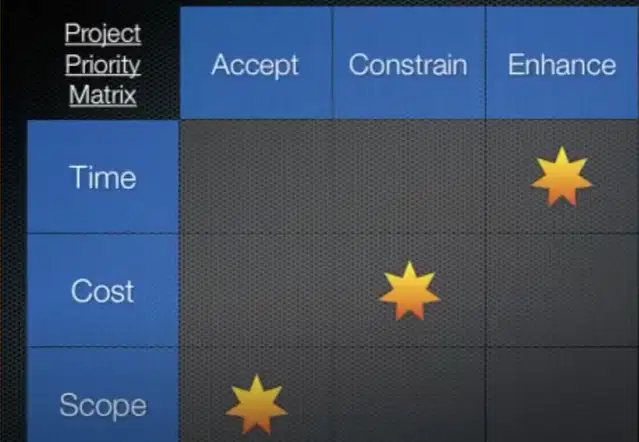
How does the acceptance of scope changes influence the project's deliverables in this matrix?
The client is open to adjusting the scope, allowing changes without significant constraints.
The scope is fixed, and no changes are allowed during the project
The scope must be enhanced at all costs to improve project quality
The scope is constrained and cannot be modified.
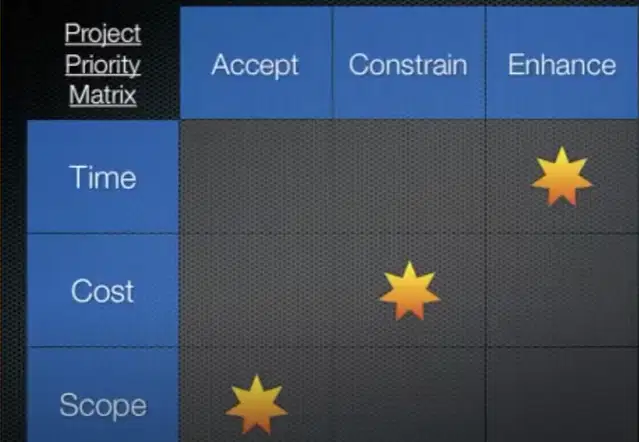
What is the overall conclusion of this matrix in terms of project priorities?
The project team has no constraints and can manage the project freely.
The project must be completed quickly, with flexibility in scope but strict adherence to the budget.
The project should focus on reducing costs, even at the expense of scope and time
The client is willing to enhance the scope and time while ignoring costs.
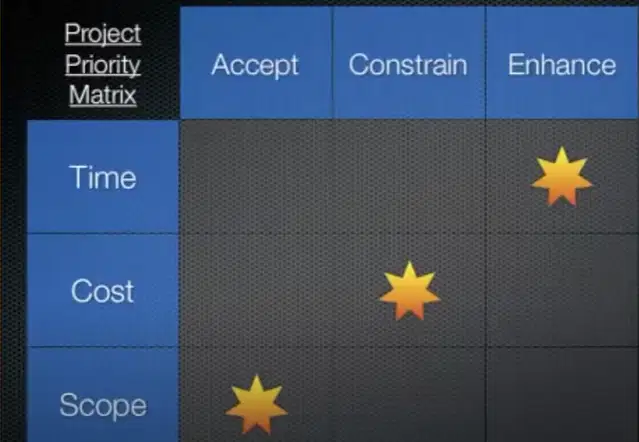
How might the decision to enhance time and accept scope changes affect the project's execution and quality?
The project team will likely need to reduce quality to meet early deadlines.
Enhancing time might lead to earlier completion, while accepting scope changes provides flexibility in deliverables
The project will likely be delayed to ensure all scope changes are integrated.
Enhancing time and accepting scope will result in higher costs.

