

wayground logo

Free Printable Worksheets

NEW

Font size

S
M
L
XL
Worksheets

Unit 5 Age of Exploration

Total questions: 71

Worksheet time: 1hrs 10mins

Name
Class
Date
1.

In order to reach Asia, explorers had to sail around which continent?

a)

Africa

b)

Antarctica

c)

South America

d)

Australia

2.
Which is not one of the three reasons Europeans explored?
a)

God

b)

Gas

c)

Gold

d)

Glory

3.
What is an astrolabe? 
a)
A tool that helped sailors use the sun and stars to find their location. 
b)
A small, fast ship. 
c)
A tool that shows which direction is North. 
d)
None of the above. 
4.
What is a caravel?
a)
A small, fast ship. 
b)
A tool that helped sailors use the sun and stars to find their location. 
c)
A tool that shows which direction is North. 
d)
All of the above. 
5.
Which country was the leader in exploration? (7-1.1)
a)
Spain 
b)
Portugal
c)
Germany
d)
England
6.
Area around the Mississippi and Great Lakes region, was claimed by
a)
Portugal
b)
Spain 
c)
France
d)
England
7.
A (n)___________________ is one who makes maps.
a)
astronomer
b)
cartographer
c)
mapmetician 
d)
physicist
8.
Which country claims the land occupied by letter B?
a)
France
b)
England
c)
Spain
d)
Portugal
9.
Type of colony that grew in the South Eastern part of the Americas and the Caribbean
a)
Trade
b)
Settlement
c)
Plantation
d)
Essential
10.
Economic pattern that imported and exported goods among the West Indies, England, Africa and the 13 original colonies.
a)
Sea Commerce
b)
Economic Caravels
c)
Triangular Trade
d)
Three-port Dollar Route
11.
The inhumane voyage of slaves across the Atlantic ocean was called the
a)
End of Days
b)
Middle Passage
c)
Final Destination
d)
End of Freedom
12.
Which country claimed the most territory in the Americas?
a)
England
b)
Portugal
c)
France
d)
Spain
13.
Name of first successful English settlement in America
a)
St. Augustine
b)
Charlestowne
c)
Plymouth Rock
d)
Jamestowne
14.
Large numbers of people come to live in this type of colony and establish a permanent presence
a)
Settler
b)
Residential
c)
Trade
d)
Plantation
15.
A system in which people, rather than governments, own property and make goods
a)
capitalism
b)
money exchange
c)
global interdependence
d)
nationalism
16.
An economic policy where nations increased their wealth and power by obtaining large amounts of gold and silver and by selling more goods than they bought
a)
Socialism
b)
Imperialism
c)
Mercantilism
d)
Militarism
17.

Which statement accurately describes the Aztec civilization?

a)

Aztecs employed diverse governance structures, ranging from small tribal units to complex societies.

b)

City-state kings ruled over a fragmented Aztec society.

c)

Floating gardens, known as Chinampas, adorned their capital, Tenochtitlan.

d)

Aztecs engaged in trade with tribes and civilizations from South America.

18.

What were the similarities between the Maya and Aztec civilizations in Latin America?

a)
Both civilizations were located in Europe
b)
Maya and Aztec civilizations had no advanced agriculture
c)
Maya and Aztec civilizations did not have complex calendars
d)
Similarities between the Maya and Aztec civilizations include advanced agriculture, impressive cities with temples and pyramids, complex calendars, and human sacrifice rituals.
19.

What would a study of the Maya, Aztec, and Inca civilizations reveal?

a)

They forged substantial trading networks with Pacific Rim nations.

b)

Their development was significantly shaped by interactions with Asian and African civilizations.

c)

The Mayans, Aztecs, and Incans developed advanced and complex societies before the arrival of Europeans.

d)

They were relatively expansive, yet lacked effective organization.

20.

What type of religions were practiced by Mesoamerican societies?

a)

Christian

b)
Monotheistic religions
c)
Polytheistic religions
d)
Animistic practices
21.

Which statement is NOT true regarding the Incas?

a)

The Incas were located in Central America

b)

The Spanish Conquistadors had conquered them.

c)
The Incas worshiped the Greek gods.
d)
The Incas were known for their advanced road system.
22.

What is the primary motivation that MOST accurately identifies the intentions of explorers during the Age of Exploration?

a)

The pursuit of the 3 G's

b)
To discover new fashion trends
c)
To learn about different cultures
d)
To find the lost city of Atlantis
23.

Which of the following was NOT a resource utilized by Europeans during the Age of Exploration to facilitate their maritime discoveries?

a)

Industrial Assembly line

b)

Compass

c)

Astrolabe

24.

Among the listed options, which nation did not engage in colonization efforts during the Age of Exploration?

a)
Portugal
b)
France
c)

Germany

d)
Spain
25.

Which of the following statements accurately describes a dynamic during the arrival of Spanish conquistadors in the Americas and their interactions with native empires?

a)
Spanish conquistadors peacefully coexisted with native empires in the Americas
b)
Native empires easily defeated Spanish conquistadors due to their lack of military prowess
c)
Spanish conquistadors primarily relied on negotiation and diplomacy to establish relationships with native empires
d)

Indigenous individuals who held animosity toward the Aztecs or Incas provided assistance to the conquistadors

26.

In what way were Native Americans not impacted by exploration?

a)
Native Americans were immune to diseases brought by explorers
b)
Native Americans were not impacted by violence during exploration
c)
Explorers did not displace any Native American tribes
d)

Endured a two-month journey aboard ships during the Middle Passage.

27.


Which ancient civilization is renowned for crafting colossal stone heads? Regarded as the earliest known civilization in Mesoamerica, they are often referred to as the "mother culture" due to their influence on subsequent Mesoamerican societies.

a)
Inca civilization
b)
Aztec civilization
c)
Olmec civilization
d)
Maya civilization
28.

How did Aksum differ from its neighboring regions during the 9th century?

a)

Its practice of Christianity distinguished it from neighboring cultures.

b)
Aksum was a landlocked kingdom while most of its neighbors were coastal.
c)
Aksum was a monarchy while most of its neighbors were republics.
d)
Aksum was a Buddhist kingdom while most of its neighbors were Hindu.
29.

Who had the biggest impact and control over North Africa?

a)
Greeks
b)

Muslims

c)
Aztecs
d)

Bantu

30.

What were the main commodities traded by kingdoms in West Africa like Ghana, Mali, and Songhai through the Trans-Saharan trade routes?

a)
Cotton, copper, and silk
b)

Gold and Salt

c)
Diamonds, ivory, and spices
d)
Wheat, horses, and timber
31.

What is Mansa Musa famous for?

a)

Richest person in history and Distributing gold during his journey to Mecca.

b)
Discovered America
c)
Invented the printing press
d)
First person to reach the South Pole
32.

During the Age of Exploration, when Europeans ventured to Africa, what did they transport from Africa to the New World?

a)
Cotton
b)

Enslaved individuals

c)
Spices
d)
Gold
33.


He enabled exploration by starting a school that instructed in cartography, navigation, and maritime construction.

a)
Christopher Columbus
b)
Prince Henry the Navigator
c)
Amerigo Vespucci
d)
Ferdinand Magellan
34.


The conquistador who explored the western regions of South America and brought about the downfall of the Inca Empire.

a)
Francisco Pizarro
b)
Ferdinand Magellan
c)
Vasco Nunez de Balboa
d)
Hernan Cortes
35.

The conquistador who explored Central America and Mexico, ultimately leading to the downfall of the Aztec Empire.

a)
Ferdinand Magellan
b)
Hernan Cortes
c)
Vasco Nunez de Balboa
d)
Francisco Pizarro
36.


The Aztec leader in power at the time of the Spaniards' initial arrival in Tenochtitlan.

a)
Cortes
b)
Atahualpa
c)

Montezuma

d)
Pizarro
37.

The Spanish monarch who provided financial backing for Christopher Columbus' voyages westward to the Americas.

a)

Coach Davis

b)
Charles V, Holy Roman Emperor
c)

Pizzaro

d)

King Ferdinand

38.

What year did Ferdinand Magellan start his voyage ?
a)
1607
b)
1519
c)
1776
39.

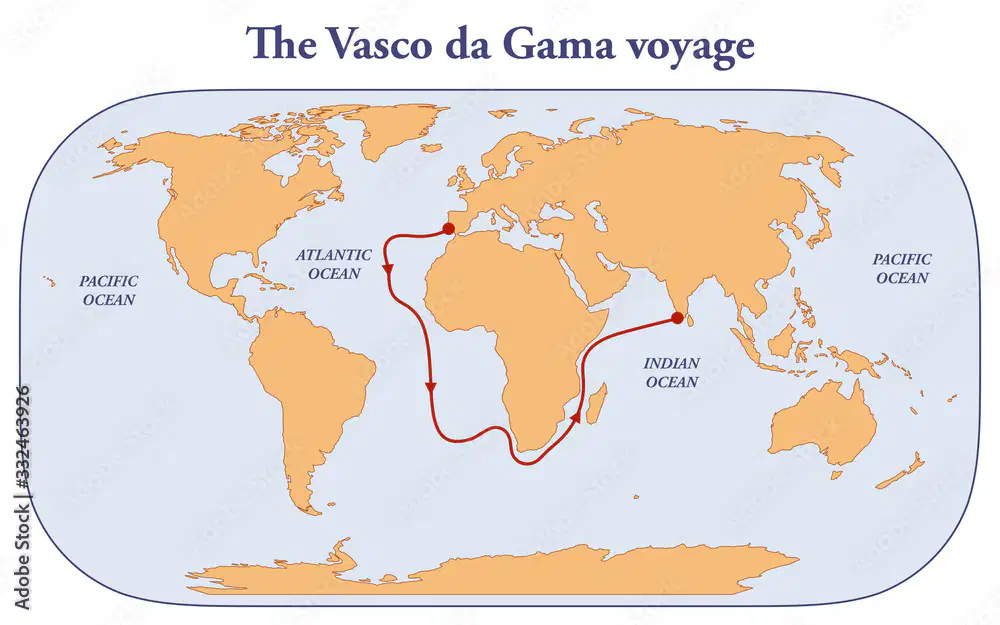
What year did Vasco Digamma start his voyage ?

a)
1492
b)
1497
c)
1505
d)
1510
40.
What were the three reasons for European exploration?
a)
Game, God, Glory
b)
Glory, Fame, and God
c)
God, Glory, and Gold
d)
Gifts, Greatness, Glory
41.
As a result of the Columbian exchange, which disease wiped out the majority of natives? 
a)
Black Plague
b)
Whooping Cough
c)
Smallpox
d)
Measles
42.
What was the purpose of European exploration?
a)
To find a sea route to Asia.
b)
To expand the Silk Road.
c)
To take back the Holy Land.
d)
To find a land route to Africa.
43.
Who was the first captain whose crew circumnavigated the globe?
a)
Vasco da Gama
b)
Ponce de Leon
c)
Christopher Columbus
d)
Ferdinand Magellan
44.
The trading of ideas, culture, people, goods, and diseases between Europe and the New world came to be known as...
a)
Triangular Trade.
b)
the Middle Passage.
c)
the Columbian Exchange.
d)
Mercantilism.
45.

This explorer, "discovered" America for Europe, and made 4 successful voyages to modern day Cuba. However, Vikings were there 1st.

a)

Christopher Columbus

b)

Ferdinand Magellan

c)

Bartholomew Dias

d)

Francisco Pizarro

46.

This famous Spanish conquistador conquered the Aztec civilization.

a)

Francisco Pizarro

b)

Hernan Cortez

c)

Amerigo Vespucci

d)

Christopher Columbus

47.

What is one result of the Columbian Exchange?

a)

Being able to eat a meal that includes ingredients from all over the world

b)

Christopher Columbus is known everywhere as a hero to everyone

c)

The thriving cultural and political success of the Native American population in our modern world

d)

The Columbian Exchange actually did not have an effect on the modern world at all

48.
The art and science of map making is called:
a)
cartography
b)
mapography
c)
quilting
d)
mapology
49.

Sailors used astrolabes to tell

a)

direction

b)

latitude

c)

speed

d)

longitude

50.
set the boundary established in 1493 to define Spanish and Portuguese possessions in the Americas.
a)
Treaty of Tordesillas
b)
Columbian Exchange
c)
Age of Exploration
d)
longhouses/plank houses
51.

Why did the conquistadors bring priests with them to the Americas?

a)

To help the Spaniards hold religious services

b)

To perform weddings between Spanish soldiers and native women

c)

To teach the Spanish soldiers about Christianity

d)

To convert the native peoples to Christianity

52.

Henry the Navigator set up a school for:

a)

doctors to learn about scurvy

b)

to train sailors

c)

learning to build boats

d)

learning new languages

53.

Which foods came from America?

a)

wheat and rice

b)

apples and grapes

c)

lettuce and cabbage

d)

potatoes and tomatoes

54.

Which of the following was a negative impact of the Columbian Exchange?

a)

Introduction of new crops to Europe

b)

Spread of diseases to the New World

c)

Exchange of cultural ideas

d)

Increased trade and commerce

55.

Who was the Spanish conquistador who conquered the Inca civilization?

a)

Francisco Pizarro

b)

Hernan Cortez

c)

Amerigo Vespucci

d)

Christopher Columbus

56.
What were the three reasons for European exploration?
a)
Game, God, Glory
b)
Glory, Fame, and God
c)
God, Glory, and Gold
d)
Gifts, Greatness, Glory
57.
As a result of the Columbian exchange, which disease wiped out the majority of natives? 
a)
Black Plague
b)
Whooping Cough
c)
Smallpox
d)
Measles
58.
What was the purpose of European exploration?
a)
To find a sea route to Asia.
b)
To expand the Silk Road.
c)
To take back the Holy Land.
d)
To find a land route to Africa.
59.
Who was the first captain whose crew circumnavigated the globe?
a)
Vasco da Gama
b)
Ponce de Leon
c)
Christopher Columbus
d)
Ferdinand Magellan
60.
The trading of ideas, culture, people, goods, and diseases between Europe and the New world came to be known as...
a)
Triangular Trade.
b)
the Middle Passage.
c)
the Columbian Exchange.
d)
Mercantilism.
61.

This explorer, "discovered" America for Europe, and made 4 successful voyages to modern day Cuba. However, Vikings were there 1st.

a)

Christopher Columbus

b)

Ferdinand Magellan

c)

Bartholomew Dias

d)

Francisco Pizarro

62.

This famous Spanish conquistador conquered the Aztec civilization.

a)

Francisco Pizarro

b)

Hernan Cortez

c)

Amerigo Vespucci

d)

Christopher Columbus

63.

What is one result of the Columbian Exchange?

a)

Being able to eat a meal that includes ingredients from all over the world

b)

Christopher Columbus is known everywhere as a hero to everyone

c)

The thriving cultural and political success of the Native American population in our modern world

d)

The Columbian Exchange actually did not have an effect on the modern world at all

64.
The art and science of map making is called:
a)
cartography
b)
mapography
c)
quilting
d)
mapology
65.

Sailors used astrolabes to tell

a)

direction

b)

latitude

c)

speed

d)

longitude

66.
set the boundary established in 1493 to define Spanish and Portuguese possessions in the Americas.
a)
Treaty of Tordesillas
b)
Columbian Exchange
c)
Age of Exploration
d)
longhouses/plank houses
67.

Why did the conquistadors bring priests with them to the Americas?

a)

To help the Spaniards hold religious services

b)

To perform weddings between Spanish soldiers and native women

c)

To teach the Spanish soldiers about Christianity

d)

To convert the native peoples to Christianity

68.

Henry the Navigator set up a school for:

a)

doctors to learn about scurvy

b)

to train sailors

c)

learning to build boats

d)

learning new languages

69.

Which foods came from America?

a)

wheat and rice

b)

apples and grapes

c)

lettuce and cabbage

d)

potatoes and tomatoes

70.

Which of the following was a negative impact of the Columbian Exchange?

a)

Introduction of new crops to Europe

b)

Spread of diseases to the New World

c)

Exchange of cultural ideas

d)

Increased trade and commerce

71.

Who was the Spanish conquistador who conquered the Inca civilization?

a)

Francisco Pizarro

b)

Hernan Cortez

c)

Amerigo Vespucci

d)

Christopher Columbus
