
 Worksheets
Ch 7/8 Test
Total questions: 45
Worksheet time: 23mins
Name
Class
Date
1.
1. Spanish soldier who participated in conquest of indigenous peoples of Mexico.
a)
Mestizo
b)
Vertical Climate Zone
c)
Conquistadors
d)
Archipelagos
2.
2. A climate area that occurs as elevation increases, with its own natural vegetation and crops
a)
Mestizo
b)
Conquistadors
c)
Vertical Climate Zone
d)
Archipelagos
3.
3. The loss or destruction of woodlands, mainly for logging or farming
a)
Deforestation
b)
Land Subsidence
c)
Vertical Climate Zone
d)
Archipelagos
4.
4. A city that dominates a country’s economy, culture, and government
a)
Archipelago
b)
Primate City
c)
Capital
d)
Isthmus
5.
5. A person of mixed indigenous and European descent
a)
Toro
b)
Matador
c)
Conquistador
d)
Mestizo
6.
6. A great city that is made up of several large and smaller cities
a)
Capital
b)
Mega City
c)
Country
d)
Continent
7.
7. The combining of beliefs and practices from different religions.
a)
Syncretism
b)
Monotheism
c)
Polytheism
d)
Judaism
8.
8. A strip of land that connects two larger landmasses, enabling the migration of plants and animals.
a)
Island
b)
Land-bridge
c)
Peninsula
d)
Mountain
9.
9. Technological and economic growth that does not deplete the human and natural resources of a given area.
a)
Free Trade Zone
b)
Sustainable Development
c)
Seismic
d)
Land Subsidence
10.
10. A group or a chain of islands
a)
Sustainable Development
b)
Archipelagos
c)
Free Trade Zone
d)
Isthmus
11.
11. Movement relating to or caused by an earthquake
a)
Sustainable Development
b)
Archipelagos
c)
Seismic
d)
Toxic Development
12.
12. The sinking or settling of land to a lower level in response to various natural and human-caused factors
a)
Land Subsidence
b)
Sustainable Development
c)
Seismic
d)
Free Trade Zone
13.
13. An area of a country in which trade restrictions do not apply
a)
Land Subsidence
b)
American Protectorate
c)
Free Trade Zone
d)
Isthmus
14.
14. A narrow strip of land connecting two larger land areas
a)
Mega City
b)
Land-Link
c)
Isthmus
d)
Primate City
15.
15. Why is Mexico City considered a primate city?
a)
A. It is a primary destination for immigrants in Mexico
b)
B. It is the largest city and the political, cultural, and economic center of Mexico
c)
C. It is the capital city
d)
D. It is the most populous city in North America
16.
16. What resource is Mexico the world’s leading producer?
a)
A.silver
b)
B.petroleum
c)
C.timber
d)
D. agriculture
17.
17. Mexico is part of a _______________________ that connects North America and South America
a)
A. crossroads
b)
B. canal
c)
C. steppe
d)
D. land bridge
18.
18. In Mexico, many people live with their ___________, which includes different generations of a family, as well as cousins and relatives.
a)
A. blended family
b)
B. nuclear family
c)
C. heterogamous family
d)
D. extended family
19.
19. If someone is called a mestizo, they are descendants of what two groups?
a)
A. French and Spanish
b)
B. German and English
c)
C.European and indigenous
d)
D. European and American
20.
20. Why does 50% of Mexico’s population live in poverty?
a)
A.The population struggles to find basic resources
b)
B. There are no resources feeding into the economy
c)
C.Immigrants took most of the jobs available
d)
D. none of these
21.
21. What two large landmasses does the region of Central America connect?
a)
A. North America and South America
b)
B. Mexico and Brazil
c)
C. Honduras and Panama
d)
D. Mexico and Venezuela
22.
22. Why are inland lakes and waterways important for Central America’s growth and development?
a)
A. provides transportation
b)
B. provides drinking water
c)
C.hydroelectric power
d)
D. All of these
23.
23. Why is the Panama Canal one of the most important human-made waterways?
a)
A. increases international trade
b)
B. allows for ships to travel between oceans
c)
C. it provides drinking water for the country of Panama
d)
D. Both A and B
24.
24. __________ are large agricultural estates, ________ are small family farms
a)
A. minifundia;latifundia
b)
B. haciendas; plantations
c)
C. Latifundias; minifundia
d)
D. Plantations; haciendas
25.
25. Since 1900, why have a number of people migrated away from Central America?
a)
A. resources and cities growing
b)
B. there are job opportunities elsewhere
c)
C. civil wars, poor economies, and instability
d)
D. problems concerning pollution
26.
26. What has rapid population growth resulted in for Central America and the Caribbean cities?
a)
A. pollution and lack of housing
b)
B. corrupt government
c)
C. strained resources like food and water
d)
D. Both A and C
27.
27. Where is the most popular living area in Mexico?
a)
A. Near the U.S. border
b)
B. Mexican Plateau
c)
C. Sierra Madre Oriental
d)
D. Sierra Madre Occidental
28.
28. What type of government does Mexico have today?
a)
A. federal republic
b)
B. constitutional monarchy
c)
C. communist
d)
D. socialist
29.
29. Household made up of several generations
a)
Homogenous Family
b)
Large Family
c)
Extended Family
d)
Bilateral Family
30.
30. the sum of factors within a population that reduce the ability of an environment to support the population
a)
Population Demand
b)
Pressure Storm
c)
Population Pressure
d)
Resource Abundance
31.
31.in Latin America, large agricultural estates owned by families and corporations
a)
Minifundia
b)
Latifundia
c)
Estados Mejor
d)
Estados Minor
32.
32. small farms that produce food chiefly for family use
a)
Latifundia
b)
Estados Mejor
c)
Minifundia
d)
Estados Minor
33.
33. the practice and business of recreational travel based on concern for the environment
a)
Ecotourism
b)
Biodiversity
c)
Archipelagos
d)
Land Subsidence
34.
34. A manufacturing company owned by a foreign country
a)
Latifundia
b)
Minifundia
c)
Estado Mejor
d)
Maquiladora
35.
35. One of the most important human-made waterways that helps to make trade more efficient.
a)
Mexican Plateau
b)
Caribbean Land bridge
c)
Panama Canal
d)
Hudson River
36.
36. Local form of a language used in a particular place or by a group of people
a)
Patois
b)
Maquiladora
c)
Dialect
d)
Jargon
37.
37. A dialect used in everyday speech that blends elements of different languages
a)
Dialect
b)
Patois
c)
Jargon
d)
Simile
38.
38. Large variety of plant and animal species in an environment
a)
Biodiversity
b)
Environmental Spread
c)
Bioethics
d)
Environmental Mix
39.

39. Name the corresponding Country
a)
Honduras
b)
Guatemala
c)
Panama
d)
Nicaragua
40.
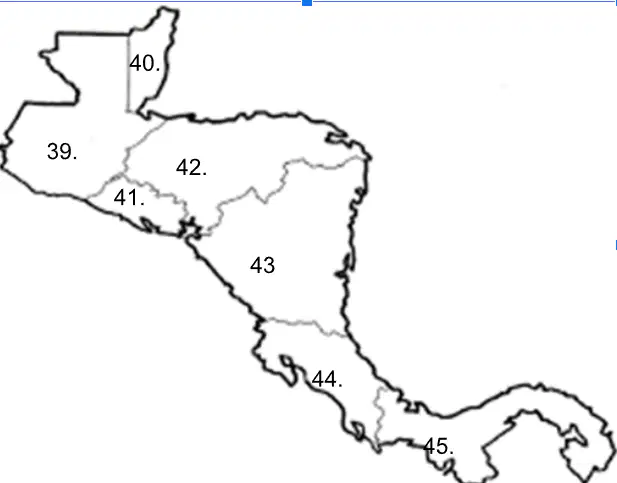
40. Name the corresponding Country
a)
Belize
b)
Guatemala
c)
Honduras
d)
Costa Rica
41.
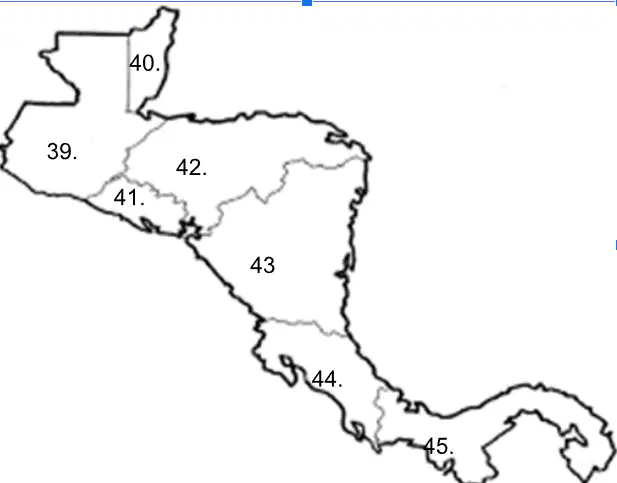
41. Name the corresponding Country
a)
Honduras
b)
Panama
c)
El Salvador
d)
Costa Rica
42.
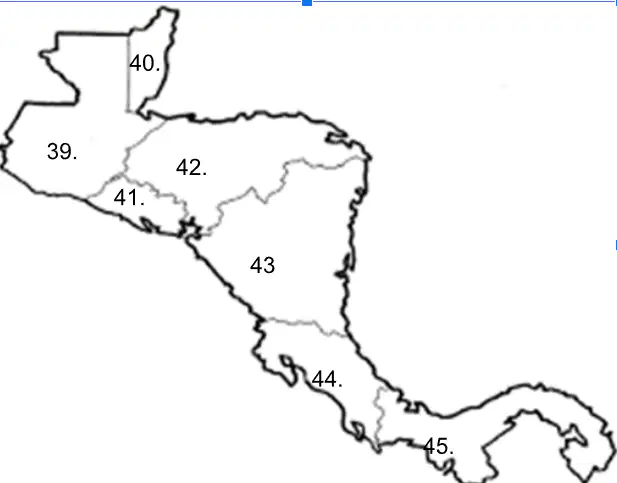
42. Name the corresponding Country
a)
Nicaragua
b)
Honduras
c)
El Salvador
d)
Panama
43.
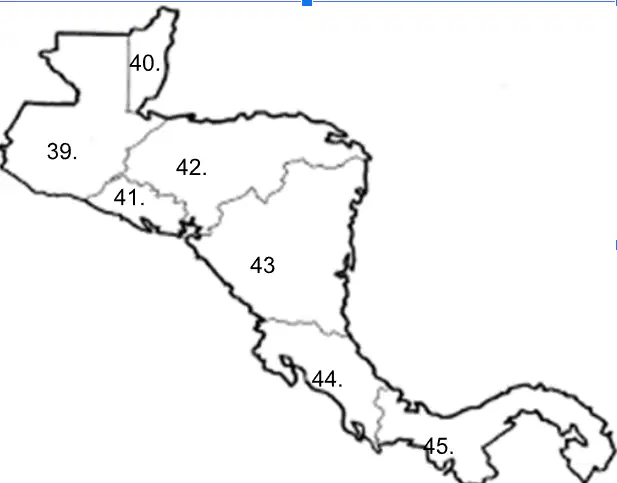
43. Name the Corresponding Country
a)
Panama
b)
El Salvador
c)
Costa Rica
d)
Nicaragua
44.
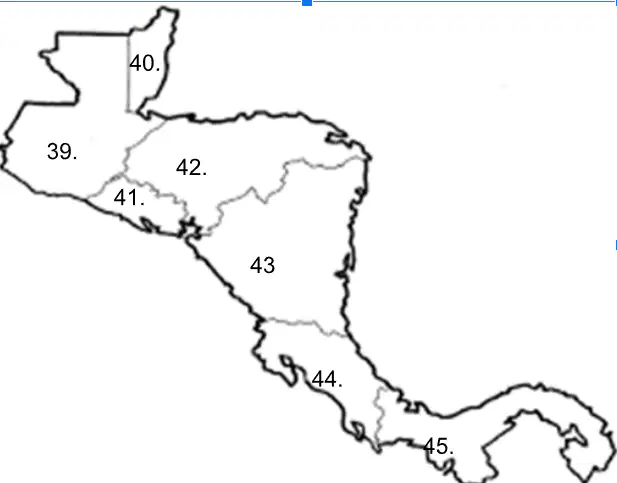
44. Name the corresponding Country
a)
Costa Rica
b)
Panama
c)
Belize
d)
Honduras
45.
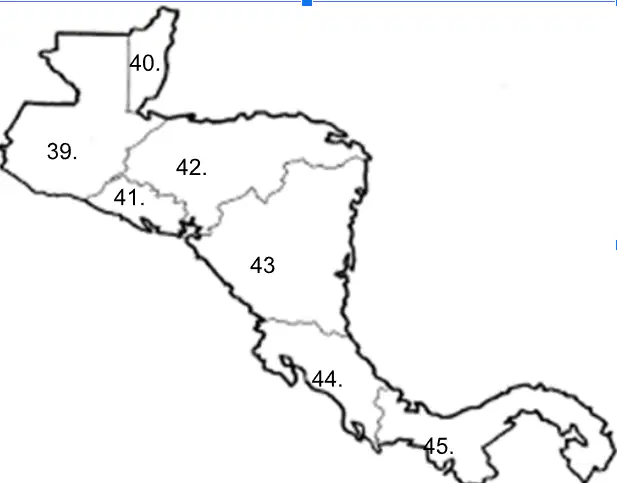
45. Name the corresponding Country
a)
Guatemala
b)
Nicaragua
c)
Panama
d)
Belize
100 %

