
 Worksheets
G5-T1-Review HW
Total questions: 50
Worksheet time: 50mins
What are the two main types of light sources?
Static and dynamic light sources
Natural light sources and artificial light sources
Incandescent and fluorescent light sources
Solar and lunar light sources
Define transparent materials and give an example.
Wood
Glass
Plastic
Metal
What is the difference between translucent and opaque materials?
Translucent materials are completely transparent; opaque materials are slightly see-through.
Translucent materials allow partial light transmission; opaque materials block all light.
Translucent materials block all light; opaque materials allow partial light transmission.
Translucent materials reflect all light; opaque materials absorb all light.
How does light travel through different materials?
Light travels through materials by refraction in transparent substances and by absorption or reflection in opaque substances.
Light travels faster in opaque materials than in transparent ones.
Light cannot pass through any material without being absorbed.
Light travels only in straight lines regardless of the material.
What is the best scientific description for a shadow?
someone that follows you around
a bright spot behind an object
light that bounces back behind an object
a dark area or shape produced by a body coming between rays of light and a surface
What happens to light when it hits a mirror?
Light reflects off the surface.
Light passes through the surface.
Light bends at the surface.
Light is absorbed by the surface.
Can you name a natural source of light?
A flashlight
A light bulb
The sun
Fireflies
What is a periscope and how does it use light?
A periscope is a device that emits sound waves for navigation.
A periscope uses lenses to magnify images.
A periscope is an optical device that uses mirrors to reflect light, allowing observation from a hidden position.
What experiment can you conduct to observe light reflection?
Shine a flashlight at a mirror and observe the reflected light.
Turn on a lamp and watch the shadows it creates.
Fill a glass with water and look at the bottom.
Place a plant in sunlight and observe its growth.
What is the phenomenon called when light changes direction as it passes from one medium to another?
Reflection
Refraction
Diffraction
Dispersion
What is the effect of a prism on white light?
A prism reflects white light without changing it.
A prism disperses white light into its component colors.
A prism absorbs all colors of light.
A prism only allows red light to pass through.
What do we call a surface that REFLECTS light well?
Translucent surface
Mirror or any shiny surface
Opaque surface
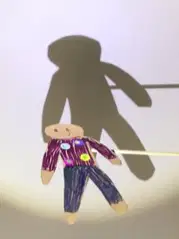
What is created when light is blocked by an object?
Shadow
Reflection
Light beam
How does light travel?
Light travels in circles
Light travels in waves
Light travels in straight lines
A material that does not allow light to pass through it is known as:
transparent
refractive
translucent
opaque

What causes the formation of a rainbow?
Light travels in a straight line
Reflection of light
Refraction of light
Light in bounced in two different mediums
A solid wood door is an example of what kind of object.
transparent
translucent
opaque

This investigation is carried out to show that
light travels in a straight line
light can be seen through the holes
light penetrates a transparent object
light travels in many ways

How to increase the size of the shadow on the screen?
Move the light source farther from the object
Move the object closer to the screen
Change the type of object used
Move the object closer to the light source

The following diagram shows a driver who could see the image of a vehicle behind him without turning his back.
Why?
Light travels in a straight line
Light is refracted
Light is reflected
Light travels in two different mediums
How many components of white light?
5
6
7
8
We are able to see the moon because it ____________
gives out light
glows
reflects light from the sun
reflects light from the earth
What color does a red object appear when viewed through a red filter?
yellow
red
green
blue
What color does a green object appear when viewed through a red filter?
black
green
blue
red
Which of these is NOT correct about light?
Light travels in a straight line.
The speed of light is the fastest in the entire universe.
Light bends while changing the medium through which it is passing
Light can pass through all objects

Which two parts control the amount of light entering your eye?
lens and cornea
cornea and pupil
pupil and iris
retina and optic nerve

When light hits a barrier that is solid/opaque what is usually created?
a hot object
a shadow
nothing
When the Sun is behind you, your shadow is ...
behind you
in front of you
at the side of you
not there
When an object moves closer to a light source, its shadow...
Gets smaller
Gets bigger
Changes shape
Stays the same size
Shadows are longest during _______.
morning and evening
noon
night

Where will the tree's shadow be?
A
B
C
which of these are required to form the shadow of a ball
Torch
Ball
Screen
All of these
Image formed in a pinhole camera is always
Erect
Inverted
Parallel
None of these
What does reflection mean?
Light bouncing off an object.
Light is bending around an object.
Light is moving through and object.
This is no light.
There is light on the Earth even on a dark, cloudy day. This is because clouds are:
Opaque
Translucent
Transparent
Luminous
Which of the following properties are used while using the periscope ?
gravitational force
reflection of light
property of lights and beams
None of these

A student placed a pencil in a cup of water. The pencil appears broken because light
always travels in a straight line.
bends when it passes through water.
makes the water in the glass evaporate.
reflects the pencil on the water's surface.
What do we call a material that light can travel through?
air
water
medium
pathway
When does the light is refracted?
When light travels in a straight line
When light is bounced
When light travels in two different mediums
When light cannot pass through an opaque object
What causes the formation of a rainbow?
Light travels in a straight line
Reflection of light
Refraction of light
Light in bounced in two different mediums

Which of the following shows that light travels in a straight line? Tick the correct answers.
A
B
C
D
E

Which of the following shows the principle of light refraction? Tick the correct answers.
A
B
D
E
F

Which of the following shows the principle of light reflection? Tick the correct answers.
A
B
D
E
F


