
 Worksheets
Unit 3 - Biosphere
Total questions: 36
Worksheet time: 18mins
Name
Class
Date
1.
Which interaction of a biotic and an abiotic factor can help stabilize a forest area in North Carolina?
a)
increased precipitation, reducing soil erosion in the area
b)
increased decaying organic material, adding nutrients to soil in the area
c)
decreased water salinity, reducing biodiversity of animals in the area
d)
decreased number of predators, allowing the number of prey to increase in the area
2.
What can scientists infer from a pattern of narrow tree rings over several consecutive years?
a)
A period of excessive rainfall
b)
A period of drought or lower than average rainfall
c)
An increase in atmospheric carbon dioxide
d)
A rise in average global temperatures
3.
3)Which foods are derived from organisms that occupy the level that contains the greatest amount of energy in a biomass pyramid?
a)
shrimp and rice
b)
chicken and lettuce
c)
bread and tomatoes
d)
hamburger and french fries
4.

The red dots in the image below represent the concentration of Mercury in parts per million (ppm). This image is a representation of which concept?
a)
Trophic level
b)
Poisoning
c)
Biomagnification
d)
Biodiversity
5.
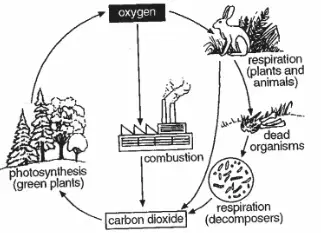
11)Which statement is best supported by the diagram below of the carbon-oxygen cycle?
a)
Producers generate oxygen and utilize carbon dioxide
b)
Decomposers add oxygen to the atmosphere and remove carbon dioxide
c)
Consumers generate oxygen and utilize carbon dioxide
d)
Combustion adds oxygen to the atmosphere and removes carbon dioxide
6.
30. The characteristics of some organisms are listed below.
trout = carnivorous fish
minnow = herbivorous fish
algae = producers
osprey = large carnivorous birds
bacteria = decomposers
Based on the information given above, which food chain is most probable?
a)
bacteria ---> algae ---> trout ---> minnow ---> osprey
b)
minnow ---> algae ---> trout ---> bacteria ---> osprey
c)
algae ---> minnow ---> trout ---> osprey ---> bacteria
d)
trout ---> osprey ---> algae ---> minnow ---> bacteria
7.

Greenscape Valley, a once lush and thriving ecosystem, is devastated by a volcanic eruption. The eruption covers the valley in a thick layer of volcanic rock and ash, wiping out all previous vegetation and leaving the landscape barren and lifeless.
What does the image represent in terms of ecological processes?
a)
The life cycle of a plant
b)
The seasonal changes in a forest
c)
The stages of primary succession
d)
The stages of secondary succession
8.
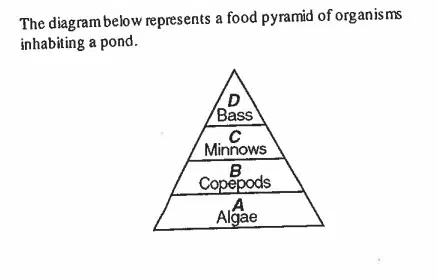
37) At which level of the food pyramid is the smallest percentage of total stored energy found?
a)
A) A
b)
B) B
c)
C) C
d)
D) D
9.
Biomes include both biotic and abiotic elements. Which set includes BOTH biotic and abiotic elements of an estuary?
a)
cordgrass, water salinity, great blue herons
b)
ospreys, oysters, black needle rush
c)
silt, air temperature, tidal pattern
d)
periwinkles, bats, egrets
10.

The table lists some ways that plants have adapted to survive in a desert biome. Which statements describe adaptations to biotic factors in a plant’s desert biome?
a)
1 and 2
b)
1 and 3
c)
2 and 4
d)
3 and 4
11.
Which biomes are found in temperate latitudes?
a)
they are at different altitudes
b)
they are at different latitudes
c)
the forest gets more precipitation
d)
the grassland gets more precipitation
12.
Which of the following would be most effective in slowing the loss of biodiversity?
a)
Creating large parks/preserves in biodiversity hotspots
b)
Requiring every country to maintain a seed bank
13.
The variety of life in the world or in a particular habitat or ecosystem
a)
Biodiversity
b)
Carrying capacity
c)
Demography
d)
Poaching
14.
Many synthetic chemicals, such as PCBs, act as estrogen mimics. These chemicals are persistent, meaning that they build up in the ecosystem and an organism's body and do not disappear or go away over time.
In an ecosystem, these persistent chemicals would have the greatest effect on which of the following?
a)
Producers
b)
Plants
c)
Primary consumers
d)
Secondary consumers
15.
Which habitat exhibits the greatest biodiversity?
a)
A habitat with 15 different species with about 300 individuals each
b)
A habitat with 10 different species with about 75 individuals each
16.

Biodiversity is important to keep an area (biome) healthy. In this example, "Food Web A" is sustainable. Why is sustainability important for an ecosystem in "Food Web A"?
a)
If one organism is removed from the food web, it can still operate (work) with little or no negative effect.
b)
If an organism is removed from the food web, it will collapse and will affect the environment.
17.
What level of biodiversity is most commonly equated with the overall concept of biodiversity?
a)
Genetic
b)
Species
c)
Ecosystem
18.
Why is biodiversity important to ecosystems?
a)
It helps populations adapt to ecological changes
b)
It increases at each level of the food chain
19.
Some toxic compounds are ingested and retained in the tissues. These pollutants pose special risks to humans and other organisms high on the food chain because of which process?
a)
Synergism
b)
Biomagnification
c)
Threshold effect
d)
Compound contamination
20.
Which of the following is true of carbon as it cycles in nature?
a)
Carbon dioxide is released during photosynthesis.
b)
Carbon compounds rarely exist in the gaseous state.
c)
Carbon sinks include forests and oceans.
d)
The carbon dioxide concentration in the atmosphere is reduced by cutting trees
21.
Trees are carbon sinks, because they absorb and store carbon dioxide from the atmosphere during photosynthesis. Burning large stands of rainforest not only reduces the amount of photosynthesis on Earth, but it releases carbon back into the atmosphere as carbon dioxide gas.
Carbon dioxide levels in the ocean are directly correlated to carbon dioxide levels in the atmosphere. What would be the MOST likely effect of burning large
a)
The ocean water would become more alkaline.
b)
The ocean water would become more acidic.
c)
The ocean water would dissolve gases more easily.
d)
The ocean water would dissolve gases less easily.
22.
The Eruption of a large volcano on a tropical island releases ash and gases into the atmosphere. After the eruption, the air temperatures on the island cool temporarily before returning to normal. Which is the most likely reason for the temporary cooling of the island?
a)
Water vapor condenses and causes precipitation.
b)
Large particles of ash blanket the ground surface.
c)
Fine particles of atmospheric dust block sunlight.
d)
Carbon dioxide levels increase in the atmosphere.
23.
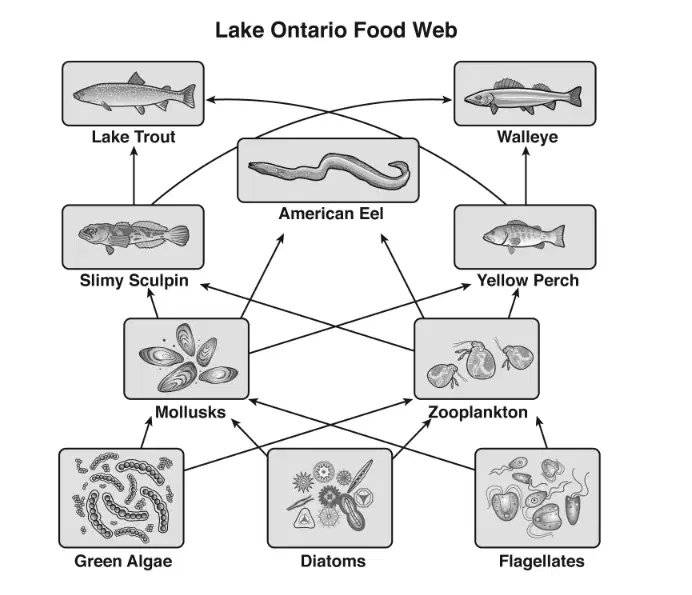
The food web below shows the feeding relationships among some of the organisms that live in Lake Ontario.
If the population of walleye in Lake Ontario decreased due to disease, which of these populations would also be MOST likely to decrease?
a)
diatoms
b)
slimy sculpin
c)
mollusks
d)
american eel
24.

The data table below shows plant biodiversity of different ecosystems in Glacier National Park. In parts of the park, the glacier is receding leading to succession.
Based on the data in the table, which ecosystem is in the earliest stages of succession?
a)
Ecosystem A
b)
Ecosystem B
c)
Ecosystem C
d)
Ecosystem D
25.
You are an ecologist studying a forest ecosystem. Your research involves analyzing the different levels of the ecosystem hierarchy, from individual organisms to the entire biosphere. You need to document interactions at each level. Which of the following sequences correctly represents the hierarchical organization from the most specific to the most inclusive level?
a)
Ecosystem, Community, Population, Organism, Biosphere
b)
Organism, Population, Community, Ecosystem, Biosphere
c)
Biosphere, Ecosystem, Community, Population, Organism
d)
Population, Community, Organism, Ecosystem, Biosphere
26.
How can changes in nitrate and phosphate levels affect water quality and biodiversity in aquatic ecosystems?
a)
Increased levels of nitrates and phosphates can decrease plant growth and reduce oxygen levels, leading to higher biodiversity.
b)
Increased levels of nitrates and phosphates can cause eutrophication, leading to algal blooms that deplete oxygen in the water, resulting in decreased biodiversity.
c)
Decreased levels of nitrates and phosphates can cause eutrophication, leading to algal blooms that increase oxygen in the water, resulting in higher biodiversity.
d)
Increased levels of nitrates and phosphates have no significant impact on water quality and biodiversity in aquatic ecosystems.
27.
Which biome is characterized by low rainfall, high temperatures, and vegetation like cacti and succulents?
a)
Tundra
b)
Desert
c)
Rainforest
d)
Grassland
28.
Which biome experiences permafrost and strong winds as key abiotic factors?
a)
Tundra
b)
Desert
c)
Rainforest
d)
Taiga
29.
Which of the biomes would be located in the temperate zone?
a)
Tundra
b)
Rainforest
c)
Taiga
d)
Grassland
30.
Which of the following data sources is most commonly used to determine past climate trends over thousands of years?
a)
Satellite imagery
b)
Ice core samples
c)
Ocean temperature readings
d)
thermometers
31.
Which process in the diagram removes CO₂ from the atmosphere?
a)
Plant respiration
b)
Photosynthesis by producers
c)
Fossil fuel combustion
d)
Animal respiration
32.
What happens to carbon when fossil fuels are combusted, according to the diagram?
a)
It is fixed by consumers
b)
It is released into the atmosphere as CO₂
c)
It is used by plants for photosynthesis
d)
It is absorbed by the oceans
33.
How do animals contribute to the carbon cycle based on the diagram?
a)
By performing photosynthesis
b)
By fixing carbon in their tissues
c)
By producing fossil fuels
d)
By releasing CO₂ through respiration
34.
Which of the following includes ONLY carbon reservoirs?
a)
atmosphere, oceans and fossil fuels
b)
atmosphere, photosynthesis and combustion
c)
Cellular respiration, photosynthesis and decomposition
d)
Carbon dioxide, soil, ecosystems
35.
Why is biodiversity important for ecosystems?
a)
It increases the number of predators in an ecosystem.
b)
It ensures the survival of only the fittest species.
c)
It helps ecosystems remain resilient and productive by providing a variety of genes and species that contribute to ecosystem stability and function.
d)
It reduces competition among species.
36.
Which of the following are all major threats to biodiversity?
a)
Endemic species, predators, keystone species
b)
Invasive species, habitat loss, survival of the fittest
c)
Habitat destruction, invasive species, habitat fragmentation
d)
Anthropomorphic sources, endangered species, fossil fuels
100 %

