
 Worksheets
untitled
Total questions: 45
Worksheet time: 29mins
During photosynthesis, the light-dependent phase only takes place in the presence of light and the dark phase, also known as the light-independent phase, only takes place in the absence of light.
True
False
Which of the following is not an example of a way in which ATP is used?
ATP provides energy for the beating of cilia and flagella, which are the hair-like organelles found in some microorganisms that help with movement or mobility.
ATP is used for the breaking down of macromolecules such as nucleic acids, proteins and fats.
ATP is used for active transport or movement of substances across cell membranes.
ATP is used in animals for the contraction of muscle cells.
With low levels of light, a plant cannot photosynthesise, even if there is plenty of water and carbon dioxide available.
True
False
Which of the following is the correct equation for PHOTOSYNTHESIS?
CO2 + H2O + light --> Sugar + O2
CO2 + sugar + H2O --> O2 + light
O2 + H2O + light --> CO2 + Sugar
CO2 + O2 + H2O --> light + Sugar
All living things do which of the following?
photosynthesis
cell respiration
What is a high energy molecule with 3 phosphates?
ATP
ADP
ribose
adenine
What are the products of the light DEPENDENT reactions?
Glucose and Oxygen
NADPH/ATP and Oxygen
Glucose and Carbon Dioxide
NADP+/ADP and Glucose
Where do the light-dependent reactions occur?
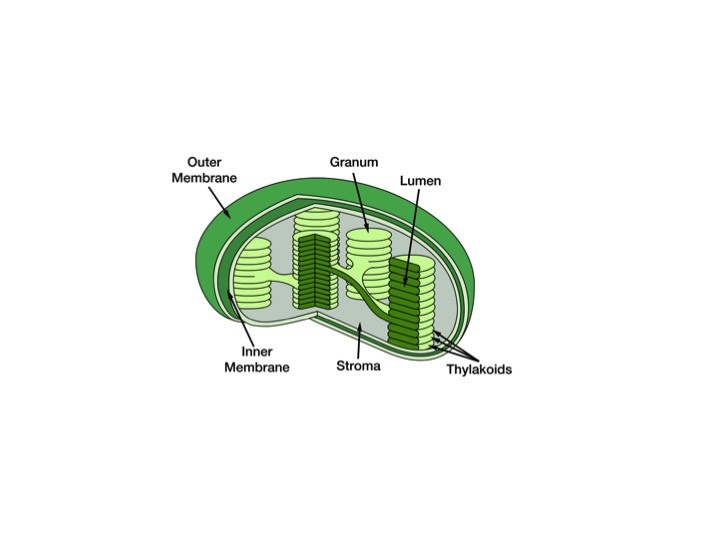
thylakoid
stroma
mesophyll
mitochondria
ATP is used as...
The building block of proteins
An energy source for diffusion
The building block of DNA and RNA molecules
An energy source for cell processes
Chloroplasts in a plant cell contain a light absorbing molecule called what?
Stroma
Carotenoid
Chloroplast
Chlorophyll
Plants absorb green light.
True
False
What are stacks of flattened sacs that contain the pigment chlorophyll called?
Stroma
Thylakoids
Chemiosmosis
Chlorophyll
In addition to sunlight, what else is required for photosynthesis to take place?
Sugar and water
Water and oxygen
Oxygen and Carbon Dioxide
Carbon Dioxide and Water
What are the products of the light INDEPENDENT reactions?
Glucose and Oxygen
NADPH/ATP and Oxygen
Glucose and Carbon Dioxide
NADP+/ADP and Glucose
Where do the light-independent reactions occur?
thylakoid
stroma
mesophyll
mitochondria
Energy is released from ATP when...
a phosphate group is added
adenine bonds to ribose
ATP is exposed to sunlight
a phosphate group is removed
Which of the following is the correct structure of ATP?


Using the figure, between which two parts of the molecule must the bonds be broken to form an ADP molecule?
A and B
B and C
C and D
all of the above
What is a low energy molecule with 2 phosphates?
ATP
ADP
Ribose
Adenine


Which bond of the ATP molecule is broken in order to release energy?
A
B
C
D

What substance helps in removing a phosphate?
Adenosine
Water
Hydrogen
Phosphates


An enzyme that has a channel through which the H+ flows back out of the thylakoids.
ATP synthase
ADP catalazye
thylakoidase
photosystems
Two groups of molecules, photosystem 1 and photosystem 2, that absorbs light during the light-dependent reactions.
photosynthesis
photosystems
light reactions
light independent reactions
A chain of proteins in the thylakoid membranes that moves electrons. The electrons have energy that helps pump hydrogen ions into the thylakoids.
electron disappearing chain
electron transport chain
electron creating chain
electron hydrogen chain
This is a molecule that is similar to ATP
NADPH
NADP+
NADPY
ATP-Y
Red and blue light support the highest rates of photosynthesis because …
Chlorophylls absorb light of these wavelengths more than other wavelengths.
These are the only wavelengths that carotenoids cannot absorb.
Light of these wavelengths have the highest energy in the visible spectrum.
Light of these wavelengths activate the ATP synthase enzyme.
The role of water molecule in light dependent reaction is to …
Hydrolyse NADP+ at the end of the electron transport chain.
Involve directly in the production of ATP.
Replace the excited electron of reaction centre molecule in photosystem II.
Involve directly in Calvin cycle.
Which of the following are products of the light reactions of photosynthesis that are utilised in the Calvin cycle?
Electrons and H+
CO2 and glucose
ATP and NADPH
ADP, Pi and NADPH

