
 Worksheets
Pollution air water land noise
Total questions: 92
Worksheet time: 1hrs 1mins
How much of the world's forest have been destroyed?
50%
15%
90%
80%
Recycling doesn't help stop soil pollution
TRUE
FALSE
Soil pollution refers to the contamination of soil with abnormal concentration of:
toxic substances
oxygen
land
What gas does garbage release when it is buried?
Carbon dioxide
Oxygen
Methane
What is an effect of land pollution?
no clean drinking water
loss of habitat for animals
diseases from breathing in poor quality air
What is the largest cause of land pollution?
Animal waste
Plants decomposing
Human actions
The CAUSES of desertification are:
drought
overgrazing
human environment interaction such as deforestation
all of the above
What is an effect of land pollution?
no clean drinking water
loss of land for human habitation
diseases from breathing in poor quality air
damage to the ear drums
Which of the following causes land pollution?
Rainfall
Increase in greenhouse gases
Afforestation
Human sewage
Which serious health problem could be caused due to long term exposure to contaminated soil?
skin diseases
cancer
respiratory problems
None of the above
Which of the following is a biodegradable waste?
food scraps
plastic
steel
Styrofoam
What is the main example of land pollution?
Soil Erosion
Earthquake
Volcano Eruptions
Floods
Which human action can cause pollution?
Walking
Biking
Mining
Recycling
The CAUSES of desertification are:
drought
overgrazing
human environment interaction such as deforestation
all of the above
How do landfills effect the environment?
Landfills cause fish to be poisoned and die
Landfills support plant growth and heatlhy soil
Lanfills cause smog in the air
Landfills cause chemicals from trash to absorb into the soil and harm plants
The illegal dumping or littering of waste onto the land is called __________ pollution.
Air
Land
Water
Which is the most harmful form of land pollution?
Plastic
Paper
Branches and leaves
Food waste
What is a landfill?
A place for people to recycle
A place where people's trash is taken
A place where oil spills begin
A type of factory
The atmosphere is neutrally stable under the condition of
a) ELR>ALR
b) ELR<ALR
c) ELR=ALR
d) none of the above
Full
form of PAN is ,
a) Permanent Account Number
b) Peroxy Acetyl Nitrate,
c)
Peroxy Alkyl Nitrate,
d) None of the above
Which one is not a primary pollutant?
a) O3,
b) CO2
c) NO2
d) SO2
During temperature inversion
a) Temperature decreases with altitude
b) Temperature increases with altitude
c) Temperature remains same
d) none of these.
Which pollutant combines with hemoglobin to inhibit carrying of oxygen?
a)CO
b) NO
c) CO2
d) SO2
Ozone is a pollutant when present in
a) troposphere
b) stratosphere
c) mesosphere
d) thermosphere
Which one is a greenhouse gas?
a) CO
b) H2O (vapour),
c)NO2,
d) SO2
Air pollution causes all of the following, except
holes in the ozone layer
increased particles in the air
acid rain
healthy air to breath
smog
Natural causes of air pollution include all of the following
forest fires
dust
volcanic ash
wind
pollen
A radioactive gas that can build up in homes.
uranium
helium
oxygen
radon
Exposure to too much radon gas can cause
lung cancer
sun burn
blindness
acne
Radon is usually found in this location in your home.
attic
basement
bathroom
kitchen
How do humans cause air pollution?
plowing of fields
burning fossil fuels (coal, oil)
using solar power
driving electric cars
What is the main cause of air pollution?
plowing fields and releasing dust
using solar power
burning fossil fuels
using water power
Climate change caused by extra carbon dioxide in the air that causes heat to get trapped in the atmosphere is called
global warming
photosynthesis
smog
Gases released from power plants mix with water vapor in the sky to make ________________.
smog
acid rain
global warming
particulate matter
A mixture of smoke, fog and chemicals in the air is known as ________.
oxygen
radiation
smog
What are ways that we can decrease air pollution?
carpool
conserving electricity
follow laws made by the EPA
burning extra fossil fuels

what is shown in the picture ?
dirty water
purified water
clean, purified water
none of these
What should we do to stop water pollution ?
make more air pollution
use plastic bag
put oil and waste material in water
stop putting garbage waste material in water

What can you see in this picture ?
clean water
purified water
polluted, dirty water
none of these
How we can make the water more safe ?
by throwing plastic bottle in water
by throwing waste material in water
by telling everyone how to safe water
None of these
From which the water pollution can be decrease?
Throw garbage in the rivers
Using plastic
None of these
Avoid plastic
Which river is known as SNOW RIVER?
Yamuna river
Ganga river
Kaveri river
None of these
Which of the following are the primary causes of water pollution?
Plants
Human activities
Animals
None of these
Which of the following is mainly responsible for the causes of water pollution?
Oil refineries
Afforestation
Paper factories
Both A and C
how to be safe form water pollution ?
by throwing garbage on the road even in water
by making the water more dirty
Skip the use of plastic
none of these
What is water pollution ?
clean water
healthy water
dirty and polluted water
none of these

Water pollution occurs when:
Harmful substances enter a water supply
Industries dispose of waste safely and correctly.
Industries cut costs with waste disposal.
None of the above.

We can prevent water pollution by:
Reduce the use of plastic.
Properly dispose of chemicals.
Clean up after your animals.
All of the above
What are the main sources of water pollution?
Plastic, Paper, and Metal
Snails in water
Help, there is a boot with a snake inside of it that somehow in the nearby lake.
Agriculture, Industry, and Community
Who does water pollution impact?
Shrek and his swamp
my water inside of my Fiji water bottle ಠ╭╮ಠ
Only us people
Everything on the planet
Animals only
Can be traced back to the point of origin.
Point Source Pollution
Non-point source pollution
Cannot easily be traced to the source of the pollution.
Point Source Pollution
Non-point source pollution

Pollution that comes from a single source
Point
Non-Point

Pollution that comes from MANY different places and is hard to identify its source.
Point
Non-Point
Which one of the following can cause thermal pollution?
Residential houses
Power plants
Death of marine organisms
Oil spill
Q7. What is soil erosion?
A naturally occurring process that affects all land forms
Type of soil
A time period
The wearing away of top soil
What are the common factors of soil erosion?
wind and water movements
plate tectonics
earthquakes
What is taken away during erosion?
soil
water
trees
How can planting trees prevent erosion?
Trees slow down the water cycle.
The leaves soak up all the water.
The roots hold on to the soil.
Trees don't actually prevent erosion.
How can farmers prevent/slow down soil erosion?
Cover their crops
Water the soil everyday in order to weigh it down
Plant crops, plants, etc. to hold the soil in place
Cut down all of the trees and crops.
Terrace farming is a method common in ______ region.
Forest
Mountain
Coastal
Plains
In eutrophication, what directly causes the death of fish?
The plants use up oxygen in respiration
The fish are poisoned by high CO2 levels
Bacteria use up oxygen in respiration
The fish use up oxygen in respiration
In eutrophication, what does 'algal bloom' refer to?
The rapid increase in the number of bacteria
The rapid increase in the number of plants
The rapid decrease in the number of fish
The rapid increase in the amount of nitrates in the river
Eutrophication is defined as a change that occurs to an aquatic ecosystem. This change is mainly due to what?
Newly introduced fish
Depletion of the ozone layer
Increased nutrient concentration
Increase in atmospheric carbon dioxide.
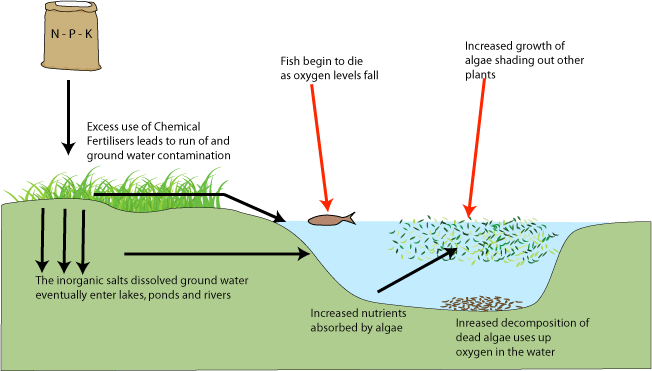
An increase in the amount of nutrients in a lake is known as
calcification
cellular respiration
eutrophication
photosynthesis
In a dead zone, _________ levels are really low such that living organisms are not able survive.
nitrogen
oxygen
fertilizer
carbon dioxide
When algae levels increase in a body of water, it
cuts off light to plants at the bottom.
increases light to the plants on the bottom.
causes dissolved Oxygen levels increase.
causes bacteria populations decrease.
How does low Dissolved Oxygen levels affect organisms?
Organisms may die or have to leave if levels get too low
Organisms go through more cellular respiration
Organisms eat more
Algae blooms will ____________ the amount of dissolved oxygen in an aquatic system.
Decrease
Increase
Which of the following best describes soil erosion
The breakdown of soil by chemicals
The breakdown of the soil by drought
The improvement of soil quality by fertilizers
The movement of soil by wind or water
What is the allowable daily noise exposure level?
85dB for 12 hours exposure
85dB for 8 hours exposure
45dB for 12 hours exposure
85dB for 8 hours exposure
What unit is noise pollution measure?
Hb
Db
dB
hB
A form of energy that is transmitted by pressure variations
Definition of sound
Definition of noise
Which one is use for noise monitoring?


What is noise?
Desirable sound
Desirable and unwanted sound
Undesirable and unwanted sound
Undesirable and wanted sound
In which unit sound is measured?
KiloMeter
Pascal
Decibel
Kilogram
Which pollution causes hearing loss in organisms?
Air pollution
Noise pollution
Water pollution
Soil pollution
Roadways noise can be reduced by:
Use of noise barriers
Limitation of vehicle speed
Alteration of roadway Surface texture
All of the above
Which disease can be caused by noise pollution?
Asthma
Brain tumour
Malaria
Blindness
What is one way to reduce noise pollution?
Go deaf
Use special glasses
You can’t reduce it
Mask noise by turning on fans
Does noise pollution affect humans?
Yes
No
Both
Planting of trees reduces noise pollution.
True
False
Both
The level at which sound becomes physically painful is:
Above 95 decibel
Above 65 decibel
Above 80 decibel
Above 60 decibel
Which of the following sound is pleasant to our ears?
Heavy machinery
Transportation equipment
Loud noise
Music

