
 Worksheets
Sound Energy Quiz Review
Total questions: 89
Worksheet time: 47mins
What type of wave is sound energy?
Transverse wave
Longitudinal wave
Electromagnetic wave
Surface wave
What are the areas of a medium with a high density of particles called?
Rarefactions
Compressions
Oscillations
Vibrations
What is required for a longitudinal wave to travel?
Vacuum
Medium
Light
Heat
What happens when a tuning fork's prongs vibrate?
It creates light waves
It disturbs air molecules, creating sound waves
It generates heat
It produces electromagnetic waves
What is the range of frequencies that the average human ear can hear?
20 Hz - 20,000 Hz
10 Hz - 15,000 Hz
30 Hz - 25,000 Hz
50 Hz - 30,000 Hz
What is the term for sound wave frequencies below 20 Hz?
Ultrasonic
Supersonic
Infrasonic
Subsonic
What is the term for sound wave frequencies above 20,000 Hz?
Ultrasonic
Supersonic
Infrasonic
Subsonic
What factor does the speed of a sound wave depend on?
The color of the medium
The medium and its temperature
The size of the sound wave
The distance from the source
Why do sound waves travel faster through solids than gases?
Solids are heavier
Molecules in solids are closer together
Solids are colder
Solids are more colorful
What type of waves radiate outward in all three dimensions from the source of the sound?
Longitudinal waves
Transverse waves
Spherical waves
Surface waves
What factors affect the speed of sound?
Temperature and medium
Color and shape
Volume and pitch
Distance and time
How is the speed of a wave measured?
In meters per second (m/s)
In kilometers per hour (km/h)
In feet per minute (ft/min)
In miles per hour (mph)
What does intensity refer to in terms of sound?
The speed of the sound wave
The perceived loudness of a sound
The frequency of the sound wave
The color of the sound wave
What is the speed of sound at 22°C (room temperature)? Use the equation s=331+0.6T
331 m/s
344 m/s
358 m/s
372 m/s
What is the speed of sound at 0°C (freezing)? Use the equation s=331+0.6T
331 m/s
344 m/s
358 m/s
372 m/s
What is the speed of sound at 100°C (boiling)? Use the equation s=331+0.6T
331 m/s
344 m/s
358 m/s
386 m/s
What is the speed of sound at 35°C (hot summer day)? Use the equation s=331+0.6T
331 m/s
344 m/s
351 m/s
372 m/s
Which of the following animals can hear sounds that are higher in frequency than humans can hear?
Elephant
Cat
Mole
Human
What is an example of a sound that is higher in frequency than humans can hear?
Thunder
Dog whistle
Human speech
Birdsong
Which part of the ear is responsible for hearing and balance?
The Outer Ear
The Middle Ear
The Inner Ear
The Upper Ear
What are the main components of the outer ear?
Pinna and Ear Canal
Cochlea and Eustachian Tube
Malleus and Incus
Semi-circular Canals and Vestibular Nerve
What is the primary function of the outer ear?
To balance the body
To collect sounds
To produce earwax
To regulate temperature
How does cupping your ear affect its ability to hear?
It decreases its ability to hear
It has no effect
It exaggerates its natural shape and increases its ability to hear
It blocks out all sound
What separates the outer and middle ear?
Cochlea
Eardrum (tympanic membrane)
Semicircular canals
Auditory bones
How thick is the eardrum?
Less than 0.1 mm
1 mm
0.5 mm
2 mm
What causes the eardrum to vibrate?
Light
Sound
Heat
Pressure
What are the three connected bones in the middle ear?
Hammer, Anvil, Stirrup
Femur, Tibia, Fibula
Radius, Ulna, Humerus
Clavicle, Scapula, Sternum
What is the function of the bones in the middle ear?
Increase sound and pass it to the middle ear
Decrease sound and pass it to the outer ear
Increase sound and pass it to the inner ear
Decrease sound and pass it to the inner ear
What is the middle ear filled with?
Water
Air
Blood
Fluid
What can cause pressure buildup in the middle ear?
Temperature changes
Altitude changes
Loud noises
Bright lights
What action helps equalize air pressure in the middle ear?
Sneezing
Coughing
Swallowing and yawning
Blinking
What structure in the inner ear resembles a snail shell and is filled with fluid?
Cochlea
Eardrum
Semicircular canals
Auditory nerve
What does the movement of the last middle ear bone create in the cochlea?
Sound waves
Light waves
Waves in the cochlea's liquid
Electrical signals
What causes the movement of microscopic hairs inside the cochlea?
Light waves
Sound waves
Water waves
Heat waves
What is the motion of the microscopic hairs in the cochlea changed into?
A magnetic signal
A chemical signal
An electrical signal
A thermal signal
How does the brain interpret the signals sent from the cochlea?
As light
As sound
As taste
As smell
What is the general range of frequencies that humans can hear?
10Hz to 15kHz
20Hz to 20kHz
30Hz to 25kHz
40Hz to 30kHz
What happens to our ability to hear high frequencies as we age?
It improves
It remains the same
We lose the ability to hear high frequencies
We gain the ability to hear lower frequencies
What is the most common cause of hearing loss among teens?
Aging
Listening to music too loudly while wearing earbuds
Disease
Trauma
Why are earbuds especially bad for hearing?
They are too expensive
They are uncomfortable
They send the sounds directly into the ear
They are difficult to use
What can cause hearing loss according to the text?
Loud noises damaging tiny hair in the ear
Low volume music
Whispering sounds
Wearing headphones
How many out of 10 teenagers listen to music too loudly for too long?
5/10
7/10
9/10
3/10
What is one way to prevent direct sound from entering your ears?
Use earbuds instead of headphones
Use headphones instead of earbuds
Increase the volume
Stand close to speakers

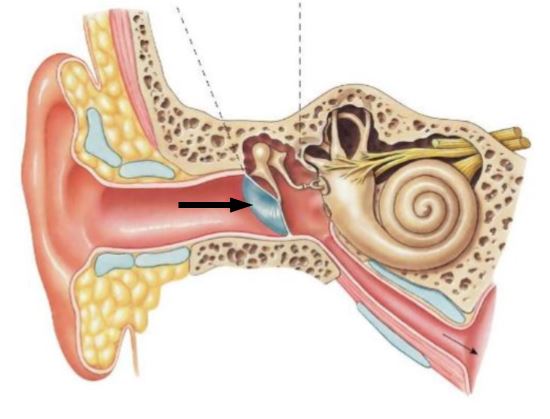
What is this?
Ear Drum
Ear Canal
Pinna
Cochlea
Hearing Nerve
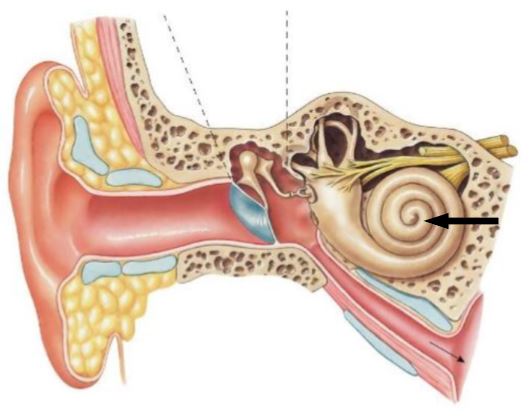
What is this?
Ear Drum
Ear Canal
Pinna
Hammer
Cochlea
What is this?
Pinna
Hearing Nerve
Cochlea
Ear Drum
Anvil

What is this?
Anvil
Hammer
Stirrup
Cochlea
Ear drum

What is this?
Anvil
Hammer
Stirrup
Cochlea
Ear drum

What is this?
Hearing Nerve
Cochlea
Pinna
Stirrup
Hammer

What is this?
Anvil
Hammer
Stirrup
Ear Canal
Ear drum
The cochlea is found in which section of the ear?
outer
inner
middle

What part is #9?
Semicircular Canals
Eustachian Tube
Cochlea
Oval Window
The function of pinna is ...
to collects sound
to keep the body balance
pathway for the sound to reach the ear drum
to deliver the sound to the brain
A part of ear that can deliver the sound to the brain is ...
auditory nerve
cochlea
ear drum
semicircular canal

How is your eardrum like a real drum?
It produces sound.
It vibrates.
It is frequently struck by the bones in your middle ear.
It is hollow.

What is unique about the hammer, stirrup, and anvil?
They are the smallest bones in your body
They are the only bones in your body that move
They are the only bones located in your head
They are the only bones that cannot be broken

A series of vibrations you can hear
intensity
pitch
sound
frequency


The cochlea has ______ that help send signals to the auditory nerve
tiny bones
tiny hairs
large hairs
Connects the middle ear to the throat, maintains equal are pressure
What is the function of the Pinna in the human ear?
It is responsible for the balance and spatial orientation.
It helps in the amplification of sound.
It is the visible part of the ear that helps in collecting sound waves.
It produces earwax to protect the ear canal.
What role does the tympanic membrane play in the ear?
It collects sound waves
It amplifies sound waves
It transmits sound to the ossicles
It protects the inner ear
What is the tympanic membrane commonly known as?
Cochlea
Earlobe
Eardrum
Auditory tube
What is the scientific name for the hammer?
Stapes
Malleus
Incus
Ossicles
What is the scientific name for the anvil?
Stapes
Malleus
Incus
Ossicles
What is the scientific name for the stirrup?
Stapes
Malleus
Incus
Ossicles
What is the primary function of the Eustachian tube?
To amplify sound
To equalize air pressure
To produce earwax
To transmit sound to the brain
Which part of the ear is responsible for maintaining balance?
Semicircular Canals
Cochlea
Ear Drum
Auditory Nerve
the ear has three important parts: The outer ear, middle ear and inner ear.
true
false
When sound travels through a medium, what does it need in order to move?
A vacuum
A solid, liquid, or gas
Light waves
Air only
What are the two main types of waves?
Mechanical and Electromagnetic
Transverse and Longitudinal
Sound and Water
Visible and Invisible
Which type of wave requires a medium to travel through?
Electromagnetic waves
Mechanical waves
Radio waves
Light waves
What type of wave is a sound wave?
Transverse
Longitudinal
Electromagnetic
Radio
In longitudinal waves, particles move in which direction relative to the wave?
Perpendicular
Parallel
Circular
Diagonal
Frequency is the number of wavelengths that pass a given point per second, measured in _____.
Meters (m)
Seconds (s)
Hertz (Hz)
Joules (J)
The speed of sound depends on what 2 factors?
The medium and the frequency
The medium and the surrounding temperature
The frequency and the wavelength
The wavelength and the amplitude
The _____ of the medium affects the speed of sound.
Temperature
Density
Frequency
Wavelength
Which is the correct ranking, from fastest to slowest, through the mediums that sound travels?
gas, liquid, solid
solid, liquid, gas
liquid, solid, gas
gas, solid, liquid
Sound waves travel faster in which type of air?
Cool
Warm
Humid
Dry
What is the speed of sound equation?
V = 331 m/s + 0.6T
V = 300 m/s + 0.5T
V = 350 m/s + 0.7T
V = 340 m/s + 0.8T
Sonic booms occur when an object travels faster than what?
The speed of light
The speed of sound
The speed of wind
The speed of water
Which animal has the best hearing?
Bat
Dolphin
Dog
Moth
Humans can hear frequencies between what range?
10 Hz - 10,000 Hz
20 Hz - 20,000 Hz
30 Hz - 30,000 Hz
40 Hz - 40,000 Hz

