
Font size
 Worksheets
Wound healing review quiz
Total questions: 19
Worksheet time: 24mins
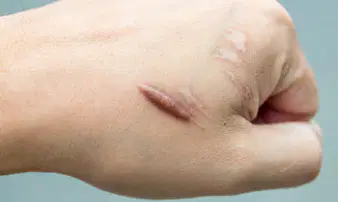
Scar tissue is formed during which phase of wound healing?
Inflammatory
Proliferative
Remodeling
Hemostasis
When educating a patient about wound healing the nurse should include what in the teaching?
long term steroid use diminishes the inflammatory response and speeds up wound healing
Chronic wounds heal better in a dry, open environment so leave them open to air.
Fat tissue heals more rapidly because there is less vascularization.
Inadequate nutrition delays wound healing and increases risk of infection.
A postsurgical patient who is morbidly obese informs the nurse that as she was coughing, she felt a "pop" at her abdominal incision site. Upon inspection, the nurse notes the sutures to the incision are intact; however, there is an increase in the amount of serosanguineous drainage. The nurse would suspect wound:
Dehiscence
Fistula
Hemorrhage
Evisceration
The nurse is providing education on healing by primary intention. Which statement indicates an understating of the education?
Wounds are allowed to granulate
Skin edges are brought together and sutured, stapled, or glued
Wounds are left open to the air
Wounds are treated in a community setting
Which statement about secondary intention is correct?
When a nurse has a lot of dressings to do, these are the ones she does second because they are not as urgent.
Wound edges are brought together.
Wounds remain sloughy.
The wound is left unsutured to fill with granulation tissue from the wound bed upwards.
Which of the following is true regarding keloid

Keloid scar
Keloid: More often in light-skin people
Keloid: raised beyond boundary of the wound

Keloid scar
Which of the following terms is a minor wound resulting from rubbing or friction to the epidermal layer of the skin?
Laceration
Abrasion
Thermal burn
Sunburn
Which of the following terms is a minor wound resulting from a sharp-edged object cutting through the skin layers?
Laceration
Abrasion
Thermal burn
Sunburn
Which of the following phases is responsible for producing an immediate response to injury?
Maturation
Proliferative
Inflammatory
Glycolysis
Which of the following phases is responsible for filling the wound with new connective tissue?
Maturation
Proliferative
Inflammatory
Glycolysis
Which of the following phases is responsible for breaking down and synthesizing collagen where the goal is replacing weak collagen with high-tensile-strength collagen?
Maturation
Proliferative
Inflammatory
Glycolysis
Which of the following describes a wound that heals by secondary intention healing?
incision with easily approximated edges
wound that has been stitched/stapled shut
deep/wide wound with granulation tissue in base
infected wound that first must be cleaned
A break in skin or mucous membranes is known as a(n) _________ wound
Open
Closed
A keloid scar remains confined to the site of the original skin injury.
True
False
Which is a characteristic of chronic wounds?
Are full-thickness wounds
Result from pressure
Are usually infected
Exceed the typical healing time

