
 Worksheets
Unit 4 Review over Periodic Table and Trends
Total questions: 50
Worksheet time: 47mins
As you move ______ a group, more energy levels are added, which increases the size of the atom
down
up
diagonal
away

Which element's atom is larger? Nitrogen or Phosphorus?
Nitrogen
Phosphorus

Which element's atom is the smallest?
Rhodium
Silver
Cadmium
Tin
Which of these best explains the reasoning behind the trend that as you go across a period, size decreases?
As you go across a period, more energy levels are added, which shrinks the atom.
The added electrons in the nucleus give the atom a negative charge, which shrinks the atom.
The added protons in the nucleus pull the electrons closer to them, which shrinks the atom.
All of the above

Which order is correct from largest to smallest atomic radius?
Thallium, Indium, Gallium, Boron
Boron, Thallium, Indium, Gallium
Boron, Gallium, Indium, Thallium
Thallium, Gallium, Indium, Boron
Select ALL that explain the ionization energy trend within periods going left to right
electrons are closer to the nucleus
their is a weak pull between electrons from the nucleus, making them easily moveable
feel more of a pull from nucleus, making them harder to move
electrons are further from the nucleus
Ionization energy __________ as you go down a group.
stays the same
decreases
increases

Which element has the greater ionization energy?
Magnesium (Mg)
Phosphorus (P)

Which element has the greater ionization energy?
Iodine (I)
Chlorine (Cl)
As you look down a group, ionization energy and electronegativity
increases
decreases
As you look from left to right across a period, ionization energy and electronegativity both
increase
decrease
Which element has the greater ionization energy?
Iodine (I)
Chlorine (Cl)

Which has the greater electronegativity:
N or C?
C
N

Which has the greater electronegativity:
Cl or Al?
Cl
Al

Which atom is more electronegative?
Fluorine
Oxygen
Which atom is more electronegative?
Carbon
Germanium
Which atom is least electronegative?
Beryllium
Boron
Which atom is least electronegative?
Hydrogen
Sodium

Which direction does the electronegativity values increase on the periodic table?
to the right
to the left
What is added to an atom when you go down a group?
Energy levels
Protons
Match the following terms to the definitions
How strongly an atom is attracted to electrons
Electronegativity
The distance from the valence electrons to the nucleus of an atom
Atomic Radius
The amount of energy needed to remove an electron from an atom
Ionization Energy
The tendency to undergo a chemical reaction
Reactivity
Click on the transition metal
Click on the noble gas
Click on the metalloid
Reorder the following from smallest atomic radius to largest
P
Zn
W
Ba
Ni (nickel) has (a) ionization energy than K (potassium)
Which of these has the highest electronegativity?
Ca
Fe
N
Au
Match the following elements to their position in the periodic table. Please look at a periodic table to do this properly.
Group 2, Period 5
Sr
Group 8, Period 4
Fe
Group 1, Period 3
Na
Group 14, Period 2
Si
Group 18, Period 6
Rn
Match the following elements to the correct Lewis Dot diagram

Ca

Se

F

Xe

B
Click on the Alkali metal
Click on the halogen


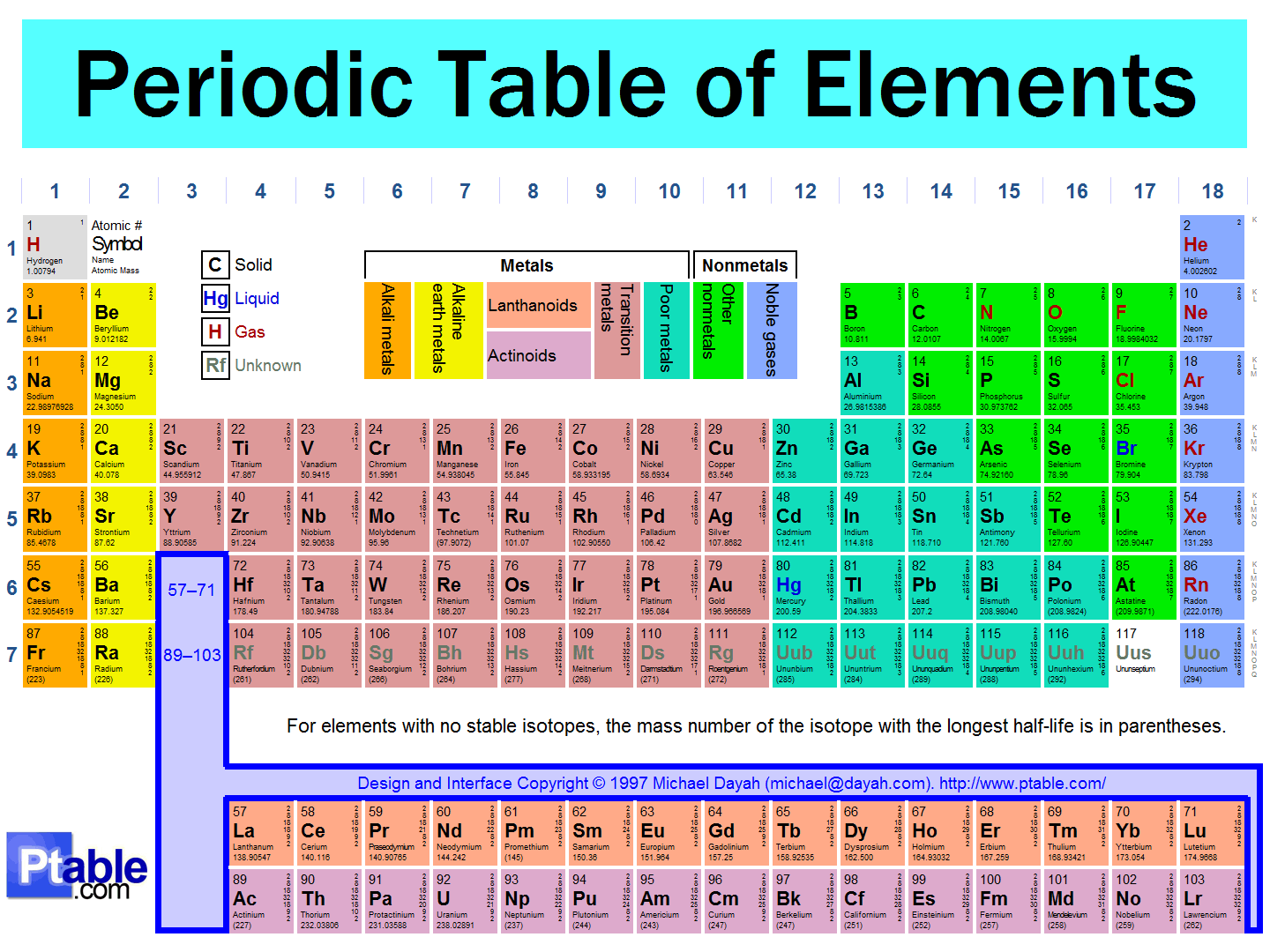
The vertical (up and down) columns in the Periodic Table are called
groups
towers
periods
atomic numbers
Who arranged the periodic table of the elements using atomic mass?
Henry Moseley
Neils Bohr
Dmitri Mendeleev
Which of the following period 4 elements has the smallest atom
Ga
Kr
Ca
Br
Which scientist developed a periodic table that put the atoms in order of increasing atomic number?
Melville
Mendeleev
Mosely
Bohr
Based on it position the periodic table, which element would NOT be a good conductor of heat and electricity and would NOT be malleable?
Cs
Mn
Rb
P

