
 Worksheets
PRESSURE CHANGE II
Total questions: 55
Worksheet time: 28mins
Name
Class
Date
1.
While conducting a pressure change leakage rate test using a barometer and an ordinary pressure gage to measure the system pressure, a decrease in barometric pressure is observed. If there is no measurable leakage and the system temperature is unchanged, the system gage pressure will:
a)
increase by the amount of the barometric pressure decrease.
b)
decrease by the amount of the barometric pressure decrease.
c)
remain the same.
d)
vary the same as the system absolute pressure.
2.
While conducting a reference system pressure change measurement test, an increase m barometric pressure is observed. If there is no measurable test system leakage, the differential pressure between the reference system and the test system will:
a)
increase by the amount of the barometric pressure increase.
b)
decrease by the amount of the barometric pressure increase.
c)
remain the same.
d)
vary the same as the system absolute pressure.
3.
Zero degrees Kelvin (K) is about equal to:
a)
-360 °R,
b)
-170 °F.
c)
0 °C.
d)
-273 °C.
4.
A pressure change measurement test of a system is conducted using a pressure gage that indicates pressure with a consistent small error. The temperature during the test is constant. The effect o the results of the test is:
a)
to show a greater pressure loss than the actual amount.
b)
negligible because of cancellation of repeating error.
c)
to show less pressure loss than the actual amount.
d)
none of the above.
5.
A temperature of 60 °F would be about the same as an absolute temperature of:
a)
329 K.
b)
15 °C.
c)
520 °R.
d)
285 °R
6.
When a system's drybulb temperature and, in turn, total pressure, increases during a pressure change leakage rate test, the water vapor pressure in the system under test would normally:
a)
increase.
b)
remain the same.
c)
decrease.
d)
oscillate.
7.
The purpose of performing a pressure change measurement test is to determine:
a)
that the component leakage rate can be measured.
b)
that the component meets the minimum intended service requirements.
c)
that preliminary leak testing was performed in accordance with the procedure.
d)
all of the above.
8.
In a rigid volume pressure change measurement test system, if the system internal drybulb temperature reaches the system internal dewpoint temperature, how can this affect the system leakage rate test results?
a)
It will have absolutely no effect.
b)
Moisture condensed into the system reduces the system volume, causing an increase in system pressure not attributable to temperature change.
c)
When dewpoint sensors become saturated, the dewpoint temperature readings can be very inaccurate. If the situation is not accounted for in the data analysis, the leakage rate test results can be very inaccurate.
d)
The system will be saturated minimizing pressure variations caused by temperature
changes. This reduces deviation of the data and increases the reliability of the test results.
9.
The general gas law showing the relationship of pressure, temperature and volume of an ideal gas is expressed by which one of the following relationships?
a)
= constant or P1T1 = P2T2 (when V1 = V2)
b)
PV = nRT or P1T2 = P2T1 (when V1 = V2)
c)
PV = nRT or P1V2 = P2V1 (when T1 = T2)
10.
If the pressure change measurement test for each of three different systems results in the same pressure loss for the same test time, test pressure and temperature, the leakage rates for each system would:
a)
be the same,
b)
vary directly with the volume of each system; i.e., the bigger the volume, the larger the leakage rate. \
c)
vary indirectly with the volume of each system; i.e., the smaller the volume, the larger the leakage rate.
d)
vary directly with the surface area of each system; i.e., the bigger the surface area, the larger the leakage rate.
11.
Assuming uniform temperature, the amount of pressure change per unit of time at test pressure for a given constant volume system is dependent on the total system:
a)
barometric pressure and leakage rate.
b)
volume and leakage rate.
c)
partial pressure and volume.
d)
leakage rate and partial pressure.
12.
When the pressure change per unit of time at test pressure for a system is known, to determine the leakage rate for that system, it is necessary to know the:
a)
contained volume of the system.
b)
number of leaks in the system.
c)
size of the largest leak in the system.
d)
surface area of the system.
13.
For a pneumatically pressurized constant volume system at an internal temperature of 27 °C, what approximate percentage change in the system absolute pressure can be expected for a system internal temperature change of 1 °C?
a)
3%.
b)
6%.
c)
0.3%.
d)
10%.
14.
The reliability of the reference chamber technique of pressure change measurement testing rigid volume systems is mostly dependent on the accuracy and resolution (readability) of the:
a)
test system pressure gage.
b)
drybulb temperature sensors.
c)
differential pressure gage between the reference chamber and the test system.
d)
differential temperature sensors between the reference chamber and the test system.
15.
To obtain reliable results when pressure change measurement testing very large volumes, the reference chamber technique is less dependent than the absolute pressure technique on the accuracy of the:
a)
Temperature weighting factors.
b)
Dewpoint temperature readings.
c)
Changes in differential pressure between the reference chamber and test system.
d)
Relative humidity in the system.
16.
When pressure change measurement testing very large volumes, the weighting factors used for system internal drybulb temperature and dewpoint temperature readings are based on the:
a)
proportionate number of sensors in each system section volume.
b)
proportionate volume represented by each sensor or group of sensors relative to the total system volume.
c)
total system free volume relative to the system test pressure volume.
d)
system test pressure.
17.
The purpose in plotting absolute temperature and absolute pressure against time during the course of a pressure change measurement leakage rate test is:
a)
for greater ease in detecting errors in recorded data.
b)
for easier establishment of valid data points.
c)
to provide visual aid for early determination of validity and acceptability of results.
d)
all of the above.
18.
When the percent relative humidity is measured instead of the dewpoint temperature for the pressure change leakage rate test for a large volume system, the water vapor partial pressure of the internal gas can be determined in conjunction with the:
a)
system dewpoint temperature only.
b)
system drybulb temperature and use of steam tables.
c)
use of steam tables only.
d)
system dewfail measurements.
19.
While a system is being pressurized with air for a pressure change measurement test, the contained system gas volume in standard volume units increases by the amount of the system free volume for every increase, in system pressure of:
a)
two standard atmospheres.
b)
double the test pressure.
c)
one standard atmosphere.
d)
one half of the design pressure.
20.
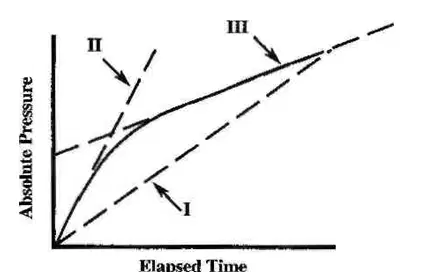
When the vacuum pumps are isolated for a pressure change measurement test of an
evacuated system, the following pressure rise versus time curve results. The pressure rise
caused by system leakage would be that part of a curve represented by dotted slope line:
a)
I.
b)
II.
c)
III
d)
II minus III.
21.
Where Q is leakage rate, V is system volume at test pressure, DP is pressure change during test and t is the duration of the test, which of the following is the fundamental pressure change equation for determining leakage rates of rigid volume systems?
a)
a)
b)
b)
c)
c)
d)
d)
22.
Which one of the following pressure change measurement test allowable is different from the other three when they are all converted to a common time base?
a)
0.5 psi loss/1 h.
b)
0.25 psi loss/0.5 h.
c)
1.0 psi loss/2 h.
d)
2.5 psi loss/10 h.
23.
The weighting factor for each drybulb temperature sensor and each dewpoint temperature sensor for a pressure change leakage rate test of a very large volume system will:
a)
vary for each sensor depending on the portion of the total system volume represented by the individual sensor.
b)
be the same for the sensor of the same type but may differ between the two types of sensors,
c)
be the same for each drybulb temperature and dewpoint temperature sensor positioned as a pair.
d)
usually be the same for all sensors.
24.
For a pressure change measurement test of a rigid volume system at a temperature of 40 °F
and 35 psig. a temperature change of 1 °F could be expected to cause a pressure change of about:
a)
0.01 psi.
b)
0.1 atm.
c)
0.07 psi.
d)
0.10 psi.
25.
Which of the following are true statements regarding the flow measurement technique of
pressure change measurement testing as applicable to a large variety of test systems?
a)
Calculation or measurement of system volume is unnecessary.
b)
Measurement of system dewpoint gas temperature during test is usually necessary.
c)
The test must be performed with a special tracer gas.
d)
All of the above are true.
26.
For pressure change measurement tests of evacuated systems in the absolute pressure range of 10-4 to 10-6 torr, which one of the following gages would be the best to use?
a)
Thermocouple gage.
b)
Quartz bourdon tube manometer.
c)
Ionization gage.
d)
Pirani gage.
27.
For the flow measurement technique of pressure change measurement testing, the type of flow measurement usually encountered that directly represents a leakage rate is:
a)
mass flow.
b)
volume flow.
c)
pressure change flow.
28.
To obtain a more accurate leakage rate when pressure change measurement testing a very large volume system, it is necessary to:
a)
temperature correct the gage pressure readings.
b)
correct the absolute pressure readings by subtracting the water vapor partial pressure.
c)
measure the percent relative humidity to ensure that drybulb temperature sensors are not being affected by excess moisture.
d)
correct the absolute pressure readings for variations in atmospheric temperature changes.
29.
When no dryer or aftercooler is used in the pressurizing air line to a large system to be pressure change measurement tested, as the pressure in the test system increases, the:
a)
barometric pressure increases.
b)
system drybulb temperature decreases,
c)
system dewpoint temperature increases.
d)
system water vapor partially decreases.
30.
When pressure change measurement testing evacuated systems, outgassing is a major factor that must be considered in determining the system leakage rate. Outgassing rates in a vacuum system are influenced by:
a)
the amount of surface area inside the system.
b)
the type of material exposed to the system.
c)
the cleanliness of the surface inside the system.
d)
all of the above.
31.
A pressure change measurement test is conducted on a system at operating pressure using a different ideal gas than the ideal gas to be used when the system is in service. To determine the in service leakage rate, the leakage rate measured during the test must be adjusted for which one of the following property differences between the two gases?
a)
Vapor density.
b)
Gaseous viscosity.
c)
Specific weight.
d)
Vapor pressure.
32.
Which of the following is an advantage of the pressure change measurement test method?
a)
It requires no special tracer gas.
b)
It can be used for measuring total leakage rate on either evacuated or pressurized systems.
c)
It can be used to measure total leakage rate for any size system.
d)
All of the above apply.
33.
For the pressure rise technique of pressure change measurement testing an evacuated system, the system sensitivity increases as test time increases and:
a)
volume increases and pressure decreases.
b)
volume increases and pressure increases.
c)
volume decreases and pressure decreases.
d)
none of the above apply.
34.
When pressure change measurement testing an evacuated system in the pressure range of 10-4 to 10-5 torr, a factor that must be considered to determine the leakage rate is the:
a)
total outgassing load.
b)
water vapor condensation.
c)
ionization of molecules.
d)
vacuum pump system speed.
35.
Volume change caused by thermal expansion or contraction of a constant volume system during a pressure change measurement test:
a)
does not affect leakage rate calculations.
b)
is automatically accounted for by the corrections for difference in temperature.
c)
is not normally significant.
d)
has a very significant error impact on the leakage rate results.
36.
In an evacuated system, the sensitivity of a pressure change measurement test is dependent not only on the pressure change caused by leakage but also on the degree of outgassing. Pressure change caused by outgassing is:
a)
the result of the viscosity of gas.
b)
caused by the evaporation or boiling of absorbed materials and gases from the walls of the container.
c)
directly proportional to the temperature of the gas.
d)
caused by leakage from the vacuum manifold.
37.
For a large evacuated system exposed to the weather and the accompanying wide temperature variations, determination of the leakage rate by the pressure change measurement test method requires:
a)
comparison of test data when the temperature is in a down trend.
b)
comparison of test data during stable temperature periods or during comparable temperature trends or cycles.
c)
longer evacuation time before the test to eliminate all outgassing.
d)
use of extreme cleaning procedures before the test to eliminate the outgassing.
38.
If a system to be pressure change measurement tested is so small that internal temperature
sensors cannot be used, then:
a)
use surface thermometers to measure the system temperature.
b)
maintain a stable external temperature around the system.
c)
test the system using a mass flow measurement technique.
d)
use any of the above alternatives.
39.
For pressure change measurement test systems pressurized above atmospheric pressure, the most sensitive and accurate type of absolute pressure measuring gage or instrument available is which one of the following?
a)
A pressure gage with very small minor graduations.
b)
A quartz bourdon tube pressure gage.
c)
A compound pressure/vacuum gage.
d)
A pressure sensing cell with a diaphragm which acts to unbalance a capacitive bridge circuit.
40.
A sensor that can be used to measure drybulb temperature in pressure change measurement test systems which consists of a bimetallic junction that produces an electromotive force that varies with temperature is known as a:
a)
thermocouple.
b)
resistance bridge.
c)
dewpoint sensor.
d)
balanced junction thermopile.
41.
The number of drybulb temperature sensors selected for a pressure change measurement test is a function of many factors, one of which is the:
a)
type of sensors selected.
b)
surface area of the system.
c)
contained free air volume of the system.
d)
anticipated internal air temperature during the test.
42.
A pressure change measurement test system is considered to be a constant volume system when the:
a)
temperature variation anticipated during test is so small that it can be ignored. .
b)
temperature variation during test is so small that it has little or no effect on the results.
c)
pressure variation is so small that it can be considered as constant.
d)
physical change in the size of the system caused by temperature variation is so small that it can be ignored.
43.
The sensitivity of the flow measurement technique of the pressure change test method is
very dependent on the:
a)
accuracy of the system volume.
b)
system dewpoint temperature.
c)
number of temperature sensors in the system.
d)
accuracy of the flow measuring instrument.
44.
The test technique used to confirm the accuracy of the leakage rate test results and the instrumentation used in conducting a pressure change measurement test of a large system is commonly called a:
a)
confirmation test.
b)
reliability test.
c)
verification test.
d)
controlled test.
45.
As pressure change measurement test systems get smaller in size, the accuracy of the volume or mass leakage rate becomes more dependent on the:
a)
accuracy of the system volume.
b)
accuracy of the starting test pressure.
c)
level of the test temperature.
d)
dewpoint temperature in the system.
46.
A sensor used to measure drybulb temperature in pressure change measurement test systems which consists of a metal tube containing a metallic core wound with wire whose ohm rating with temperature is known as:
a)
a dewpoint resistance detector.
b)
a resistance temperature detector.
c)
a thermocouple temperature detector.
d)
an electromotive force sensor.
47.
Where Q is leakage rate, V is system volume, P is system absolute pressure and t is time, which of the following is the fundamental pressure change equation for determining leakage rates of variable volume systems?
a)
a)
b)
b)
c)
c)
d)
d)
48.
At a temperature of about 68 °F (20 °C), a system being evacuated for a vacuum retention
pressure change measurement test will not pump below an absolute pressure level of about 18 mm Hg. The problem is most likely:
a)
a faulty gage or a gage applied to the wrong absolute pressure gage.
b)
nonexistent since all evacuated systems cannot be pumped below this level without the use of special high speed diffusion pumps.
c)
excessive moisture boiling or outgassing into the system.
d)
excessive amounts of leakage caused by improper preliminary leak testing techniques or methods.
49.
For pressure change measurement tests of large volume systems, the number of temperature sensors selected and their location within the system shall be:
a)
determined by calculations only.
b)
confirmed or corrected by a prior survey of the system to reveal the actual temperature pattern.
c)
double the actual requirement to provide a safe level of redundancy.
d)
based on the combined results of past tests on similar size systems.
50.
For pressure change measurement tests of large volume systems, the number of temperature sensors selected is a function of:
a)
contained system volume.
b)
configuration of the system.
c)
redundancy desired caused by possible malfunction of sensors.
d)
all of the above.
51.

One set of internal drybulb temperature data for a pressure change leakage rate test is: ; ; ; and
For each of these four sections of this system, the respective weighting factor is 0.27, 0.18, 0.22 and 0.33. The mean absolute drybulb temperature of system air for this test data point is:
a)
a) 532.53 °R.
b)
a) 345.53 K.
c)
a) 532.48 °R.
d)
a) 532.48 K.
52.
Which one of the following is the correct relationship for converting temperature in degrees Fahrenheit (°F) to temperature in degrees celsius (°C)?
a)
a) °C = (9/5)°F.
b)
a) °C = 273° + °F.
c)
a) °C = (5/9)(°F-32).
d)
a) °C = 460 °F (5/9) °F.
53.
A rigid constant volume vessel contains 3 ft3 of air mass (quantity) at standard atmospheric pressure. Assuming uniform standard temperature and standard atmospheric pressure as 15 psia, what would be the system pressure if 9 ft3 of air were added to the system?
a)
30 psig.
b)
45 psia.
c)
60 psig.
d)
60 psia.
54.
A constant volume system contains an air volume of 10 ft3 at a pressure of 75 psia and a temperature of 40 °F. What is this air mass in standard cubic feet? Assume standard pressure as 15 psia and standard temperature as 60 °R
a)
52.0 ft3.
b)
62.4 ft3.
c)
75.0 ft3.
d)
90.0 ft3.
55.
If a system contains an air mass of 30 000 cm3 at standard atmospheric pressures how much air mass does it contain in standard cubic feet when it is evacuated to an absolute pressure of 1 psia? Assume uniform standard temperature and standard pressure of 15 psia.
a)
500 ft3.
b)
1000 ft3.
c)
2000 ft3.
d)
10 000 ft3.
100 %

