
 Worksheets
Waves Types, Parts and Properties
Total questions: 60
Worksheet time: 50mins
Name
Class
Date
1.
Waves that move particles parallel to the path of the wave are called
a)
Transverse
b)
Longitudinal
c)
Ocean Waves
d)
Ultraviolet Waves
2.
What kind of wave can travel through space?
a)
electromagnetic waves
b)
compressional waves
c)
water waves
d)
longitudinal waves
3.
A wave carries...?
a)
energy only
b)
matter only
c)
the matter carries the energy
d)
neither
4.
The lowest part of the wave is?
a)
trough
b)
crest
c)
point of origin
d)
compression point
5.
The highest point of a wave is?
a)
crest
b)
trough
c)
point of origin
d)
comppression point
6.
What is the measure of how many waves pass a point in a certain amount of time?
a)
frequency
b)
wavelength
c)
midpoint
d)
crest and trough
7.
Amplitude reflects the amount of ____________________ in a wave.
a)
energy
b)
compression
c)
rarefaction
d)
speed
8.
A _____________________ is the distance between a point on one wave and the identical point of the next wave.
a)
amplitude
b)
wavelength
c)
frequency
d)
compression
9.

This type of Electromagnetic wave shows a break in bones.
a)
gamma ray
b)
x-ray
c)
brokenometer
d)
radio wave
10.

Which wave has a greater frequency?
a)
A
b)
B
11.

_______ carry the greatest amount of energy.
a)
x-rays
b)
gamma rays
c)
infrared rays
d)
visible light
12.
Sound is caused by?
a)
force
b)
vibrations
c)
instruments
d)
medium
13.
What is vibration?
a)
how loud a sound is
b)
the back and forth movement of matter
c)
how high or low a sound is
d)
the loudness or softness of a sound
14.
Why is sound able to travel faster through a solid than a gas?
a)
Gas molecules are packed tightly.
b)
Sound does not travel faster through a solid than a gas.
c)
Solid molecules are packed tightly.
d)
Gas molecules move slowly.
15.
How does a sound wave interact with a human ear?
a)
vibrates the ear drum
b)
bounces off the ear canal
c)
rotates the ear drum
d)
vibrates the ear canal
16.
In a transverse wave, particles move...?
a)
perpendicular to the path of the wave
b)
parallel to the path of the wave
c)
diagonally
d)
wherever the matter's going
17.
In a longitudinal wave, the particles move...?
a)
perpendicular to the path of the wave
b)
parallel to the path of the wave
c)
vertically
d)
in the direction of the hertz
18.
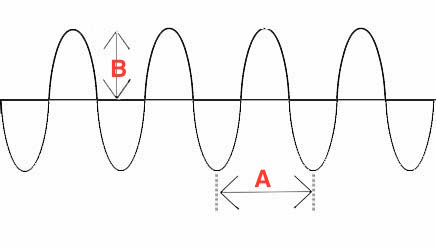
What property of this wave is represented by the letter "A"
a)
amplitude
b)
crest
c)
trough
d)
wavelength
19.
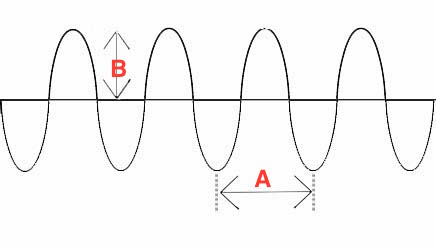
What property of the wave is represented by the letter "B"?
a)
amplitude
b)
crest
c)
trough
d)
wavelength
20.
The type of waves that require medium to pass:
a)
Mechanical Waves
b)
Electromagnetic Waves
21.

Which vocabulary term is used to identify the distance between points C & G?
a)
Amplitude
b)
Crest
c)
Frequency
d)
Wavelength
22.
When the frequency of a wave increases, what happens to the wavelength?
a)
The wavelength is not directly affected by the frequency of a wave.
b)
The wavelength increases.
c)
The wavelength decreases.
d)
More specific information is needed to form a conclusion about the wavelength.
23.
A mechanical wave cannot travel through...
a)
a vacuum(empty space).
b)
water.
c)
air.
d)
glass.
24.
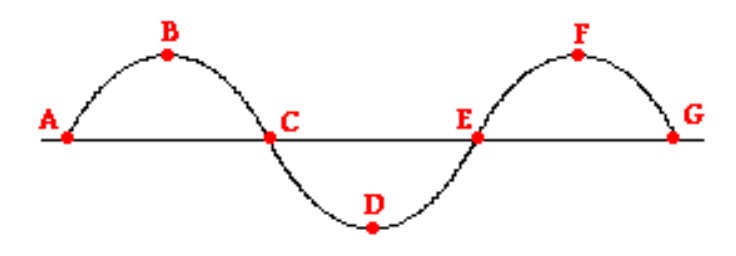
Which letter(s) represent the trough of the wave?
a)
A
b)
B & D
c)
D
d)
C & G
25.
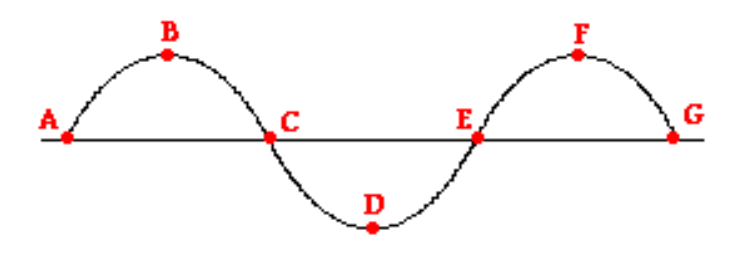
Which letter(s) represent the crest of the wave?
a)
A
b)
B & D
c)
B & F
d)
F
26.
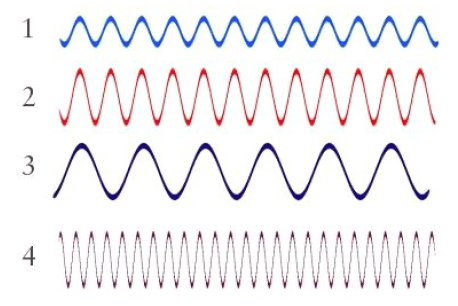
Which wave in the diagram has the greatest wavelength?
a)
1
b)
2
c)
3
d)
4
27.
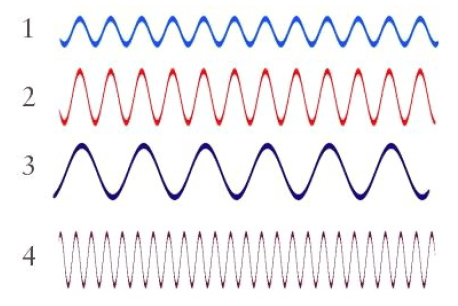
Which wave in the diagram has the greatest frequency?
a)
1
b)
2
c)
3
d)
4
28.
Which of the following can sound travel through?
a)
solid
b)
liquid
c)
gas
d)
all of the above
29.
crest to crest or trough to trough
a)
crest
b)
trough
c)
amplitude
d)
wavelength
30.
Electromagnetic waves include the following except
a)
radio waves
b)
X-rays
c)
doing the wave at a football game
d)
microwaves
31.
regular disturbances that carry energy through matter or space
a)
crest
b)
energy
c)
wave
d)
trough
32.

What kind of wave is pictured below?
a)
compressional wave
b)
transverse wave
c)
sound wave
d)
mechanical wave
33.
What do we call the bottom of a transverse wave?
a)
crest
b)
trough
c)
wavelength
d)
amplitude
34.
What do we call the top of the wave?
a)
crest
b)
trough
c)
amplitude
d)
frequency
35.
Waves that require a medium are called
a)
mechanical waves
b)
transverse waves
c)
light waves
d)
gamma rays
36.
What kind of wave moves at right angles to the direction of the wave?
a)
compressional waves
b)
mechanical waves
c)
transverse waves
d)
ultraviolet rays
37.
What do we call the part of a longitudinal wave that is when the waves are squeezed together?
a)
compression
b)
rarefaction
c)
crest
d)
trough
38.
What do we call the part of a longitudinal wave that is spread a part?
a)
compression
b)
rarefaction
c)
crest
d)
trough
39.
Waves are a transfer of what?
a)
Heat
b)
Light
c)
Energy
d)
Food
40.
What is a wave?
a)
a disturbance in a medium
b)
a small disturbance
c)
a medium disturbance
d)
a large disturbace
41.
Which of these waves can travel in a vacuum (empty space)?
a)
sound wave
b)
radio wave
c)
compressional wave
d)
water wave
42.
All waves carry
a)
energy
b)
light
c)
matter
d)
particles
43.

Which letter represents the wave crest?
a)
A
b)
B
c)
C
d)
D
44.

Which letter represents the wave trough?
a)
A
b)
B
c)
C
d)
D
45.

Which letter represents amplitude?
a)
A
b)
B
c)
C
d)
D
46.

How would a person measure the wavelength on this sound wave?
a)
dense to less dense
b)
trough to crest
c)
compression to compression
d)
beginning of illustration to the end
47.
Which of the following is transmitted by waves?
a)
atoms
b)
matter
c)
energy
d)
resonance
48.
Which answer best explains how a wave is created?
a)
A wave is created when energy stays still
b)
A wave is created when a force causes a vibration
c)
A wave is created when molecules become a medium
d)
A wave is created when a liquid becomes a solid
49.
Waves can travel through empty space or they can travel through a medium. Which statement best describes a medium?
a)
The solid matter that waves travel through
b)
The gas matter that waves travel through
c)
The liquid matter that waves travel through
d)
The solid, liquid, or gas matter that waves travel through
50.
Mechanical waves cannot be transmitted through a vacuum. Therefore, which of the following are NOT mechanical waves?
a)
Water waves
b)
Seismic waves
c)
Sound waves
d)
Light waves
51.
What do mechanical waves travel through?
a)
Medium
b)
empty space
c)
vacuum
d)
the boo
52.

Which is an example of a longitudinal wave?
a)
light wave
b)
sound wave
c)
visible wave
d)
radio wave
53.
When a wave's amplitude increases it means
a)
it's carrying more energy
b)
its wavelength gets longer
c)
its frequency increases
d)
its wavelength decreases
54.
What do seismic waves and sound waves have in common?
a)
they're mechanical waves
b)
they're electromagnetic waves
c)
they're transverse waves
d)
they're permanent waves
55.
The longer the _____________ the ______________ the frequency.
a)
wavelength, lower
b)
wavelength, higher
c)
amplitude, lower
d)
amplitude, higher
56.
Amplitude is a measure of how much _________ the wave is carrying
a)
energy
b)
matter
c)
medium
d)
frequency
57.

_____________ wave particles move left to right.
a)
Transverse
b)
Electromagnetic
c)
Longitudinal
d)
Ocean
58.
________________ particles vibrate up and down, while the wave as a whole moves left to right.
a)
Transverse Wave
b)
Longitudinal Wave
c)
Sound Wave
d)
Wavy hair
59.
All of the following are examples of transverse waves except for:
a)
X - Ray
b)
Visible Light
c)
Sound
d)
Gamma Rays
60.
The shorter the wavelength the
a)
shorter the frequency
b)
higher the freuqnecy
c)
frequency stays the same
d)
less energy
100 %

