
 Worksheets
Unit 1: Composition of Matter Practice Test
Total questions: 56
Worksheet time: 1hrs 12mins
In the modern periodic table, elements are arranged by:
atomic mass
atomic number
valence electrons
number of isotopes
Anything that has mass and takes up space is called
heterogeneous
homogeneous
matter
density
The number of protons in the nucleus of an atom
atomic mass
atomic number
isotope
nucleus
equal to the number of protons plus neutrons in the nucleus of an atom
atomic mass
atomic number
isotope
valence electrons
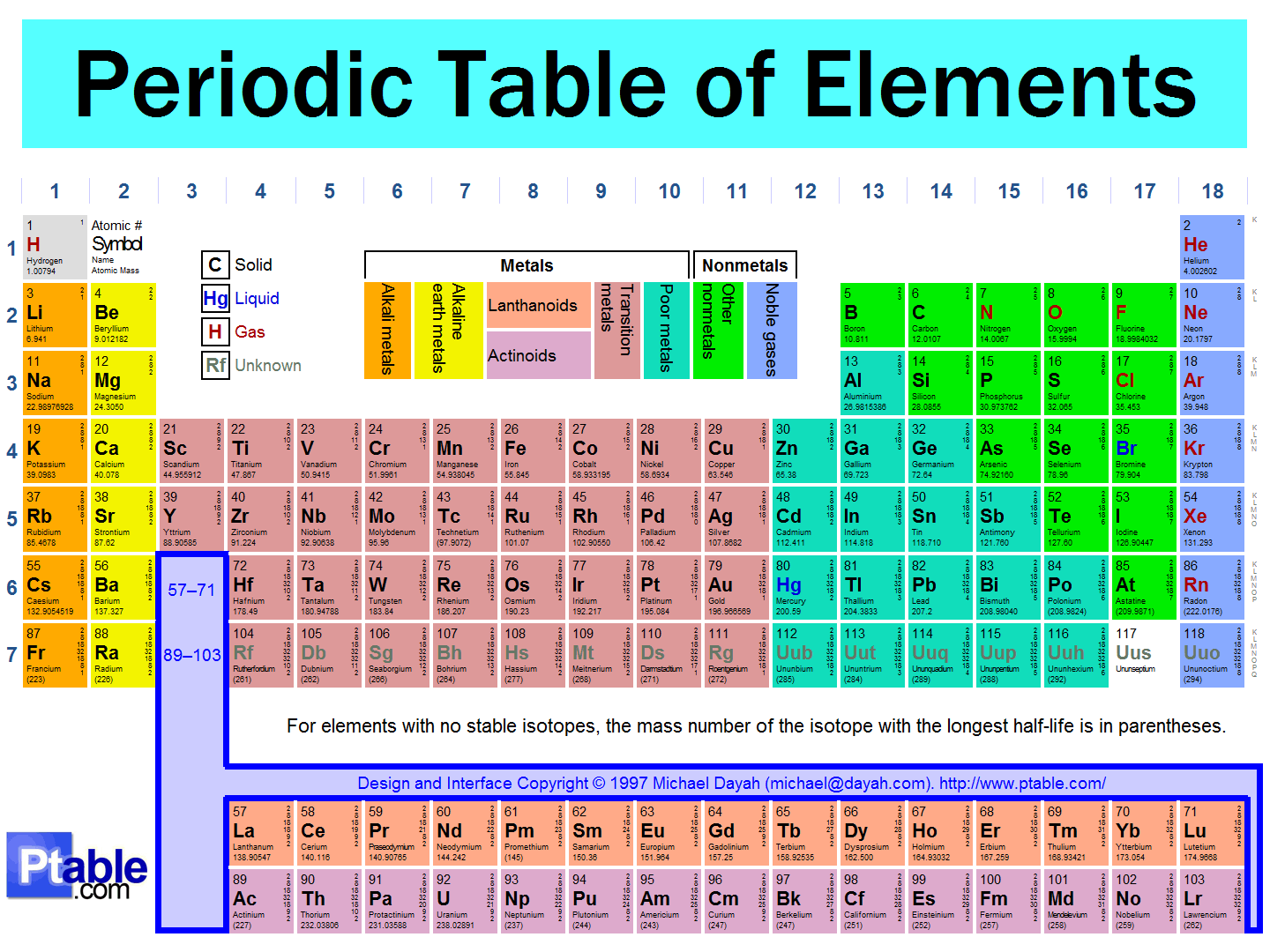
The vertical (up and down) columns in the Periodic Table are called
groups
towers
periods
atomic numbers

What group is this element located in?
5
6
7
8

The horizontal (left to right) rows on the periodic table are known as
periods.
atoms.
groups or families.
valence electrons.
one or two letters that represent the name of an element
element name
element symbol
atomic number
atomic mass
The number of electrons in an atom is equal to the...
Atomic number
Protons
Atomic Mass
Neutrons
The formula used to calculate the number of neutrons is:
Mass Number - Atomic Number
Protons + Electrons
Atomic Number - Mass Number
Protons x2
What particles are in the nucleus?
Protons
Neutrons
Electrons
Nucleus
Which particle is outside the nucleus?
Protons
Neutrons
Electrons
Nucleus
Which two particles have mass?
Protons
Neutrons
Electrons
Nucleus
Two or more atoms NOT chemically bonded together are called a

This picture represents which of the following?
Element
Compound
Mixture
The ______ are numbers found on the lower right-hand side of an element symbol.
Coefficient
Exponent
Multiplier
Subscript
Coefficients in chemical formulas...
Multiply just the first atom
Add to the subscripts at the end of the molecule
Multiply elements without subscripts
Multiply EVERYTHING!
How many different elements are present in this molecule?
3 NH4C2H3O2
15
36
5
4
What is a compound?
A compound is a substance that contains more than one type of atom.
An atom with protons, neutrons, and electrons.
A pure substance that contains only one type of atom.
Part of an atom.
What is a chemical bond?
A pure substance made up of two or more different atoms.
Two or more atoms.
The attractive force that hold tow or more atoms together.
It is two Hydrogen atoms.
What is a molecule?
two elements bonded together (sharing electrons)
a mixture of different substances
smallest individual particles
salt mixed in water
Which of the following is a chemical formula?
H2SO4
Si
Hg
C
How many bonds can Carbon make? (**Hint HONC rule)
2
4
1
3

Which student correctly recorded all the changes that took place?


A physical change is
a change where the characteristics do not change the substance
a change where the characteristics do change the substance
a change where the chemistry changes
A chemical change is when
the chemical properties change
the chemical properties do not change
a change where the characteristics do not change the substance
When you describe how matter reacts with other matter--for example you describe a substance's flammability or toxicity
Chemical properties
Physical properties
When you describe matter by color, size, shape, state it is known as the
Chemical properties
Physical properties
different materials placed together, but each material keeps its own properties
mixture
solution
physical change
chemical change
a change in some properties of matter without forming a different kind of matter
mixture
solution
physical change
chemical change
a change of one or more types of matter into other types of matter with different properties.
mixture
solution
physical change
chemical change
Select only those that are Chemical Properties of Matter.
Texture
Ability to react with other substances
Hardness
Ability to rust
Ability to conduct heat
Select only those that are Physical Properties of Matter.
Texture
Ability to react with other substances
Ability to conduct heat
Hardness
Ability to rust
3-dimensional, repeated patterns make up _____.
Polymers
Crystals
Simple Molecule
Extended Structure

This is an example of a
Polymer
Crystal
Box
Atom
_______ form as a result of repeated patterns of atoms or molecules..
Simple Molecule
Polymer
Crystal
Extended Structure
One difference between a polymer and a crystal is that...
A crystal is a two-dimensional structure
A crystal is a three-dimensional structure
A polymer is a three-dimensional structure
Crystal
molecules appearing in any direction and forming geometric shapes
Polymer
molecules forming long chains
Crystals AND Polymers
molecules packed together in an orderly fashion
Made of repeated subunits of molecules
Polymer
Made of repeated atoms OR molecules
Crystals
Crystals
Geometric patterns
Polymers
Chain pattern

Is the extended structure pictured a polymer or a crystal?
crystal
polymer

Is the extended structure pictured a polymer or a crystal?
crystal
polymer
Label the following item
How many total atoms in the following equation?
2(H2)3
2
6
7
12
How many atoms of Hydrogen are in this equation?
5Cl2H5
10
2
5
25

