wayground logo

Free Printable Worksheets

Font size

S
M
L
XL
Worksheets

HC Quarterly Review

Total questions: 58

Worksheet time: 39mins

Name
Class
Date
1.

What is particle X?

a)

A) an alpha particle

b)

B) a beta particle

c)

C) a proton

d)

D) a positron

2.

What is the volume shown in this graduated cyclinder?

a)

24.0 mL

b)

24 mL

c)

23.7 mL

d)

23 mL

3.
In an atom, electrons move in definite orbits around the nucleus.
a)
Thomson
b)
Rutherford
c)
Bohr
d)
Democritus
4.
What scientist is best known for his "Plum Pudding" model of the atom?
a)
J.J. Thomson
b)
Ernest Rutherford
c)
John Dalton
d)
Democritus
5.
This is a correct dot diagram for fluorine (F)
a)
true
b)
false
6.
It is a measure of how close measurements come to each other when they are made in the same way
a)
Accuracy
b)
Precision
c)
Error
d)
Extrapolation
7.
What is the mass number defined as?
a)
the number of protons
b)
the number of protons and neutrons
c)
the number of neutrons
d)
the number of protons and electrons
8.
Place the following scientists in order, from earliest to latest: 
Rutherford, Dalton, Bohr, Thomson
a)
Dalton, Rutherford, Bohr, Thomson
b)
Thomson, Dalton, Rutherford, Bohr
c)
Dalton, Thomson, Rutherford, Bohr
d)
Bohr, Dalton, Rutherford, Thomson
9.
What atom matches this electron configuration?
1s22s22p63s23p64s23d10
a)
Zinc
b)
Copper
c)
Nickel
d)
Germanium
10.
Rutherford's gold foil experiment provided evidence that...
a)
negative and positive charges are spread evenly throughout the atom.
b)
alpha particles have a positive charge.
c)
gold is not a dense as previously thought.
d)
there is a dense positively charged nucleus at the center of an atom.
11.
He discovered the electron using cathode ray tube experiment.
a)

JJ Thomson

b)
John Dalton
c)
Ernest Rutherford
d)

Niels Bohr

12.
Glass breaking s an example of a
a)
Chemical change
b)
Physical change
13.
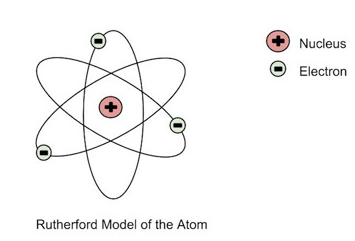
Who's model is this? 
a)
Millikan
b)
Rutherford
c)
Thomson
d)
Bohr
14.

How close a measurement is to the accepted value is called..

a)

Accuracy

b)

Precision

c)

Significant

d)

Estimate

15.
12m = ___mm
a)
12,000
b)
120
c)
1,200
d)
120,000
16.
Calculate 12.34 + 1.234 + 0.1234 and give your answer with the appropriate number of significant figures.
a)
13.6974
b)
13.697
c)
13.70
d)
13.7
17.

The particle represented by X is

a)
b)
c)
d)
18.

The nucleus of an atom contains which subatomic particles?

a)

protons and electrons

b)

protons and neutrons

c)

electrons and neutrons

d)

protons, electrons, and neutrons

19.

1)    In a nuclear fusion reaction, the mass of the products is

a)

1. less than the mass of the reactants because some of the mass has been converted to energy

b)

2. less than the mass of the reactants because some of the energy has been converted to mass

c)

3. more than the mass of the reactants because some of the mass has been converted to energy

d)

4. more than the mass of the reactants because some of the energy has been converted to mass

20.

Which subatomic particle does the YELLOW(-) circle represent?

a)

proton

b)

neutron

c)

electron

d)

nucleus

21.

Which list of nuclear emissions is arranged in order from the least penetrating power to the greatest penetrating power?

a)

A) alpha particle, beta particle, gamma ray

b)

B)alpha particle, gamma ray, beta particle

c)

C) gamma ray, beta particle, alpha particle

d)

D) beta particle, alpha particle, gamma ray

22.

1)     Which equation is an example of artificial transmutation?

a)
b)
c)
d)
23.
Isotopes are atoms of the same element that have the same number of __________ but different number of __________ . Therefore, isotopes of the same element have different masses. 
a)
protons, neutrons
b)
protons, electrons
c)
neutrons, protons
d)
electrons, protons
24.
Any atom containing an unstable nucleus is called
a)
radioisotope
b)
unisotope
c)
particles
d)
nuclei
25.
What is the atomic number?
a)
the number of protons
b)
the number of protons and neutrons
c)
the number of neutrons
d)
the number of protons and electrons
26.
Calculate 1.23 m x 0.89 m and give your answer with the appropriate number of significant figures.
a)
1.0 m2
b)
1.1 m2
c)
1.0947 m2
d)
1.09 m2
27.

Which group of the periodic table are alkali metals found in?

a)

Group 1

b)

Group 2

c)

Group 7

d)

Group 8

28.

NaCl is a compound formed between

a)

Alkaline earth metal /Halogen

b)

Alkali metal/Halogen

c)

Halogen/Alkaline earth metal

d)

None of the above

29.
A neutral atom of Carbon-13 has ________ electrons and _________ neutrons
a)
13, 13
b)
6, 7
c)
7, 7
d)
6, 6
30.

Which of the following exists as a diatomic element?

a)

Helium

b)

Hydrogen

c)

Boron

d)

Xenon

31.
A neutral atom of the isotope 2612Mg would consist of
a)
12 protons, 26 neutrons, 26 electrons
b)
26 protons, 12 neutrons, 26 electrons
c)
26 protons, 14 neutrons, 14 electrons
d)
12 protons, 14 neutrons, 12 electrons
32.

The average atomic mass of an element is the ___.

a)

average of the mass number and the atomic number for the element

b)

weighted average of the masses of the isotopes of the element

c)

total mass of the isotopes of the element

d)

total number of subatomic particles in the nucleus

33.
Which measurement contains 3 sig figs?
a)
200 mL
b)
20.0 mL
c)
0.02 mL
d)
0.020mL
34.

Which nuclear emanation has the greatest mass?

a)

alpha particle

b)

beta particle

c)

positron

d)

neutron

35.

Which balanced equation represents nuclear fusion?

a)
b)
c)
d)
36.
Which of the following correctly lists the three main groups of elements from greatest conductivity to least conductivity?
a)
Nonmetals -metalloids-metals
b)
metals-nonmetals-metalloids
c)
metalloids-metals-nonmetals
d)
metals-metalloids-nonmetals
37.
How many sig. fig. are in the number below:
350.540
a)
4
b)
5
c)
6
d)
7
38.
How many sig. fig. are in the number below:
0.0005
a)
1
b)
2
c)
3
d)
4
39.
How many Significant Figures in the number below?
4.56 x 10³
a)
5
b)
4
c)
6
d)
3
40.
Calculate 345.009 g - 23.009 g and give your answer with the appropriate number of significant figures.
a)
322.00 g
b)
322 g
c)
322.000 g
d)
322
41.
Convert from m to cm:  9 meters
a)
900 cm
b)
90 cm
c)
0.9 cm
d)
0.09 cm
42.

What is the length of the screw?

a)

5.0cm

b)

5.1cm

c)

5.11cm

d)

51mm

43.

To make a proper measurement...

a)

write down only the certain digits.

b)

write down all certain digits and one estimated digit.

c)

write down all certain digits and a few estimated digits.

d)

look at the instrument carefully

44.
Which would describe an electron that has gained energy and jumped to another shell?
a)
ground state
b)
excited state
c)
valence
d)
core
45.
The energy of an electron __________ as it moves further away from the nucleus
a)
increases
b)
decreases
46.
For an electron to change from ground state to an excited stated it must...
a)
Absorb energy
b)
Release energy
47.

Choose the correct shortcut configuration for iodine.

a)

[Ar]4s24d104p5

b)

[Kr]5s24d105p5

c)

[Xe]5s25d105p5

d)

none of the above

48.
The maximum number of electrons that can be placed in an p orbital.  
a)
2
b)
6
c)
10
d)
14
49.
What are the sublevels that make up the n=4 energy level?
a)
s
b)
s, p
c)
s, p, d
d)
s, p, d, f
50.
This is the correct dot diagram for sodium (Na)
a)
true
b)
false
51.
This is a correct dot diagram for oxygen (O)
a)
true
b)
false
52.
This is the correct dot diagram for nitrogen (N)
a)
true
b)
false
53.

As you move left to right on a row or period what happens?

a)

Atomic number increases by 1

b)

Electrons decrease

c)

Number of shells decrease

d)

Nothing

54.
What are the three major categories of the periodic table?
a)
Alpha, Beta & Gamma
b)
Metals, Non-Metals and Metalloids
c)
Metals, Semi-metals and Metalloids
d)
Non-Metals, Semi-Metals and Metalloids
55.
Water that is heated and changed to steam is a 
a)
Physical change
b)
Chemical change
56.
Burning wood is an example of 
a)
Chemical change
b)
Physical change
57.

Which isotope has 4 neutrons?

58.

Match the following

a)

the mass of the atom is found here

1.

nucleus

b)

these are in the nucleus

2.

protons & neutrons

c)

if you change the number of protons you get a different...

3.

element

d)

if you change the number of neutrons you get a different...

4.

mass

e)

an isotope has the same number of protons but a different number of...

5.

neutrons