
 Worksheets
IB Physics Structure of the atom (SL)
Total questions: 46
Worksheet time: 52mins
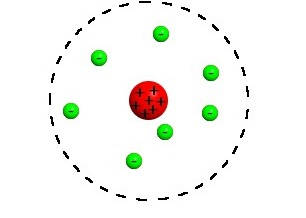




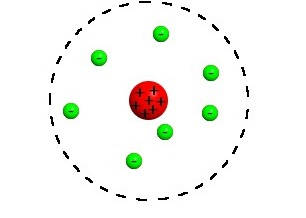
In Rutherford's Gold Foil experiment, what particle was aimed at the gold foil?
alpha particles
beta particles
photons
marbles
In the gold foil experiment, what conclusion can be drawn from the fact that a portion of the particles bounced right back and others were deflected at large angles?
That the protons in the atom were like a lump of plum pudding
That the protons are located in a small, densely packed nucleus
That the gold foil is too solid for the particles to pass through
That the particles are attracted to electrons
Experiments with alpha particles and gold foil, led to the discovery of
negative electron
electron energy levels
neutral neutron
a positive nucleus

Why are the alpha particles passing straight through?
The electrons are too small to stop them.
There is no positive charge to deflect them.
The positive charge is too scattered to deflect them.
The blob looks like a meatball.
What is an alpha particle?
It is a dominant particle in a subatomic world
It is a particle that has 2+ charge
It is a particle that has 2- charge
It is a helium atom without a charge
What results did Rutherford expect to see if the Plum-Pudding model is correct?
He expected that most of alpha particles would go through a gold-foil and small number of particles would deflect sightly
He expected that most of alpha particles would not go through a gold-foil and will stop on one side of a foil.
He expected that most of alpha particles would ricochet back after hitting a gold-foil
What results did Rutherford observe in his Gold-Foil experiment?
He observed that all alpha particles did go through a gold-foil in straight lines
He observed that most alpha particles did not go through a gold-foil and stopped on one side of the gold foil.
He observed that a small number of alpha particles bounced off the gold-foil at very large angles
He observed that all alpha particles slightly deflected from the straight line when going through a gold-foil
Based on Rutherford's model of the atom, electrons in the atom are located
inside of the nucleus of the atom
outside and around the nucleus of the atom
outside and inside of the nucleus of the atom
If the atom has 25 electrons, how many protons does it need to have to be neutral?
5 protons
25 protons
it doesn't need protons
15 protons

How many protons does this isotope of beryllium have?
9
5
4
2

In a correctly written isotope notation what would be located in the "A" position?
number of neutrons
atomic number
number of electrons
mass number

Which explanation of this isotope notation is correct? (Choose all correct answers.)
the 12 is the number of protons + neutrons
the 12 is the number of nucleons
the 6 tells you there are 6 protons
the 6 is the atomic number
Two atoms of the same element that have different mass numbers are called ________.
molecules
isotopes
variables
ions
A neutral atom can become an ion with a +2 charge by _?_.
losing two protons
losing two neutrons
losing two electrons
gaining two electrons
A positively charged +1 ion is formed when _?_.
an atom loses a neutron
an atom loses an electron
an atom gains a neutron
an atom gains an electron

A photon has a frequency of 4.3 x 10¹⁴ Hz, the energy of this photon is ___________ _J and the wavelength is ______m
2.8 x 10⁻¹⁹ and 7 x 10⁻⁷
2.8 and 700
2.8 x 10⁻¹⁹ and 700
2.8 and 7
What happens to the energy of a photon as frequency increases?
Which equation represents the energy of a photon?
E=mc2
E=h(f)
E=21mv2
E=λhc
Calculate the energy of a photon with a frequency of 5×10¹⁴Hz . Use h=6.63×10⁻³⁴Js .
3.32×10⁻¹⁹J
3.32×10⁻²⁰J
3.32×10⁻²¹J
3.32×10⁻²²J
If the wavelength of a photon is 400nm , calculate its energy. Use h=6.63×10⁻³⁴Js and c=3.00×10⁸m/s .
4.97×10⁻¹⁹J
4.97×10⁻²⁰J
4.97×10⁻²¹J
4.97×10⁻²²J
A photon has an energy of 2.48×10⁻¹⁹J . Calculate its frequency. Use h=6.63×10⁻³⁴Js .
3.74×10¹⁴Hz
3.74×10¹⁵Hz
3.74×10¹⁶Hz
3.74×10¹⁷Hz

Which electromagnetic wave has the highest ENERGY?
Sound
Microwaves
X Rays
Gamma radiation

the figure shows _____________
atomic emission spectrum
atomic absorption spectrum
atomic solution spectrum
photoelectric effect

A scientist has a sample of an unknown gas. In order to identify it, they shine a continuous spectrum of white light through the gas and observes which wavelengths of light are absorbed by it. This is shown in the figure, as well as the absorption spectra of five pure, gaseous elements. Which of the five elements is the unknown gas?
xenon
oxygen
helium
neon
argon

A scientist has a sample of an unknown gas. In order to identify the gas, they look at the spectrum of visible light emitted from it when it is heated. This is shown in the figure. Also shown in the figure are the emission spectra of five pure, gaseous elements. Which of the five elements is the unknown gas?
helium
neon
xenon
oxygen
argon

A scientist has a sample of an unknown gas. In order to identify the gas, they look at the spectrum of visible light emitted from it when it is heated. This is shown in the figure. Also shown in the figure are the emission spectra of three pure, gaseous elements. Which of the three elements is the unknown gas?
helium
hydrogen
oxygen

An astronomer looks at the spectrum of light from a distant star. Between Earth and the star is a large cloud of dust and gas. The star emits continuous-spectrum white light, but some of the light is absorbed by the cloud. The figure shows the spectrum of light that the astronomer observes as well as the absorption spectra of several pure elements. Which of the five elements shown does the interstellar cloud contain?
hydrogen and helium
hydrogen and oxygen
hydrogen, helium, and nitrogen
oxygen and nitrogen

An astronomer looks at the spectrum of light from a distant star. The spectrum they see is shown in the figure. They compare the emission lines within the spectrum to the emission lines in the spectra of pure elements, which are also shown in the figure, in order to identify which elements are present in the outer layers of the star. State all of the elements that are present in the outer layers of the star.
hydrogen, helium, and carbon
hydrogen, helium, and boron
helium, oxygen , and carbon
hydrogen, helium, boron, and carbon
What is emitted when an electron in a hydrogen atom jumps to a lower energy level?
A. A photon of light
B. An electron
C. A proton
D. A neutron
What happens when a hydrogen atom absorbs a photon?
A. It emits a photon
B. It releases an electron
C. It gains energy
D. It loses energy
What does the absorption spectra of a gas show?
A. The colors of light emitted by the gas
B. The colors of light absorbed by the gas
C. The energy levels of the gas
D. The temperature of the gas
What does the emission spectra of a gas show?
A. The colors of light emitted by the gas
B. The colors of light absorbed by the gas
C. The energy levels of the gas
D. The temperature of the gas
What happens when an electron in a hydrogen atom absorbs a photon of the wrong color?
A. It jumps to a higher energy level
B. It emits a photon
C. It stays in the same energy level
D. It loses energy
What part of the spectrum is not visible to the human eye?
A. Infrared light
B. Ultraviolet light
C. Red light
D. Green light
What color of photon is emitted when an electron in a hydrogen atom falls from a higher energy level to the ground state?
A. Red
B. Green
C. Yellow
D. Purple
What happens when a hydrogen atom is hit with a continuous stream of electrons?
A. It emits a continuous spectrum of colors
B. It absorbs all the electrons
C. It becomes unstable
D. It loses energy

