
Font size
 Worksheets
Atomic Structure
Total questions: 110
Worksheet time: 9hrs 10mins
Which of the following shows the correct order of Atomic Theory Timeline
Rutherford, Bohr, Dalton, Democritus, Thomson
Bohr, Democritus, Thomson, Rutherford, Dalton
Dalton, Thomson, Rutherford, Bohr, Democritus
Democritus, Dalton, Thomson, Rutherford, Bohr
How did Rutherford discovered the proton?
through the cathode-ray experiment
through the Gold-foil experiment
through studying the wave property of an electron
through injecting gamma rays in an atom
This particle balances the charges from the protons to make the atom neutral
proton
electron
neutron
nucleus
Rutherford discovered what part of the atom
nucleus
neutron
proton
electron
He claimed that matter was made of small, hard particles that he called “atomos.”
Democritis
Dalton
Moseley
Einstein
What will happen when an electron jumps from a higher energy level to a lower energy level?
Nothing will happen.
Energy is absorbed.
Energy is emitted in the form of light.
The electron will leave the ground state.
_____ is the Greek word meaning indivisible.
Atom
Atomic
Atomos
Atomis
DO YOU REMEMBER.....
You are observing 2 quantities. As one decreases, the other increases by the same amount. These quantities are _____ proportional.
inversely
not
directly
adversely
succinctly
Thomson Experimented with ______
Gold Foil
alpha particles
cathode rays
protons
Who gave the idea that the atom is mostly made up of empty space?
Ernest Rutherford
JJ Thomson
Erwin Schrodinger
Neils Bohr

light
Rutherford experimented with ____
Gold foil and alpha particles
Cathode rays and alpha particles
electron and alpha particles
gold foil and cathode rays

A
B
C
D

A
B
C
D
A
B
C
D

A
B
C
D
A
B
C
D

A
B
C
D
A
B
C
D
A
B
C
D
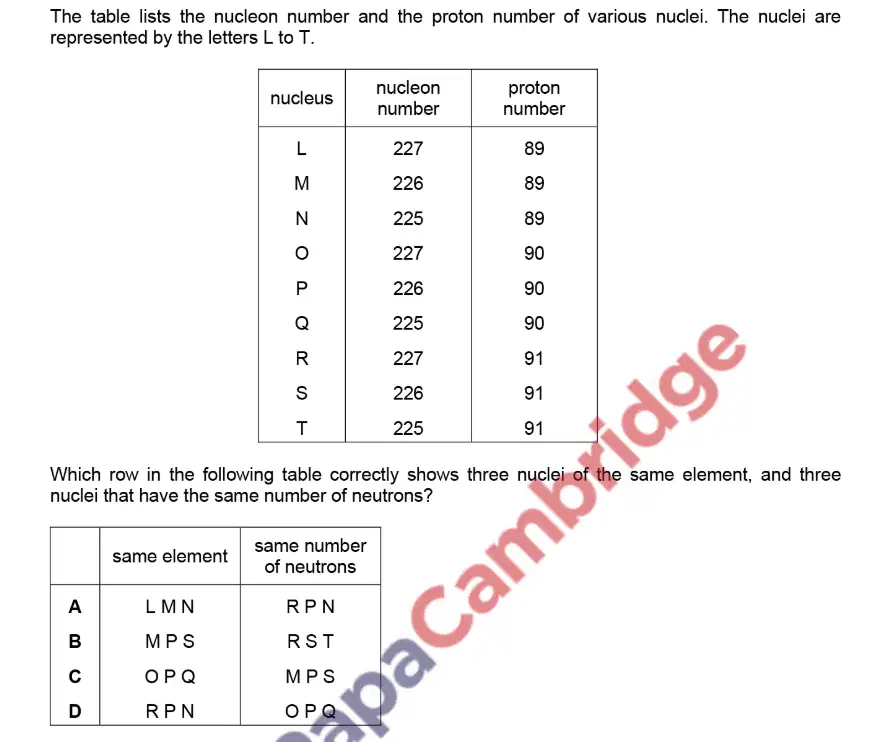
A
B
C
D
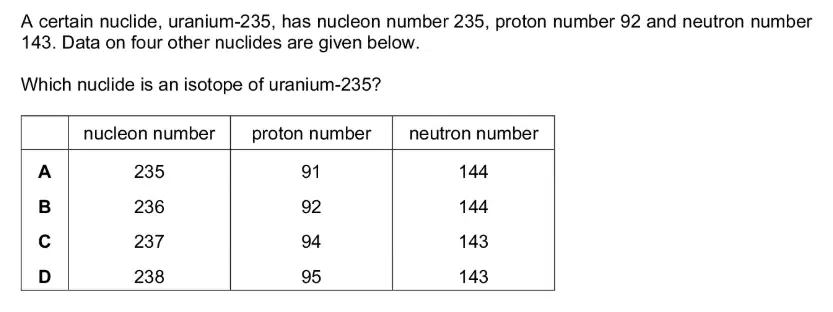
A
B
C
D
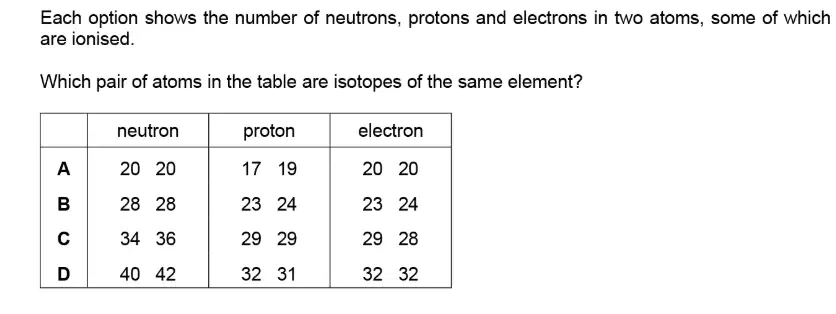
A
B
C
D

A
B
C
D
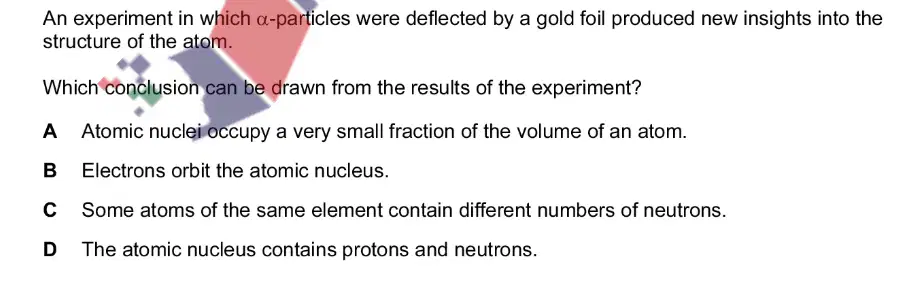
A
B
C
D

A
B
C
D
Who proposed the idea that everything is made up from tiny little particles that can't be broken down any further?
Democritus
Ernest Rutherford
Niels Bohr
John Dalton
Which scientist described atoms as solid spheres and suggested that different types of spheres might make up the different elements?
Democritus
Niels Bohr
John Dalton
J.J. Thompson
Who came up with the plum pudding model of the atom, suggesting that it was a general ball of positive charge with discrete electrons stuck in it?
J.J. Thompson
Niels Bohr
John Dalton
Ernest Rutherford
What did Ernest Rutherford and his students discover in their experiments with alpha particles and a thin sheet of gold?
The alpha particles caused the gold sheet to disintegrate
The alpha particles were absorbed by the gold sheet
The alpha particles were deflected to the side
The alpha particles passed right through the gold sheet
What did Rutherford's nuclear model propose about the structure of the atom?
The atom had a compact nucleus containing all the positive charge
The atom was a solid sphere with a cloud of negative charge around it
The atom was a general ball of positive charge with discrete electrons stuck in it
The atom had a cloud of negative electrons surrounding a positive nucleus
What was the flaw in Rutherford's nuclear model of the atom?
The model did not account for the existence of electrons
The model did not explain the presence of protons
The model did not prevent the collapse of the atom
The model did not include the concept of neutrons
Who suggested that the electrons orbited the nucleus in a similar way to how the planets orbit the sun?
Ernest Rutherford
Niels Bohr
John Dalton
J.J. Thompson
What did James Chadwick provide evidence for in the nucleus of the atom?
Electromagnetic waves
Neutral particles
Positively charged particles
Negatively charged particles
What did John Dalton describe atoms as?
Plum pudding
Nuclear models
Solid spheres
Tiny particles
What did J.J. Thompson's experiments show about the structure of the atom?
The atoms had a compact nucleus
The atoms were made up of tiny particles
The atoms contained negatively charged particles
The atoms were solid spheres
Subatomic particles with a negative charge
Electrons
Neutrons
Protons
Quarks


What are the subatomic particles?
Protons, Electrons, Neutrons
Molecules, and atoms
Electrons, Protons, Nucleus
Nucleus, and Electrons
What is this subatomic particle that has positive charge?
Electron
Neutron
Proton
Megatron
What is this subatomic particle that has negative charge?
Electron
Neutron
Proton
Megatron
What is this subatomic particle that has no charge?
Electron
Neutron
Proton
Megatron
What is the smallest particle of an ELEMENT, and it has also all the properties of it?
Molecules
Nucleus
Subatomic particle
Atoms
What is the small, DENSE REGION consisting of protons and neutrons at the CENTER of an atom?
Molecules
Nucleus
Subatomic particle
Atoms
It is consisting of two or more atoms combined together in a specific arrangement. It is the smallest particle of compound that can exist independently. What is this?
Molecules
Nucleus
Subatomic particle
Atoms
Where can we find the location of the Atomic Nucleus?
Center
Left Side
Right Side
Above
What is the atomic model proposed by J.J Thompson, and suggest that negatively-charged electrons were embedded in a kind of cloud or soup of positive charge?
Asia's Next Top Model
Quantum Atomic Model
Plum Pudding Model
Nuclear Model
What is the name of experiment conducted by Ernest Rutherford's Team, in testing the validity of Plum Pudding Model, which then resulted to introducing of the NUCLEAR MODEL of an Atom?
Planetary Model Experiment
Alpha particle scattering Experiment
Paro-Paro G Experiment
Quantum Particle Experiment
Who was the Greek philosopher who called the smallest particle of matter an "atom"?
Democritus
Aristotle
J.J Thompson
Einstein
All matter is made of
energy
atoms
electrons
compounds
The smallest particle of an element that still represents that element.
Nucleus
electron
proton
atom
Which scientist discovered the electrons?
Dalton
Thomson
Atristotle
Bohr
Bohr discovered that electrons are located in
the nucleus
inside protons
electron cloud
circular orbits around the nucleus
What is a particle with one negative charge called?
electron
proton
quark
neutron
What is a particle with one positive charge called?
proton
electron
neutron
quark
What is the neutral particle found in the nucleus called?
proton
neutron
electron
quark
What is the center of an atom called?
nucleus
electron cloud
proton center
photon center
Which of the following is/are conclusions based on Rutherford’s gold foil experiment?
Atom is mostly empty space
The nucleus is positively charged
The atom has a small dense nucleus
All answers are correct

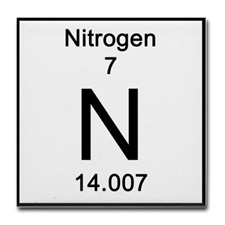
The majority of an atom's mass exists ...
In the nucleus
In the electron cloud
In the space between the nucleus and the electrons
In the neutrons


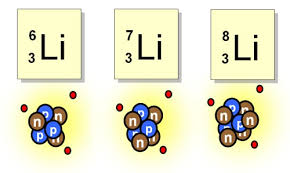

The diagram represents the neutral lithium atom. All particles in the atoms are shown on the diagram. How many electrons does in this diagram?
(a)
The diagram represents the neutral lithium atom. All particles in the atoms are shown on the diagram. How many neutrons does in this diagram?
(a)
Who's developed the idea that an atom consist of electrons that surrounded by protons like plum surrounded by pudding?
(a)

A isotope of Iridium -192 is written using this symbol. How many protons does a nucleus of Iridium-192 contains?
(a)

A isotope of Iridium -192 is written using this symbol. How many neutrons does a nucleus of Iridium-192 contains?
(a)
Subatomic particles with a negative charge
Electrons
Neutrons
Protons
Quarks
The subatomic particle that decides what an atom is.
Electron
Neutron
Neutrino
Proton

What do the red balls represent?
Protons
Neutrons
Electrons
Neutrinos
What is the region in the middle of the atom called?
The Nuclide
The Energy Levels
The Electron Shells
The Nucleus
What do the green balls represent?
Protons
Neutrons
Electrons
Neutrinos
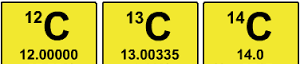
Carbon-12 and Carbon-14 are both isotopes of Carbon. What do the 12 and 14 mean?
The total number of protons in the nucleus
The total number of neutrons in the nucleus
The total number of nucleons in the nucleus
The total number of electrons around the nucleus

What is the name of the isotope in the AZE notation above?
Carbon-6
Carbon-8
Carbon-14
Carbon-20
Explain how the Rutherford gold foil experiment correctly advanced atomic theory away from the plum pudding mode
it proved the atom contained positive AND negative charges.
It proved the positive charge is concentrated in a relatively small region of the atom.
It proved the atom contains protons, electrons, and neutrons.
It proved that atoms are spherical in shape and not shaped like pudding
In the famous gold foil experiment, radioactive particles were fired at a very thin sheet of gold foil. Most of the particles passed straight through the gold foil. Only about 1 in every 8000 particles were deflected. The gold foil experiment showed the researchers that the atom is made mostly of
protons
electrons
neutrons
empty space
Carbon-12 has an atomic number of 6 and a mass number of 12. How many electrons would be found in a neutral atom of carbon-12?
6
12
18
24
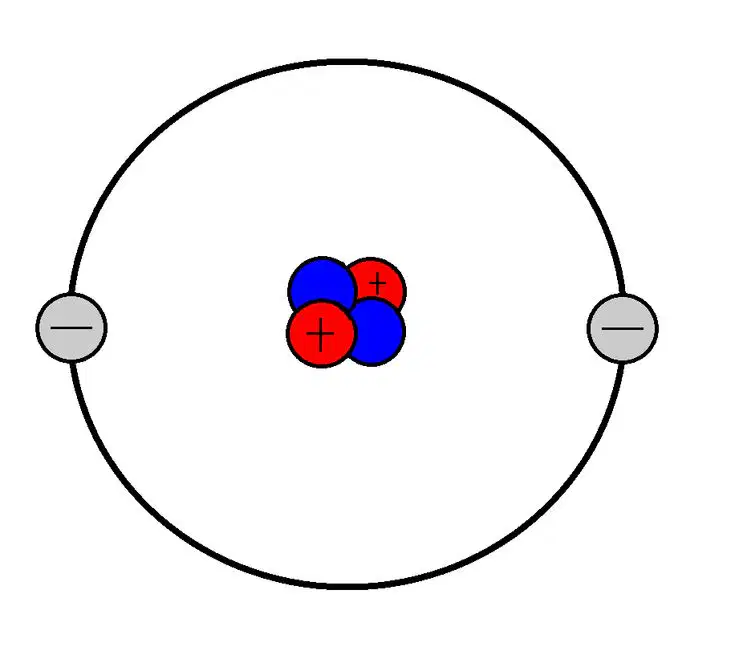
What is the name of this atom?
helium
beryllium
carbon
oxygen
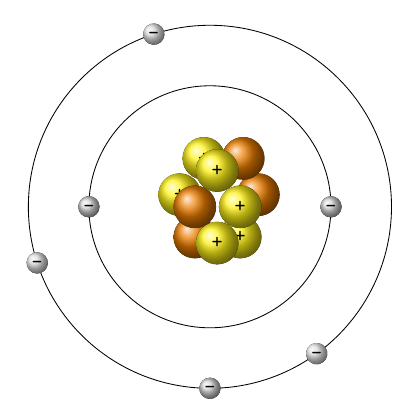
What would be the mass number of this atom?
4
10
22

Which of the following is the correct combination of nucleons (protons or neutrons) in this isotope of carbon?
14 protons and 6 electrons
8 neutrons and 6 protons
6 neutrons and 8 protons
6 protons and 8 electrons

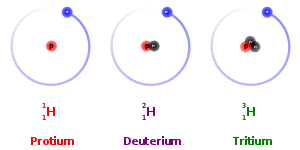
The image shows three isotopes of hydrogen.
Which of the following correctly describes the meaning of an isotope?
Atoms with the same number of electrons and neutrons, but different numbers of protons.
Atoms with the same number of protons and neutrons, but different numbers of electrons.
Atoms with the same number of electrons and protons, but different numbers of neutrons
Atoms with the same number of electrons, neutrons and protons.

In the Rutherford scattering experiment one observation noted was that most alpha particles fired at the gold foil passed straight through. What does this tell us about the structure of the atom?
The nucleus was positively charged.
The nucleus was negatively charged.
The atom was made up mostly of empty space.
The atom was very dense and tightly packed with nucleons.
In the Rutherford scattering experiment one observation noted was that some alpha particles fired at the gold foil were backscattered. What does this tell us about the structure of the atom?
The nucleus was positively charged.
The nucleus was negatively charged.
The atom was made up mostly of empty space.
The atom was very dense and tightly packed with nucleons.

Which of the following are methods for protecting a person from nuclear radiation?
Distance
Shielding
Limiting time of exposure
All of the above
Which device is used to detect nuclear radiation?
GM tube
Rutherford tube
Curie tube
Giga-counter
Which type of nuclear radiation travels at the speed of light?
Alpha radiation
Beta radiation
Gamma radiation
Neutron radiation
Particles in an atom that are neutral which means they have no charge are _____.
negatrons
electrons
neutrons
protons

