
 Worksheets
Spring 2023 PHY SCI Final
Total questions: 108
Worksheet time: 2hrs 50mins
Atoms are electrically ___________
Neutral
Positively charged
Negatively charged
particles
What is the meaning of conduction ?
Having to objects TOUCH each other and transfer protons from one object to the next.
Having to objects touch each other and transfer electrons from one object to the next.
Having to objects touch each other and seperate protons from one object to the next.
None of the above
Like charges
Hug
Repel
Attract
Hate each other
what happens when you rub the balloon against your hair?
Balloon lose protons and hair gain protons
Balloon lose electrons and hair become neutral
Balloon gain electrons and hair lose electron
both become neutral
what is grounding?
A and C
the transfer of protons from an object to the ground.
When an object fall on the ground.
Electrical connection to earth.
glass, rubber, silk, and plastic are all examples of
Conductors
Insulator
Thermel conductivity
Materials
Electric charge is _________ this means that the total electric charge in the universe is __________
conserved and constant
neutral and constant
positive and negative
Conserved and grounded
What is the effect of one negatively charged object and one positively charged object coming close to each other.
The objects repel each other.
The objects attract each other.
An object with a negative charge will be most strongly attracted to which of the following?
an object with a weak positive charge
an object with a strong positive charge
an object with a weak negative charge
an object with a strong negative charge
positive
negative
neutral or no charge
opposite


Which diagram correctly shows the electric field around a negative charge?
A
B
they are both positive
What type of force is electric force?
Pull and Push
Contact Force
magnetic force
Non contact force
Example on insulator is ......................................
Wire
metal
wood
copper


This is an example of a _______ circuit
open
series
parallel
square
is the opposition to the flow of charges in a material.
Resistance
Voltage
Time
Current

What would happen if you took one end of the wire off the battery?
The nail will be a magnet.
The nail would no longer be a magnet
Nothing will happened.
The nail will heats up.
Electric currents produce _____________
electron clouds
magnetic fields
sound waves
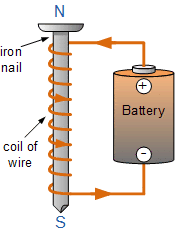


This is an object made from a battery, a nail and some wire. What will happen if you touch a metal paper clip to the nail?
The wires will melt.
The battery will spark.
The nail will give you a shock.
The paper clip will stick to the nail.
What do we call a device that converts electricity into mechanical movement?
electric charge
electric motor
electric current
electric plasma

Which statement is true?
I. All electromagnets are permanent magnets.
II. Increasing the number of coils in an electromagnet decreases it strength.
III. Increasing the batteries increases the strength of an electromagnet.
Both I and II
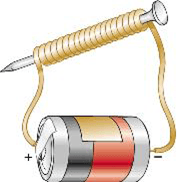
Electromagnet is a permanent magnet
True
False

What do the lines around this magnet represent?
¿Qué representan las líneas alrededor de este imán?
North Pole
South Pole
Magnetic Declination
Magnetic Field

Which pair of magnets would result from cutting the magnet in half?


The picture shows an experiment used to determine the effect of using more nails in the core of an electromagnet. Which of the following would make this a better-designed experiment?
Using a different number of batteries for each electromagnet
Using the same number of turns of wire for each electromagnet
Inserting an ammeter in each circuit between the battery and the nails
Using a different size battery for each electromagnet
Which two areas of physical science are closely related to the development of electric motors and generators?
sound and light
electricity and sound
light and magnetism
electricity and magnetism

Which of the following best describes a simple electric motor?
It converts electric energy into chemical energy and heat.
It converts mechanical energy into electric energy and heat.
It converts electric energy into mechanical energy and heat.
It converts mechanical energy into chemical energy and heat.
Electromagnetic radiation can be used to
predict the weather
make topographical maps
find volcanoes
all of the above
Which set of light types follows the pattern of low to high energy?
microwaves, infrared, visible
radio waves, x-rays, gamma
infrared, visible, ultraviolet
all of the above
Why do dentists put a lead apron on you before taking x-rays?
They want you to be comfortable, like wearing a weighted blanket.
Lead can stop x-rays from passing through you where they are not wanted.
There is no good reason for it.
The lead apron helps the x-rays take better pictures.
What unit is wavelength reported in?
meters
Hertz
meters/second
seconds/meter

Which of the following has the shortest wavelength?
microwaves
UV rays
Infrared
the color blue

Which of the following has the most energy?
X-rays
The color green
Microwaves
ultraviolet

Which of the following has the highest frequency?
TV
Microwaves
the color indigo
ultraviolet rays
How do electromagnetic and mechanical waves compare?
Mechanical waves can only travel through a vacuum, but electromagnetic waves can travel through a solid, liquid, or gas.
Mechanical waves can travel through a solid, liquid, or gas, but electromagnetic waves can only travel through a gas.
Mechanical waves can only travel through a solid, liquid, or gas, but electromagnetic waves can travel through a vacuum.
Mechanical waves can travel through a solid, liquid, or gas, but electromagnetic waves can only travel through a solid.

Which distance represents the amplitude?
W
X
Y
Z
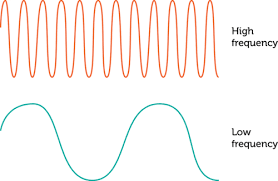
If a wave has a greater frequency, what happens to number of waves per second?
increases
decreases
stays the same
Which has the LONGEST wavelength and, therefore, the LOWEST frequency/energy
Gamma Rays
Ultraviolet
Visible Light
Infrared rays


Electromagnetic waves vary in
the speed they travel in a vacuum.
wavelength and frequency.
the way they reflect.
the orientation of their electric and magnetic fields.
Alexandra was preparing to go on a hike in the woods. She gathered the equipment she would need and placed it on the kitchen counter. By chance, she placed her compass near an electrical outlet. Although the compass was not moving, the compass needle turned toward the outlet because....
the electric current in the outlet produced a magnetic field
the compass only works properly outside
the kitchen counter was made of a ferrometal
the kitchen has a microwave
A material through which electrons do NOT flow easily is a(n) ______.
insulator
conductor
fuse
circuit breaker
How are two ways that Earth's magnetic field is useful for us?
It allows us to know which direction is "Down" and allows for better navigation
It protects the surface of the earth from UV rays and causes tides
It produces the Auroras and causes the spin of the earth
It blocks the harmful Solar Wind and allows for more efficient navigation

What kind of wave is pictured below?
compressional wave
transverse wave
sound wave
mechanical wave


The glass prism is able to bend light because .......
light is refracted as it enters a different medium
the prism offers destructive interference
energy is diffracted when it encounters an obstacle
the glass and the light's wavelength create resonance

Is the image Reflection, Refraction, or Diffraction?
Refraction
Reflection
Diffraction

The vertical (up and down) columns in the Periodic Table are called
groups
towers
periods
atomic numbers
Atom
Mixture
Compounds
Elements



What is a physical property of these strawberries?
Red
Rotten
Flammable
Bad odor
Physical properties....
change the matter when studied
can be observed and measured without changing the matter being studied
include the ability to burn and rust
are useless unless studied in a lab

What is happening at point B if heat is entering the matter?
melting
freezing
evaporating
condensing
Which statement is accurate regarding subatomic particles?
electrons are the heaviest particle, with a positive charge
protons and electrons are equal in mass with positive charges
electrons are neutral with the least mass
protons have a positive charge with a mass of 1 amu and neutrons are neutral with the same mass as a proton
What are the two elements which are liquid at room temperature
Mercury, Bromine
Iodine, sodium
Selenium, manganese

Is this an example of a physical or chemical change?
physical
chemical

Is this an example of a physical or chemical change?
physical
chemical

Is this an example of a physical or chemical change?
physical
change
Which of the following is NOT an example of a physical change?
crumpling paper
sharpening a pencil
clothes shrinking
sour milk
Describes how matter reacts with other matter. Examples: flammability and toxicity.
physical properties
chemical properties
Pb4+ and O2- create...
Pb2O
PbO2
Pb2O2
PbO
Rb+ and P3- create...
Rb3P
RbP3
RbP
Rb2P
H+ and N3- create...
H3N
HN2
H2N2
HN
A chemical bond between a metal and a non-metal
Ionic Bond
James Bond
Covalent Bond
Polar Bond
Name this group: These metals are the most reactive.


Name this group: These metals are the second most reactive.


This picture illustrates copper's
brittleness
malleability
ductility


