wayground logo

Free Printable Worksheets

Font size

S
M
L
XL
Worksheets

Regents Physics Review (21-22)

Total questions: 108

Worksheet time: 3hrs 51mins

Name
Class
Date
1.
The graph respresents
a)
no motion
b)
constant velocity
c)
increasing velocity
d)
decreasing velocity
2.
At what time did runner A pass runner B?
a)
0 seconds
b)
1 second
c)
2 seconds
d)
3 seconds
3.
Calculate the acceleration for segment A.
a)
2 m/s2
b)
2 m/s
c)
-2 m/s2
d)
0 m/s2
4.
At 60 seconds, how far had this object traveled? 
a)
0 m
b)
10 m
c)
20 m
d)
40 m
5.
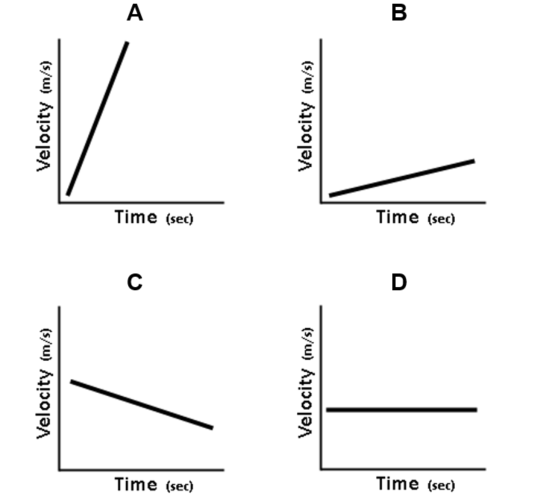
Which graph represents zero acceleration (constant velocity)?
a)
A
b)
B
c)
C
d)
D
6.
Which runner got a head start?
a)
red line runner
b)
blue line runner
7.
Which runner is faster?
a)
red line runner
b)
blue line runner
8.
What is happening between 2 and 3 seconds?
a)
The object is not moving.
b)
The object is not accelerating.
c)
The object is slowing down.
d)
The object is speeding up.
9.
What is happening between 3 seconds and 4 seconds?
a)
The object is moving in a negative direction.
b)
The object is returning to its starting position.
c)
The object is slowing to a stop.
d)
The object is changing direction.
10.
What happens at 4 seconds?
a)
The object changes direction.
b)
The object is at the starting point.
11.

What is happening between 4 and 5 seconds?

a)

The object is slowing down in a negative direction.

b)

The object is slowing down in a positive direction.

c)

The object is speeding up in a positive direction.

d)

The object is speeding up in a negative direction.

12.

Find the displacement in the first 5 seconds.

a)

8 centimeters

b)

4 centimeters

c)

2 centimeters

d)

5 centimeters

13.

Find the total displacement in the 7 seconds of motion.

a)

1 centimeter

b)

0 centimeters

c)

9 centimeters

d)

12 centimeters

14.
The red line shows...
a)
A stationary object.
b)
An object with constant velocity.
15.

A person walking along a straight line moves such that her velocity as a function of time can be represented by the graph above. At what time does the person have the same position as she had at time t = 0?

a)

At t = 5 s

b)

During the interval 5 s < t < 8 s

c)

At t = 8 s

d)

During the interval t > 8 s

16.
At 60 seconds, how far had this object traveled? 
a)
0 m
b)
10 m
c)
20 m
d)
40 m
17.
What does this graph represent?
a)
Constant Speed
b)
Acceleration
c)
Deacceleration
d)
Not moving
18.
Who had the greatest average speed after 100 seconds?
a)
Mike
b)
Katelyn
c)
Alex
d)
They had the same average speed
19.
What is happening at C?
a)
Stationary
b)
Accelerating
c)
Fast steady speed; moving away from the starting position
d)
Slower steady speed; moving away from the starting position
20.
What is happening at D?
a)
Stationary
b)
Accelerating
c)
Fast steady speed; moving away from the starting position
d)
Slower steady speed; moving away from the starting position
21.

Total distance an object travels with direction.

a)

Displacement

b)

Distance

c)

Path

d)

Velocity

22.

Which is a vector quantity?

a)

distance

b)

speed

c)

displacement

d)

time

23.

A car travels a distance of 98 meters in 10. seconds. What is the average speed of the car during this 10.-second interval?

a)

4.9 m/s

b)

9.8 m/s

c)

49 m/s

d)

98 m/s

24.
What is the speed of an object that travels 20 meters in 4 seconds?
a)
80 m/s
b)
0.2 m/s
c)
5 m/s
d)
24 m/s
25.
The force of gravity pulling down on an object is called
a)
mass
b)
weight 
c)
physical change
d)
resistance
26.
What is the density of a rock that has a mass of 4 grams and a volume of 1.2 cm3?
a)
4.8 g/cm3
b)
0.3 g/cm3
c)
3.33 g/cm3
27.
What is the speed of a rabbit that runs 56 meters in 9 seconds?
a)
504 m/s
b)
0.16 m/s
c)
6.22 m/s
d)
56 m/s
28.
What is force?
a)
A push exerted on an object
b)
A push or pull exerted on an object
c)
A pull exerted on an object
d)
Nothing
29.
How much force is needed to accelerate a 25kg bowling ball at 2m/s2
a)
50N
b)
5N
c)
12.5N
d)
100N
30.
If a 2kg bird is pushed by the wind with a force of 2N, how fast does the bird accelerate?
a)
1 m
b)
2 m/s2
c)
4m/s2
d)
1 m/s2
31.
Scott travels north 5 miles and then goes west 3 miles before coming straight back south 2 miles. What is his distance?
a)
10
b)
7
c)
8
d)
6
32.
A persons walks 50 meters directly north, stops, and then travels 32 meters directly south.  What is their displacement?
a)
82 meters
b)
18 meters
c)
28 meters
33.
What is the net force of the following picture?
a)
8N to the right
b)
2N to the left
c)
8N to the right
d)
2N to the right
34.
Objects with greater _________ also have greater inertia.
a)
speed
b)
mass
c)
temperature
d)
friction
35.
Inertia is the tendency of an object to resist a change in its ___________. 
a)
temperature
b)
shape
c)
size
d)
motion
36.
What is the rate of gravitational acceleration?
a)
9.8 m/s
b)
8.9 m/s
c)
9.8 m/s2
d)
8.9 m/s2
37.

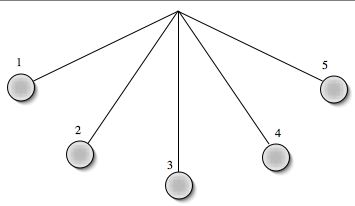
The pendulum in the image above has a mass of 1 kg and is dropped from a height of 0.5 m. How much kinetic energy does it have at B?

a)

0.5 J

b)

4.9 J

c)

9.8 J

d)

1.0 J

38.

What type of wave is light?

a)

electromagnetic

b)

mechanical

39.

If an object has a mass of 20 kg and a velocity of 4 m/s, what is the momentum of the object?

a)

80 kgm/s

b)

4 kgm/s

c)

5 kgm/s

d)

.2 kgm/s

40.

Which object has more momentum?

a)

motorcycle at 15 mph?

b)

bike at 15 mph

c)

car at a stoplight

d)

runner at 10 mph

41.
Temperature is a measure of the...
a)
total energy in a substance
b)
total kinetic energy in a substance
c)
average potential energy in a substance
d)
average kinetic energy of molecules in a substance
42.
What part of the wave is shown at letter A?
a)
crest
b)
trough
c)
wavelength
d)
frequency
43.

The amount of energy a wave carries is the _________.

a)

Amplitude

b)

Height

c)

Loudness

d)

Volume

44.
How many volts are in a circuit with a battery that has a resistance of 10 Ohms and a current of 2 Amps? 
a)
.5 Volts
b)
5 Volts
c)
20 Volts
45.
How many volts are in a circuit with a battery that has a resistance of 10 Ohms and a current of 2 Amps? 
a)
.5 Volts
b)
5 Volts
c)
20 Volts
46.
Acceleration: is the rate of change in ___________.
a)
speed
b)
distance
c)
velocity 
d)
displacement 
47.

A roller coasters accelerates from an initial speed of 6.0 m/s to a final speed of 70 m/s over 4 seconds. What's the acceleration?

a)

24 m/s2

b)

18 m/s2

c)

16 m/s2

d)

16 m/s

48.
The SI unit for acceleration is
a)
mph
b)
ft/sec2
c)
m/s2
49.
When are you undergoing an acceleration in a car? 
a)
speed up
b)
slow down
c)
make turns
d)
All of the above 
50.
Which graph shows the object standing still?
a)
A
b)
B
c)
C
d)
D
51.
Which graph demonstrates the greatest positive speed?
a)
A
b)
B
c)
C
d)
D
52.

Acceleration is

a)

the rate at which velocity changes.

b)

the change in velocity

c)

the rate of change

d)

when you speed up only

53.
Which statement describes a vector?
a)
It has magnitude but no direction
b)
It has direction but no magnitude
c)
It has both direction and magnitude
d)
It has constant magnitude but no
 direction
54.
Is this a scalar quantity or a vector quantity?
A deer running 15 meters per second due west
a)
Scalar
b)
Vector
55.
Which of these is not a vector quantity? 
a)
displacement 
b)
time
c)
velocity 
d)
acceleration
56.
What is the net force?
100 N        230 N
<------        --------->
a)
30 N to the right
b)
230 N to the right
c)
130 N to the right
d)
This is a balanced force
57.

What is this Equation: a2+b2=c2a^2+b^2=c^2  

a)

Standard Vector Form

b)

Resultant Vector

c)

Pythagorean Theorem

d)

Equation of a Circle

58.
If a car moves 12 km North, 19 km East, and 12 km South, what is its displacement?
a)
12 km
b)
19 km, East
c)
31 km
d)
43 km, East
59.
A hiker walks 5 kilometers due north and then 7 kilometers due east. What is the magnitude of the resultant vector?
a)
2 km
b)
8.6 km
c)
12 km
d)
12.6 km
60.

At what point is vy= 0 m/s?

a)

A

b)

B

c)

C

d)

D

e)

None of these points

61.
If you drop a banana, how fast is it going after 2 seconds?
a)
4.9m/s
b)
9.8m/s
c)
19.6m/s
d)
29.4m/s
62.
If you throw a baseball straight up, what is its velocity at the highest point?
a)
9.8 m/s2
b)
9.8 m/s
c)
0 m/s2
d)
0 m/s
63.
If you throw a baseball straight up, what is its acceleration at the highest point?
a)
9.8 m/s2
b)
9.8 m/s
c)
0 m/s2
d)
0 m/s
64.
The more mass an object has, the faster it will fall.
a)
True
b)
False
65.
What is the horizontal acceleration of a projectile?
a)
0 m/s2
b)
9.8 m/s2
66.
What is the vertical acceleration of a projectile?
a)
0 m/s2
b)
9.8 m/s2
67.
If I throw a crayon straight up at 12m/s, how fast is its speed when i catch it at the same height?
a)
6 m/s
b)
12 m/s
c)
18 m/s
d)
24 m/s
68.
If a bullet is horizontally shot at the same moment another bullet is dropped from the same height, which will hit the ground first?
a)
Shot Bullet
b)
Dropped Bullet
c)
Hit at Same Time
69.

When an object is moving, friction acts in the _______ direction as the motion.

a)

perpendicular

b)

same

c)

opposite

d)

precise

70.

The equation for the force of friction is _______.

a)

Ff = µFg

b)

Ff = µFN

c)

Ff = µFT

d)

Ff = µFs

71.
What is the force that causes objects to fall to Earth?
a)
Air resistance
b)
Gravity
c)
Water resistance
d)
Pressure
72.
What is the name of the units that we measure force in?
a)
Einsteins 
b)
Newtons
c)
Kg
d)
Metres
73.
When two objects rub together, what force do they produce
a)
Gravity
b)
Air resistance
c)
Friction
d)
Water resistance
74.

What is the definition of net force?

a)

a push or a pull that acts on an object

b)

Net force equal 0N and there is no change in the object's motion

c)

the overall force acting on an object after all the forces are combined

d)

The force does not equal 0N, the object accelerates

75.

What do we call a force that has a net force of zero Newtons and the object does not change its motion?

a)

balanced force

b)

unbalanced force

c)

acceleration force

d)

net force

76.

What do we call a force that causes an object to accelerate?

a)

net force

b)

moving force

c)

acceleration force

d)

unbalanced force

77.

What is the magnitude and direction of the force in the free body diagram shown?

a)

70 N right

b)

70 N left

c)

50 N right

d)

50 N left

78.

What is the magnitude and direction of the force in the free body diagram shown?

a)

20 N, no change in motion

b)

20 N right

c)

20 N left

d)

0 N , no change in motion

79.

What is the magnitude and direction of the force in the free body diagram shown?

a)

2000 N forward

b)

800 N backward

c)

1200 N forward

d)

2800 N forward

80.

What is the magnitude and direction of the force in the free body diagram shown?

a)

35 N right

b)

17 N right

c)

11 N right

d)

5 N right

81.

What is the magnitude and direction of the force in the free body diagram shown?

a)

5 N down

b)

0 N, no change in movement

c)

15 N up

d)

15 N down

82.

Newton's First Law: An object in motion will stay in motion and an object at rest will stay at (a)   unless acted on by an outside force.

83.
What is the net force?
a)
5.5 N left
b)
5.5 N right
c)
2.5 N left
d)
2.5 N right
84.
What is the net force?
a)
65 N left
b)
65 N right
c)
35 N left
d)
35 N right
85.
Momentum is a ____________________ quantity
a)
science
b)
scalar
c)
vector
d)
energy
86.

The momentum of an object depends upon the object's ___________&_____________.

a)

size and shape

b)

mass and speed

c)

mass and veloctiy

d)

mass and energy

87.
Determine the momentum of 1000-kg car moving northward at 20 m/s......... 
a)
20000 N
b)
20000 Joules
c)
20000 Kg * m/s
d)
20000 kg * m/s north
88.
The equation to calculate momentum is
a)
p=mv
b)
p=1/2mv2
c)
p=mgh
d)
p=mg
89.
In any collision (crash) the ______ is ALWAYS constant
a)
Total Momentum
b)
total speed
c)
total Velocity
d)
Energy
90.
The total momentum before a collision is _________ the total momentum after a collision.
a)
equal to 
b)
less than 
c)
more than
d)
It depends on the type of collision
91.

An impulse depends on

a)

weight and force

b)

force and time

c)

electric charge and time

d)

none of these

92.

An object having a pi of 30kg m/s has ended with a pf of 40 kg m/s. What impulse caused this?

a)

2kg m/s

b)

10kg m/s

c)

70kg m/s

d)

5kg m/s

93.

If the change of momentum of an object is 50kg m/s, we can say the impulse is equal to:

a)

0 kg m/s

b)

25 kg m/s

c)

50 kg m/s

d)

100 kg m/s

94.

In an equation Impulse is represented with the letter...

a)

I

b)

M

c)

J

d)

P

95.
An object with a mass of 2000 kg at rest has what momentum?
a)
2000 kg m/sec
b)
0 kg m/sec
c)
2000 kg
d)
2000 m/sec
96.

A 6kg cat misjudges a jump and falls 5 meters. How much gravitational potential energy does the cat have? (The cat is fine by the way.)

a)

294 J

b)

180000 J

c)

1225 J

d)

3920000 J

97.

What is the kinetic energy of a 1,600kg Mustang travelling at 15 m/s (33mph)

a)

180000 J

b)

294 J

c)

1225 J

d)

3920000 J

98.

What is the unit for distance?

a)

kilogram (kg)

b)

meter (m)

c)

Newton (N)

d)

Joule (J)

99.

What is the unit for energy?

a)

kilogram (kg)

b)

meter (m)

c)

Newton (N)

d)

Joule (J)

100.

What is the formula for speed?

a)

distance / time

b)

mass x acceleration

c)

velocity / time

d)

½(mass) x (velocity)2

e)

(mass) x (acceleration of gravity) x (height)

101.

What is the formula for force?

a)

distance / time

b)

mass x acceleration

c)

velocity / time

d)

½(mass) x (velocity)2

e)

(mass) x (acceleration of gravity) x (height)

102.

What is the formula for acceleration?

a)

distance / time

b)

mass x acceleration

c)

velocity / time

d)

½(mass) x (velocity)2

e)

(mass) x (acceleration of gravity) x (height)
103.
Energy due to motion is ____________ energy. 
a)
Potential 
b)
Energy
c)
Kinetic
d)
Friction
104.
The faster an object moves, the ________ kinetic energy it has. 
a)
more
b)
less
c)
none of the above
d)
all of the above 
105.
Gravitational potential energy depends on the ________ and ________ of the object. 
a)
Height and mass
b)
Friction and movement
c)
Mass and Movement
d)
Height and Friction 
106.
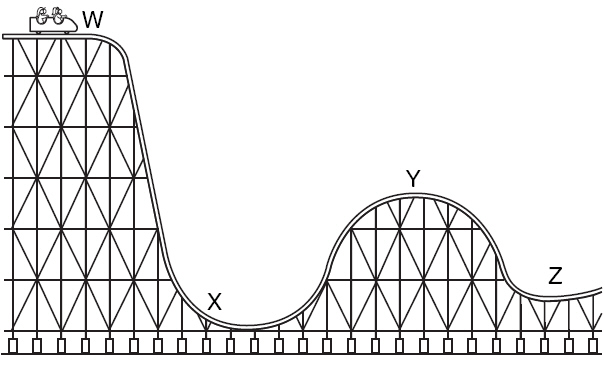
At which point is potential energy greatest?
a)
W
b)
X
c)
Y
d)
Z
107.
When a pendulum swings, at which point is potential energy at its greatest?
a)
1
b)
2
c)
3
d)
4
108.
Potential energy that depends on height is called
a)
kinetic energy
b)
gravitational potential energy
c)
elastic potential energy
d)
mechanical energy