wayground logo

Free Printable Worksheets

Font size

S
M
L
XL
Worksheets

Grade 10 end of year Quiz practice questions

Total questions: 110

Worksheet time: 2hrs 2mins

Name
Class
Date
1.
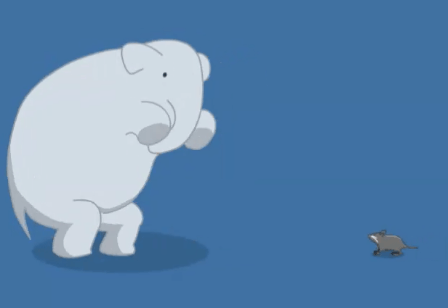
What type of force is shown in the picture?
a)
The Cat force
b)
Star Wars Force
c)
Unbalanced force
d)
Balanced  force
2.
What is a Force?
a)
The distance
b)
Mass
c)
A push or pull
d)
Give me a  failing grade 
3.
An _______ force must act on an object for it to CHANGE it's motion
a)
balanced
b)
unbalanced
c)
gravitational
d)
electrical
4.

If the net force is equal to zero, the forces acting on the object are

a)

balanced

b)

unbalanced

5.
Balanced forces do not change the objects speed or 
a)
direction
b)
distance 
c)
time
d)
mass
6.
The unit of force is
a)
m/s
b)
m/s^2
c)
newton
d)
kg
7.
What is the net force?
a)
5000 N right
b)
4000 N right
c)
40 N left
d)
4000 N left
8.
Jonny and Patty are pushing against a basketball. Both of them push against theball on opposite sides with a force of 20 N to keep the ball still. What is the net force?
a)
400 N
b)
24 N
c)
0 N
d)
40 N
9.
What is the net force in this picture?
a)
50 Newtons to the right
b)
950 Newtons to the right
c)
950 Newtons to the left
d)
50 Newtons to the left
10.
What will cause an object to move?
a)
Applied forces
b)
Balanced forces
c)
Unbalanced forces
11.

Two forces act on an object to the right at the same time. What force is required to bring the object into equilibrium?

a)

9 N to the right

b)

9 N to the left

c)

3 N to the left

d)

18 N to the left

12.
What is 'drag' another name for?
a)
dressing up
b)
air resistance
c)
friction
d)
weight
13.
What is the name for a single force on an object with the same effect as all the forces combined?
a)
big
b)
total
c)
resultant
d)
sum
14.
Is the car
a)
Stationary
b)
Moving at constant speed
c)
Accelerating
d)
Decelerating
15.
Is the car
a)
Stationary
b)
Moving at constant speed
c)
Accelerating
d)
Decelerating
16.
In a tug of war the left team pulls with a force of 200N. The right team pulls with a force of 150N.What is the resultant force?
a)
50N to the left.
b)
350N to the left.
c)
350N to the right.
d)
50N to the right.
17.
Which objects have a STRONG force of gravity?
a)
Objects with GREATER mass, like elephants
b)
Objects with LESS mass, like mice
18.
The force of gravity acting on an object is the object's ______.
a)
mass
b)
matter
c)
weight 
d)
friction 
19.
The amount of matter in an object is 
a)
pressure
b)
weight
c)
mass
d)
force
20.
A person would weigh less on on the Moon than on the Earth because . . .
a)
Moon has more mass, and therefore more gravity
b)
Moon has less mass, and therefore more gravity
c)
Moon has more mass, and therefore less gravity
d)
Moon has less mass and therefore less gravity
21.
A child has a mass of 30 Kg on Earth. If the gravity on Moon is one sixth that of the Earth what is the mass of the child on Moon? 
a)
30 Kg
b)
180 Kg
c)
5 Kg
d)
0 Kg
22.
The scientific unit for mass is
a)
Kg
b)
N
c)
pounds
d)
ounces
23.
If an object mass =30 Kg on the Earth, what would be it's weight on Earth?
a)
30 N
b)
300 kg
c)
3000N
d)
300 N
24.
If the mass of an object is 1000 kg on Earth, what is it's mass on the moon?
a)
10kg
b)
100kg
c)
1000kg
d)
10,000kg
25.
The force of gravity on Jupiter is a little more than 2 times the gravitational force on Earth. If an object has a mass of 50 kg and a weight of 490 N on Earth, what would be the object's approximate mass and weight on Jupiter?
a)
50 kg and 490 N
b)
100 kg and 490 N
c)
50 kg and 980 N
d)
100 kg and 980 N
26.

What is the formula for speed?

a)

speed = distance x time

b)

speed=distance / time

c)

speed = time / distance

d)

speed = distance + time

27.

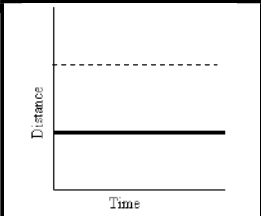
What does the solid line on this graph represent?

a)

Constant speed

b)

Acceleration

c)

At rest

d)

deceleration

28.

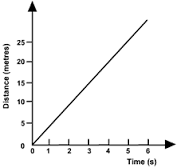
What is the line on this graph showing?

a)

moving away from starting point at a constant speed

b)

moving back towards the starting point at a constant speed

c)

acceleration (getting faster)

d)

deceleration (getting slower)

29.
Which graph is showing acceleration (getting faster)
a)
D
b)
E
c)
both D and E
d)
neither D or E
30.
How long did it take this object to travel 10 m?
a)
0 s
b)
10 s
c)
15 s
d)
20 s
31.
At 60 seconds, how far had this object traveled? 
a)
0 m
b)
10 m
c)
20 m
d)
40 m
32.

What is represented by this graph?

a)

constant speed

b)

not moving

c)

speed increasing

d)

speed increasing at a constant rate

33.
Velocity is
a)
speed and acceleration
b)
constant speed
c)
a frame of reference
d)
speed in a given direction
34.

What is happening at E?

a)

Stationary

b)

Accelerating

c)

Constant speed; moving away from the starting position

d)

Constant speed; returning to start position

35.
What happened during C to D point?
a)
not moving
b)
increasing speed at a constant rate
c)
moving at a constant speed
d)
moving at 0 m/sacceleration
36.
Which line represents an object moving at a faster speed?
a)
A
b)
B
37.
Which runner stopped for a rest?
a)
Albert
b)
Bob
c)
Charlie
38.
During which interval is the object traveling at a constant velocity?
a)
B to C
b)
D to E
c)
F to G
d)
it traveling at a constant velocity during all of the intervals shown.
39.
A quantity that has both magnitude and direction is called a scalar quantity.
a)
True
b)
False
40.
Length
a)
Vector
b)
Scalar
41.
Displacement
a)
Vector
b)
Scalar
42.

which of the following is a vector?

a)

velocity

b)

discance

c)

position

d)

speed

43.
Which of the following quantities are vectors?
a)
speed, velocity, acceleration
b)
velocity, acceleration, force
c)
force, acceleration, mass
d)
length, mass, time
44.
Which statement describes a vector?
a)
It has magnitude but no direction
b)
It has direction but no magnitude
c)
It has both direction and magnitude
d)
It has constant magnitude but no
 direction
45.

Heat energy is also called

a)

electrical energy

b)

chemical energy

c)

radiant energy

d)

thermal energy

46.
Which is the energy in motion?
a)
potential energy
b)
chemical energy
c)
thermal energy
d)
kinetic energy
47.
Which of the following energy transformations occur when a lamp that is plugged into a wall socket is functioning correctly?
a)
Chemical to light
b)
Electrical to chemical
c)
Electrical to light
d)
Chemical to electrical
48.

What energy transformations take place when a battery-operated radio is in use?

a)

Electrical to chemical to light

b)

Sound to chemical to kinetic

c)

Chemical to electrical to sound

d)

Light to electrical to thermal

49.
Which of the following shows the correct order of the energy transformations that occur when green plants produce their food from the Sun’s energy?
a)
chemical to thermal
b)
light to chemical
c)
thermal to light
d)
chemical to electrical
50.

At which point in the rollercoaster ride does the car have the greatest potential energy?

a)

W

b)

X

c)

Y

d)

Z

51.

At which point will the pole have the maximum elastic potential energy?

a)

The pole always has the greatest elastic potential energy.

b)

When the vaulter is running with the pole.

c)

When the pole is straight.

d)

When the pole is bent backwards.

52.

The hand generator works by turning the handle which lights up the bulb. What energy transformation occurs as the handle is turned?

a)

Thermal to electrical

b)

Electrical to kinetic

c)

kinetic to electrical to light

d)

Light to electrical

53.
Which type of energy transformation occurs when a flashlight shines?
a)
chemical → thermal → electrical
b)
chemical → electrical → light
c)
thermal → chemical → light
d)
chemical → electrical → chemical
54.

The picture shows a light bulb attached to a hand generator. What energy transformation occurs as the handle of the generator is turned?

a)

thermal → solar → light

b)

solar → light → electrical

c)

kinetic → electrical → light

d)

electrical → kinetic → light

55.
Calculate the KE of a moving 4 kilogram object traveling at a velocity of 3 m/s.
a)
18 J
b)
36 J
c)
12 J
d)
6 J
56.
A moving 10 kilogram object has 20 Joules of KE. What is its velocity?
a)
2 m/s
b)
4 m/s
c)
200 m/s
d)
10 m/s
57.
What is the mass of a moving object that has 100 Joules of KE and moves at a velocity of 2 m/s?
a)
50 kg
b)
200 kg
c)
25 kg
d)
100 kg
58.
As the velocity of an object decreases its KE will...
a)
increase
b)
decrease
c)
stay the same
59.

A kettle uses 100J of electrical energy to produce 7J of sound energy and 93J of thermal energy. How efficient is the kettle?

a)

100%

b)

7%

c)

93%

d)

95%

60.

A washing machine uses 250J of electrical energy to produce 125J of useful energy. How efficient is it?

a)

5%

b)

50%

c)

55%

d)

100%

61.

The energy efficiency shown in this diagram is:

a)

About 10%.

b)

About 30%.

c)

About 60%.

d)

Impossible to tell.

62.

An iPhone charger coverts 75J of electricty in to 50J of charge and 25J of thermal energy. How efficient is the charger?

a)

10%

b)

100%

c)

33%

d)

67%

63.

What is the efficiency?

a)

2%

b)

20%

c)

5%

d)

15%

64.

How much energy is wasted as thermal energy

a)

24

b)

16

c)

14

d)

12

65.

How much efficient is the device?

a)

70%

b)

28%

c)

72%

d)

65%

66.

The mass is 2kg what is the velocity of the object?

a)

12.2 m/s

b)

17.3 m/s

c)

24.5 m/s

d)

30 m/s

67.

How much energy is wasted as sound?

a)

350J

b)

450J

c)

250J

d)

550J

68.

According to Newton’s second law of motion, if force remains the same but mass increases, then acceleration will

a)

increase

b)

decreases

c)

remain constant

69.

Inertia is the resistance of an object to a change in its

a)

gravity

b)

motion

c)

mass

d)

balanced force

70.

An object weighs 30N on earth. A second object weighs 30N on the moon. Which the greater mass? (Note: due to its size, the moon has less gravity than the earth.)

a)

Object on moon

b)

Object on earth

c)

same mass

71.

.


A hockey puck is set in motion across a frozen pond. If ice friction and air resistance are neglected, the forced required to keep the puck sliding at constant velocity is

a)

Equal to the weight of the puck

b)

The weight of the puck divided by the mass of the puck

c)

The mass of the puck multiplied by 9.8 m/s

d)

Zero newtons

72.

Mike's car, which weighs 1,000 kg, is out of gas. Mike is trying to push the car to a gas station, and he makes the car go 0.05 m/s2.Using Newton's Second Law, you can compute how much force Mike is applying to the car
(F= M x A) 

a)

50N

b)

100N

c)

5N

73.
What law?
a)
1st
b)
2nd
c)
3rd
74.
According to Newton’s first law of motion, a moving object that is not acted on by an unbalanced force will
a)
remain in motion.
b)
eventually come to a stop.
c)
change its momentum.
d)
accelerate.
75.
A 20 kg bike accelerates at 10 m/s2.  what was the force
a)
25
b)
200 N
c)
20 N
d)
10 N
76.
In the picture, the vehicle will move because of...
a)
Newton's 1st Law
b)
Newton's 2nd Law
c)
Newton's 3rd Law
d)
Newton's 9th Law
77.

Whats Newtons First Law?

a)

The more force applied to an object the faster it will accelerate.

b)

An object in motion will stay in motion and an object at rest will stay at rest unless acted by an outside force.

c)

for every ection there is an equal and oposite reaction

78.

What is the Net Force?

a)

10

b)

0

c)

3

d)

2

79.
What is the standard unit force is measured in?
a)
Newtons
b)
pounds
c)
grams
d)
meters
80.

When you hit a tennis ball with a racket...

a)

The ball exerts more force on the racket

b)

The ball and racket exert the same force on each other

c)

The racket exerts more force on the ball

d)

It depends on how hard you hit it

81.
Momentum is a ____________________ quantity
a)
science
b)
scalar
c)
vector
d)
energy
82.
The equation to calculate momentum is
a)
p=mv
b)
p=1/2mv2
c)
p=mgh
d)
p=mg
83.
The momentum of an object depends upon the object's ___________&_____________.  
a)
size and shape
b)
mass and speed
c)
mass and veloctiy
d)
mass and energy
84.

Find the momentum of a 3.0 kg mass when it is stopped.

a)

0 kg*m/s

b)

need to know the velocity

c)

3.0 kg*m/s

d)

9.8 kg * m/s

85.
Which object has the greatest momentum?
a)
Object A
b)
Object B
c)
Object C
d)
cannot be determined
86.
The impulse is ______ the change in momentum
a)
greater than
b)
equal to
c)
less than
d)
always double
87.

At what speed do the two blocks move after the collision?

a)

2 m/s

b)

5 m/s

c)

10 m/s

88.

What is the unit for momentum?

a)

m/sec

b)

kg/sec

c)

kg/m

d)

kg x m/sec

89.
A 50 kg ball rolls down the street at 5 m/s. Calculate the momentum of the ball. 
a)
55 kg*m/s
b)
100 kg*m/s
c)
250 kg*m/s
d)
500 kg*m/s
90.
In any collision (crash) the ______ is ALWAYS constant
a)
Total Momentum
b)
total speed
c)
total Velocity
d)
Energy
91.

The Law of Conservation of Momentum states:

a)

The total momentum before a collision is equal to the total momentum after a collision.

b)

The total momentum before a collision is greater than the total momentum after a collision.

c)

The total momentum before a collision is less than the total momentum after a collision.

d)

The total momentum before a collision is not related to the total momentum after a collision.

92.
A large box slides across a frictionless surface with a velocity of 12 m/s and a mass of 4 kg,  collides with a smaller box with a mass of 2 kg that is stationary.  The boxes stick together. What is the velocity of the two combined masses after collision?
a)
0 m/s
b)
4 m/s
c)
8 m/s
d)
12 m/s
93.

A 7.5 kg purple bowling ball is rolling down the lane at 5 m/s. A 7.5 kg red bowling ball is rolling down another lane at 5 m/s. Which of the following statements is true?

a)

Both bowling balls have the same momentum.

b)

The purple bowling ball has a greater momentum.

c)

The red bowling ball has a greater momentum.

d)

The momentums of the bowling balls cannot be determined.

94.
Which force produces a change in motion?
a)
unbalanced force
b)
balanced force
c)
gravitational force
d)
frictional force
95.

If you double the mass of an object but apply the same force apply on it, the acceleration will __________________.

a)

double

b)

cut in half

c)

the same

d)

zero

96.

A car speeding up to get through a yellow traffic light is an example of .... (select all that apply)

a)

balanced Forces

b)

unbalanced Forces

c)

acceleration

97.

An impulse depends on

a)

weight and force

b)

force and time

c)

electric charge and time

d)

none of these

98.

If the change of momentum of an object is 50kg m/s, we can say the impulse is equal to:

a)

0 kg m/s

b)

25 kg m/s

c)

50 kg m/s

d)

100 kg m/s

99.
Softer landings tend to
a)
increase impact force
b)
increase force
c)
increase collision time
d)
increase change in momentum
100.

what is the product of force and displacement?

a)

work

b)

power

c)

energy

101.

what is the unit of work?

a)

Newton

b)

Joule

c)

Watt

d)

meter

102.

if you push a cart with a force of 60 N for 2 m... how much work have you done

a)

120 J

b)

30 J

c)

120 N

d)

30 N

103.

If 40N of force is applied to Rollo Koster's 10 kg cart over a distance of 50 meters, how much work is done?

a)

8000J

b)

8000N

c)

4000J

d)

2000J

104.

Ahmed is out with his friends. Misfortune occurs and Ahmed and his friends find themselves getting a workout. They apply a cumulative force of 1000 N to push the car 200 m out of the sand. Determine the work done on the car.

a)

2 x 10⁵ J

b)

2.70 x 10⁴ J

c)

3.2 x 10⁻⁴ J

d)

3.54 x 10⁵ J

105.

Two people push on a wall with 100 N. The wall doesn’t move. How much work is done?

a)

100J

b)

100N

c)

0J

d)

0N

106.

Power is measured in ___________.

a)

meters

b)

joules

c)

newtons

d)

watts

107.

You do 40 Joules of work in 8 seconds. How much power did you exert?

a)

0.2 watts

b)

320 watts

c)

5 watts

108.

The law of Conservation of Energy says________

a)

energy is constantly created

b)

energy can not be created or destroyed instead it changes from one form to another

c)

energy can not change forms

109.

Person A and Person B are both using the same amount of work to lift something. Person A takes half as much time to do it. Who has greater power.

a)

Person A

b)

Person B

110.
How much time is needed to produce 720 Joules of work if 90 watts of power is used? 
a)
0.125 s
b)
8 s
c)
64800 s
d)
80 s