
 Worksheets
Ancient China Technology
Total questions: 68
Worksheet time: 34mins
Which of the following are the four great inventions of ancient china?
Paper making
Printing
Gunpowder
Silk-making
The compass
When did people invent a compass which was
more accurate and convenient to use in ancient China?
The Warring States period
Tang Dynasty
Song Dynasty
Yuan Dynasty
Which ethnic group of people came to China and brought the compass-making technique back to their country and then spread it to Europe in the West?
Indian
Arab
Thai
Italian
During the later years of the 15th century, which group of people used the compass to map out a number of new routes and discovered the Americas?
Chinese voyagers
European voyagers
Indian voyagers
African voyagers
When was Gunpowder invented and gradually used in the military?
Song Dynasty
Tang Dynasty
Yuan Dynasty
Qing Dynasty
During the westward expeditions, which group of people spread the technique of making gunpowder to the Arabia?
The Mongols
The Semus
Chinese
European
In which areas did the European countries use gunpowder when it spread to the West?
Mining
Engineering
Military
Farming
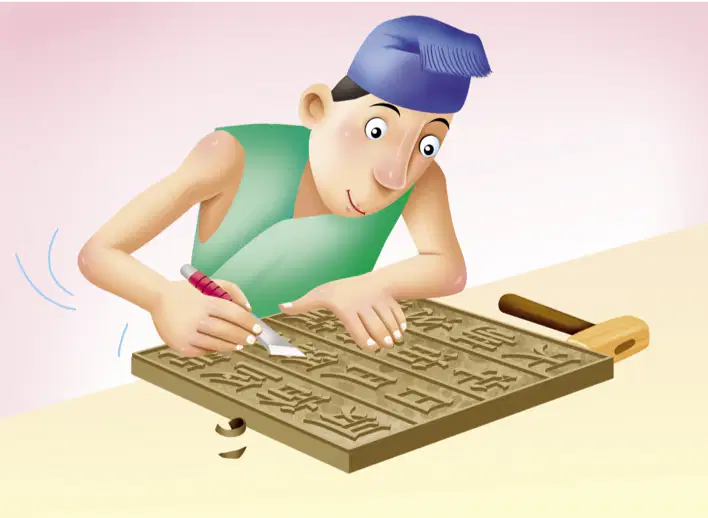
How do we call this kind of printing technology?
Metalblock printing
Woodblock printing
Machine printing
Moveable-type printing
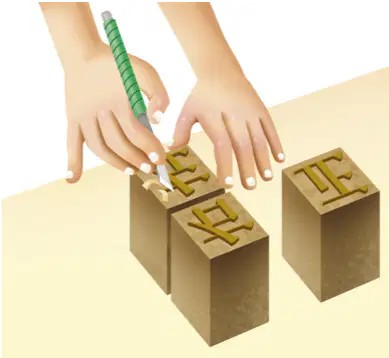
How do we call this kind of printing technology?
Metalblock printing
Woodblock printing
Machine printing
Moveable-type printing
In the 15th century, which group of people started using this printing technique to create movable types of the alphabet and print different types of books in Europe?
the French
the British
the German
the Spanish
What were the contributions of the printing technology spreading to the West?
Made book printing more convenient
Made book printing cheaper
Increased the circulation of books
Laid a good foundation on Renaissance
What is the soft, lustrous fiber taken from cocoon of silkworm?
cotton
gunpowder
pearl
silk
What is the mixture of copper and tin that was one of the first metals man made?
Bronze
Steel
Gold
Silver
a smooth rounded bead formed in the shells of mollusks
seed
bead
pearl
bronze
The act of buying or selling and exchanging goods
trade
shopping
sharing
advertising
To ship good to other countries for sale
import
export
exchange
trade
To bring in good from other countries
trade
import
export
exchange
The powder that was used to create bombs and light cannons
sulphar
fireworks
gunpowder
powder
Something formed by uniting two or more things
group
community
union
country
What was the name of the trade route that developed in the middle east because of the trade in silk?
Silk road
Spice road
trade route
China highway
Knowledge that deals with creation and use of technical means.
design
technology
skill
books
Leizu was the wife of an emperor in 2696 BC. What did she invent that is famous today?
gunpowder
grain
paper
silk
What was created by Ts'ai Lun in 100 BC?
Gunpowder
Paper
Silk
Fireworks
What did the Chinese scientists (Alchemists) accidental discover when they tried to create a potion for eternal life?
Kite
Paper
Gunpowder
Compass
In which way could have the discovery of Bronze changed the lives of people in China?
It made life easier with better weapons and stronger tools
They could decorate their houses
They used bronze to heal wounds
Bronze was used to create large statues
What invention was used for writing on?
lodestone
compass
paper
What was one thing Asoka did to make his empire more successful?
Gave all his citizens free money
Built many dams
Stopped attacking everyone and built a peaceful society
Created huge walls around his cities
After Gupta rule, which religion became the most practiced in Southern Asia?
Hinduism
Christianity
Judaism
Islam
What features protected civilizations in Southern Asia?
Lions, Tigers, and Bears
Great walls and huge forests
Deserts and quicksand
mountains and oceans
The evidence that has been discovered which proves the Harappan were an advanced society include the following:
Buildings created with bricks of uniform (the same) size
A sewer system, which included indoor plumbing
A system of writing, which we have not been able to decode.
All of these prove the Harappan society was advanced
What is the Caste system?
Basically, the way people were divided by their interests and social ranking.
A complicated system to fix a broken arm or leg
The way that the Indus River people would save water from the Indus River.
A system of trade invented by Emperor Caste.
What are the two major rivers of the Indus River Valley?
Ganges and Indus
Tigris and Euphrates
Nile and Nile II
Yellow River and Yangtzee
What is the highest mountain range in the world? (Make sure you read the question carefully!)
Himalayas
Mount Everest
Hindu Kush
The pyramids
What is the definition of tolerance?
respecting others' beliefs
When your parents are not short, you have tolerance.
ignoring others' beliefs
being correct most of the time
What is a delta?
An Indus River military leader
A mountain that is topped with snow
Where Indus River Valley residents got their technology
A place that a river spreads out and deposits dirt and sediment
What is an empire?
A land that is ruled by one person.
A hit show on television
How people use to control rivers
A land where people vote for their leader
What is the main purpose for the Silk Road?
So China could trade silk with other cultures for supplies they desired
To have a walkway that felt very soft on your feet
To pay off other civilizations so they would not attack China
To build cities outside of China
Besides silk, what other things were traded on the Silk Road?
diseases
ideas and religions
inventions
All of these things traveled on the Silk Road
How is the start of the Chinese civilization similar to the start of the other ancient civilizations?
They began to farm around rivers.
They learned how to write their language before anything else.
They made an army that could fight other civilizations
They created a giant wall to protect themselves.
Why was the Great Wall of China built?
To keep the gardens full of water
To protect them from invading armies.
To define the borders of their country.
To keep the dogs from wandering the neighborhood
China's Yellow River is called this because of what reason?
Yellow silt is in the water, which gives it the unique color.
The water is so polluted that it is yellow in color.
The water was named after Emperor Yeeloow.
The river is scared of other rivers, so it has a yellow streak.
Why was the Grand Canal such an amazing canal?
It connects the Yellow River and Yangtze River.
It was dug by hand, without machines, and is over 1000 miles long.
It allows people from all over China to travel and trade with one another.
All of these are reasons why the Grand Canal is amazing.
The Zhou dynasty lasted longer than any other dynasty in China's history. Among other reasons, what was the main thing that seemed to be the reason they eventually fell apart?
Not enough food to feed everyone
The people were constantly fighting with outside enemies or each other.
The Yellow River flooded and destroyed the Empire.
Clay Warriors went to battle, which sacred people away.
Describe a caravan.
A car that was produced in China to carry silk on the road.
A group of people traveling together a long distance. For example, on the Silk Road.
Another name given to the 8000 Terra Cotta soldiers found buried.
A rock, similar to the Rosetta Stone, where people translated the Chinese language.
If you had no money and you wanted to trade with someone, what type of system would you use?
barter system
caste system
terra cotta system
solar system
When you have a series of rulers that come form the same family, this is called a ________________________.
dynasty
empire
maritime
caravan
Which river is also known as the Yellow River?
Yahtzee River
Yangtze River
Hang He River
Amazon River
Which of the following is not a physical feature of China
Mountains
Deserts
Hills
Plains
What is a philosopher?
A person that thinks and tells others about life.
A person who teaches others about the land
A person who questions life.
A person who teaches others about religion.
What is Buddhism?
Respecting family and being a good person
The belief that pain and suffering are caused by wanting
Focusing on balance and equality
The belief in four gods
What is a dynasty?
The home of the emporer and his family
The center of town where all trade takes place
The religion followed by the majority of the Chinese
A line of rulers for a country that are from the same family
What is the capital of China?
Hong Kong
Beijing
Shanghai
Baoding
Who united and led the Mongols?
King Genghis
Genghis Khan
Genghis Khaki
King Khan
Which invention measured the strength of earthquakes?
Seismograph
Compass
Block Printing
Porcelain
Silk is a fabric made from __________.
Butterfly wings
Caterpillar legs
Paper money
Caterpillar cocoon
What was the route called that connected China to Europe for trading?
The Great Wall
Grand Canal
Silk Road
Silk Trail
How long is the Great Wall
2,000 miles
2,000 kilometers
4,000 miles
4,000 kilometers
What connects the Huang He with the Yangtze River?
Great Wall
Silk Road
Himalayas
Grand Canal
Which of the following inventions was NOT invented between the 3rd century BCE and the 9th century CE?
automatons (robotic doors)
analog computers
nano-technology
eyeglasses
vending machines
How many years ago is the 2nd century CE?
1900
2200
800
3000
The 8th century CE refers to events happening in:
The 700's, from 700-799
Events happening 1400 years ago
the 800's, from 800-899
Events happening in the 1800's

Which ONE of the inventions on the list invented outside of China were you most surprised by?
Which country invented toilet paper over 1500 years ago, and still uses it today?
United States
England
India
China

During the (a) dynasty, Buddhism helped to spread printing along the Silk Roads.

Chinese traditional medicine used alchemy (chemistry) to find a formula for longer life, accidentally inventing (a) .

The invention of bureaucracy by the Qin dynasty helped expand the need for record-keeping, increasing the need for cheaper (a) and printing.

The (a) allowed religious leaders to decide locations for buildings and for the government to increase of trade between countries.
Which ancient Chinese invention are you most interested in?



