wayground logo

Free Printable Worksheets

Font size

S
M
L
XL
Worksheets

Cells and Life Quiz

Total questions: 25

Worksheet time: 14mins
Name
Class
Date
1.

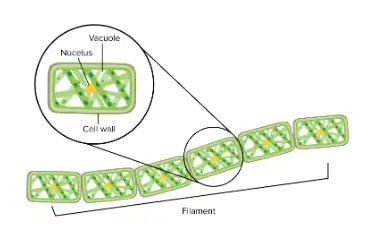
Students carried out an investigation in which they examined pond water under a light microscope. When they look at some green objects found in the pond water, they see detailed structures like the diagram. Did this investigation produce evidence that this object is a living thing?

Los estudiantes realizaron una investigación en la que examinaron el agua del estanque bajo un microscopio óptico. Cuando observaron algunos objetos verdes que se encontraron en el agua del estanque, vieron estructuras detalladas como las del diagrama. ¿Esta investigación produjo evidencia de que este objeto es un ser vivo?

a)
No; living things are large enough to be seen without a microscope.No; los seres vivos son lo suficientemente grandes como para ser vistos sin microscopio.
b)
No; there is no mouth or digestive system.No, no hay boca ni sistema digestivo.
c)
Yes; it is composed of cells. Sí; está compuesto de células.
d)
Yes; it contains organized body systems. Sí; contiene sistemas corporales organizados.
2.
How do plant cells keep bacteria out and let nutrients in? ¿Cómo las células vegetales mantienen alejadas las bacterias y dejan entrar los nutrientes?
a)

The cell membrane chooses what goes in and out of the cell. La pared celular elige lo que entra y lo que sale de la célula.

b)
Mitochondria fight off invaders. Las mitocondrias luchan contra los invasores.
c)
Golgi apparatus packages and ships bacteria out of the cell. El aparato de Golgi empaqueta y envía las bacterias fuera de la célula.
d)
Lysosomes absorb bacteria. Los lisosomas absorben bacterias.
3.

All living things are made up of one or more ____________________. Todos los seres vivos están formados por uno o más ____________________.

(a)  
4.
In addition to being made up of cells, list at least two characteristics shared by all living things. Además de estar formado por células, enumera al menos dos características que comparten todos los seres vivos.
4 lines
5.
All of the following are principles of the cell theory, EXCEPT… Todos los siguientes son principios de la teoría celular, EXCEPTO…
a)
The cell is the smallest unit of life. La célula es la unidad más pequeña de la vida.
b)
Water is the main ingredient in every cell. El agua es el ingrediente principal de cada célula.
c)
All new cells come from preexisting cells.Todas las células nuevas provienen de células preexistentes.
d)
All living things are made of one or more cells.Todos los seres vivos están formados por una o más células.
6.
Which organelle packages proteins into vesicles to transport from one area of a cell to another? ¿Qué orgánulo empaqueta proteínas en vesículas para transportarlas de un área de una célula a otra?
a)
Golgi apparatus
b)
Chloroplasts
c)
Mitochondria
d)
Rough endoplasmic reticulum
7.
In plant cells, _________________ carry out functions related to storage and support. En las células vegetales, las _________________ realizan funciones relacionadas con el almacenamiento y el soporte.
a)
Cell membrane
b)
Chloroplasts
c)
Vacuoles
d)
Mitochondria
8.
Materials enter and leave the cell through its _____. Los materiales entran y salen de la célula a través de su _____.
a)
Organelles
b)
DNA
c)
Membrane
d)
Chromatin
9.
Identify two structures that are found in a plant cell that are not found in an animal cell. Identifique dos estructuras que se encuentran en una célula vegetal y que no se encuentran en una célula animal.
4 lines
10.
What is the function of the nucleus of the cell? ¿Cuál es la función del núcleo de la célula?
a)
Ships materials around the cell/ Envía materiales alrededor de la celda.
b)
Makes proteins and lipids/Fabrica proteínas y lípidos.
c)
Stores genetic material and directs the processes of the cell/Almacena material genético y dirige los procesos de la célula.
d)
Regulates what enters and exits the cell/Regula lo que entra y sale de la célula.
11.
What is the function of mitochondria? ¿Cuál es la función de las mitocondrias?
a)
Transport proteins/Proteínas de transporte
b)
Energy producers for the cell/Productores de energía para la célula.
c)
Stores genetic material/Almacena material genético
d)
Rigid barrier that protects the cell/Barrera rígida que protege la célula
12.
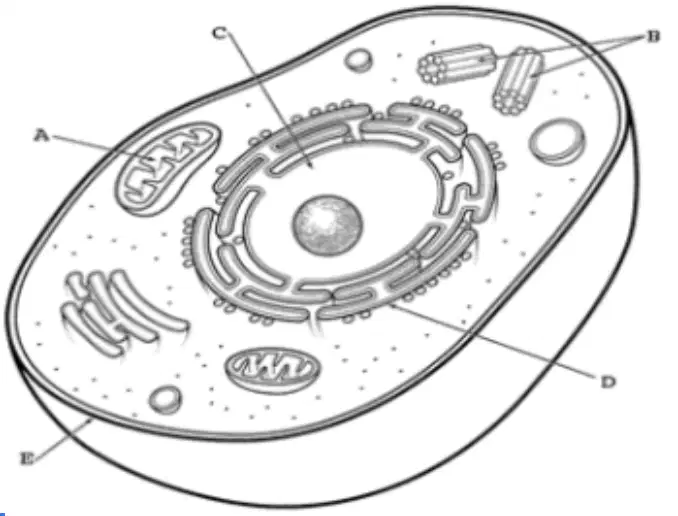
A is/are the _____.
a)
mitochondria
b)

Endoplasmic Reticulum

c)

Nucleus

d)

Cell Membrane

e)

Microtubules

13.

B is/are the _____.

a)
mitochondria
b)

Endoplasmic Reticulum

c)

Nucleus

d)

Cell Membrane

e)

Microtubules

14.

C is/are the _____.

a)
mitochondria
b)

Endoplasmic Reticulum

c)

Nucleus

d)

Cell Membrane

e)

Microtubules

15.

D is/are the _____.

a)
mitochondria
b)

Endoplasmic Reticulum

c)

Nucleus

d)

Cell Membrane

e)

Microtubules

16.

E is/are the _____.

a)
mitochondria
b)

Endoplasmic Reticulum

c)

Nucleus

d)

Cell Membrane

e)

Microtubules

17.
Cells make proteins on small structures called vesicles. Las células producen proteínas en pequeñas estructuras llamadas vesículas.
a)
True/Verdadero
b)
False/falso
18.
What is the difference between a cell wall and a cell membrane? ¿Cuál es la diferencia entre una pared celular y una membrana celular?
a)
The cell wall is just outside the cell membrane and is strong and rigid. La pared celular está justo fuera de la membrana celular y es fuerte y rígida.
b)
The cell membrane is just outside the cell wall and is strong and rigid.La membrana celular está justo fuera de la pared celular y es fuerte y rígida.
c)
The cell wall is just outside the cell membrane and is more flexible.La pared celular está justo fuera de la membrana celular y es más flexible.
d)
The cell membrane is just outside the cell wall and is more flexible.La membrana celular está justo fuera de la pared celular y es más flexible.
19.
____________________ is an organelle that transports proteins in the cell. ____________________ es un orgánulo que transporta proteínas en la célula.
a)
Nucleus
b)
Cytoplasm
c)
Endoplasmic Reticulum
d)
Chloroplast
20.
Which best explains the function of a cell membrane? ¿Cuál explica mejor la función de una membrana celular?
a)
Offers protection from the outside environment. Ofrece protección contra el ambiente exterior.
b)
Provides a framework to help the cell move. Proporciona un marco para ayudar a la célula a moverse.
c)
Transforms energy in the cell into ATP. Transforma la energía de la célula en ATP.
d)
Removes viruses from inside the cell.Elimina los virus del interior de la célula.
21.
What is the function of the lysosome? ¿Cuál es la función del lisosoma?
a)
Storing food/Almacenamiento de alimentos
b)
Preparing proteins/ Preparando proteinas
c)
Making food/Preparando comida
d)
Breaking down materials/Descomposición de materiales
22.
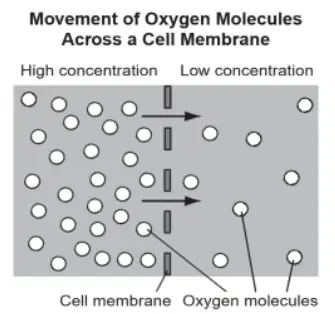
A teacher shared this model with her class. Which statement is BEST explained by the model? Una maestra compartió este modelo con su clase. ¿Qué afirmación se explica MEJOR con este modelo?
a)
How the cell membrane controls what enters and exits the cell.Cómo la membrana celular controla lo que entra y sale de la célula.
b)
How the cell membrane protects the cell from harmful chemicals.Cómo la membrana celular protege a la célula de sustancias químicas dañinas.
c)
How oxygen is important for body cells to survive and reproduce. Por qué es importante el oxígeno para que las células del cuerpo sobrevivan y se reproduzcan.
d)
How oxygen concentration is always different inside and outside of cells. Cómo la concentración de oxígeno siempre es diferente dentro y fuera de las células.
23.
The smallest unit of life is the ____________________. La unidad más pequeña de vida es el ____________________.
a)
Cell
b)
Homeostasis
c)
Organism
d)
Protein
24.
The cell theory states that all cells come from other cells that already exist. La teoría celular establece que todas las células provienen de otras células que ya existen.
a)
True/ Verdadero
b)
False/ falso
25.
Humans are considered ___________________ organisms. Los humanos son considerados organismos ___________________.
a)
unicellular/unicelular
b)
multicellular/ multicelular