

wayground logo

Free Printable Worksheets

Font size

S
M
L
XL
Worksheets

Cells Test Review

Total questions: 46

Worksheet time: 34mins
Name
Class
Date
1.
What type of cell has a nucleus? 
a)
eukaryotic
b)
prokaryotic 
2.
All living things are made of...
a)
atoms 
b)
cells 
c)
bacteria 
d)
plants 
3.
Plants and animal cells are examples of ___ cells 
a)
prokaryotic cells 
b)
eukaryotic cells 
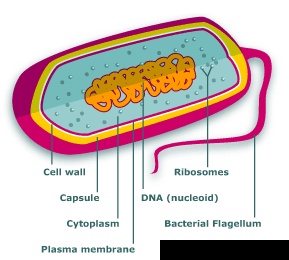
4.
Which type of cell?
a)
Prokaryote
b)
Eukaryote
5.
Both prokaryotes and eukaryotes have a nucleus.
a)
True
b)
False
6.
The main difference between prokaryotic and eukaryotic cells? 
a)
Prokaryotic cells have a cell membrane but eukaryotic cells do not.
b)
Eukaryotic cells contain DNA in a nucleus while prokaryotic cells do not.
c)
Eukaryotic cells have flagella but prokaryotic cells do not.
d)
Prokaryotic cells contain membrane-bound ribosomes while eukaryotic cells do not. 
7.
What structures distinguish a plant cell from an animal cell?
a)
Plant cells have cell walls and ribosomes.
b)
Plant cells have cell walls and chloroplasts.
c)
Plant cells have chloroplasts and ribosomes.
d)
Plant cells have chloroplasts and mitochondria.
8.

A cell biologist finds a cell without chloroplasts, but it still contains a nucleus, cell membrane, and a cytoplasm. What kind of cell is this?

a)

Prokaryotic

b)

Eukaryotic

c)

Plant

d)

Animal

9.
Every living organism is made up of one or more cells
a)
True
b)
False
10.
The nucleus is like the ____________ of the cell.
a)
foot
b)
hand
c)
stomach
d)
brain
11.

Which of the following converts food into energy for the cell?

a)

vacuole

b)

mitochondria

c)

cytoplasm

d)

cell membrane

12.
What do vacuoles do? 
a)
They actually do not have an important role
b)
They protect the cell
c)
They are the brain of the cell
d)
storage area for cells; water storage in plants 
13.
What is the function of a cell wall?
a)
to protect and support the cell
b)
to perform different functions in each cell
c)
to prevent water from passing through it
d)
to prevent oxygen from entering the cell
14.
Who was the first  person to see cells under the microscope and give them their name?
a)
Mattias Schleiden
b)
Robert Hooke
c)
Theordor Schwann
d)
Anton van Leeuwenhoek
15.
What is one way in which all living things on Earth are alike?
a)
All living things have hair.
b)
All living things are made of cells and come from other cells.
c)
The cells of all living things have chloroplast.
d)
All living things can move. 
16.

An organelle that turns solar energy into food.

a)

vacuole

b)

chloroplasts

c)

cytoplasm

d)

mitochondria

17.
cytoplasm is the gel-like substance that holds the organelles
a)
True
b)
False
18.
The part of the cell that makes protein.
a)
Vacuoles
b)
Ribosomes
c)
Golgi Apparatus
d)
Cytoplasm
19.
Packages proteins into vesicles and ships them out.
a)
Endoplasmic Reticulum
b)
Ribosomes
c)
Golgi Apparatus
d)
Nucleus
20.
Rocks are not living because
a)
they never move
b)
they aren't needed for humans
c)
they are not made of cells
d)
they don't break down
21.
a)

Organism

b)

Population

c)

Community

d)

Ecosystem

22.
a)

Organism

b)

Population

c)

Community

d)

Ecosystem

23.

These are ALL crows

a)

Organism

b)

Population

c)

Community

d)

Ecosystem

24.

Cows, grass, bird, and water.

a)

Organism

b)

Population

c)

Community

d)

Ecosystem

25.

All kinds of plants and animals

a)

Organism

b)

Population

c)

Community

d)

Ecosystem

26.

Groups of cells that are similar in structure and function are called...

a)

cell

b)

tissue

c)

organ

d)

organ system

27.

The image represents which level of organization?

a)

cell

b)

tissue

c)

organ

d)

organ system

28.

The smallest unit of life is called the

a)

cell

b)

tissue

c)

organ

d)

organ system

29.

Groups of tissue working together would be called a

a)

cell

b)

tissue

c)

organ

d)

organ system

30.

A living thing made of complex systems able to carry out life processes such as growing, reproducing, and using energy would be a

a)

cell

b)

organ

c)

organ system

d)

organism

31.

Living things are also called ______

a)

biotic factors

b)

abiotic factors

c)

renewable resources

d)

moving objects

32.

Plants produce their own food through the process of ______

a)

respiration

b)

photosynthesis

c)

digestion

d)

diffusion

33.

Three weeks after eating a slice of watermelon in his backyard, Larry observed a watermelon plant was growing in his yard. This most likely proves that living things

a)

are sensitive to the surroundings of his home

b)

reproduce

c)

feed

d)

respire

34.
A tadpole becomes a frog.  Which characteristic?
a)
Adapted to environment
b)
Reproduces
c)
Grows & develops
35.

To make more living things of the same kind

a)

nutrient

b)

vertebrate

c)

reproduce

d)

senses

36.

What type of cell is this?

a)

prokaryotic

b)

eukaryotic

37.

A cell without a nucleus is classified as ____

a)

prokaryotic

b)

eukaryotic

c)

periodic

d)

nucleotic

38.

Abiotic factors

a)

living

b)

nonliving

39.

All biotic and abiotic factors in an area

a)

organism

b)

biome

c)

community

d)

ecosystem

40.

Which of the following is a part of the Cell Theory?

a)

All living things are made of cells.

b)

Cells are the basic structure and function in all living things.

c)

All cells must contain a nucleus.

d)

New cells are made only from existing cells.

41.

--- is the maintaining of a relatively stable internal environment.

a)

mitosis

b)

miosis

c)

specialized differentiation

d)

homeostasis

42.
Which characteristic of living things does the picture represent?
a)
Living things take in and use resources for energy.
b)
Living things respond to stimuli.
c)
Living things reproduce.
d)
Living things grow and develop.
43.
Which characteristic of living things does the picture represent?
a)
Living things take in and use resources for energy.
b)
Living things reproduce.
c)
Living things respond to stimuli.
d)
Living things grow and develop.
44.
Which characteristic of living things does the picture represent?
a)
Living things take in and use resources for energy.
b)
Living things reproduce.
c)
Living things respond to stimuli.
d)
Living things grow and develop.
45.
Which characteristic of living things does the picture represent?
a)
Living things take in and use resources for energy.
b)
Living things respond to stimuli.
c)
Living things grow and develop.
d)
Living things reproduce
46.
Any change in the environment that causes an organism to react is called a _____________.
a)
growth
b)
development
c)
response
d)
stimulus
