
NEW
Font size
 Worksheets
Linear Functions and Graphing Skills
Total questions: 42
Worksheet time: 1hrs 22mins
Given the linear equation y=2x+3 , create an x-y table for x=−1,0,1 .
(−1,1),(0,3),(1,5)
(−1,5),(0,3),(1,1)
(−1,3),(0,2),(1,1)
(−1,0),(0,2),(1,4)
Identify the x-intercept of the equation 3x−4y=12 .
(0,3)
(4,0)
(0,−3)
(0,4)
Identify the y-intercept of the equation 2x+5y=10 .
(0,2)
(5,0)
(0,−2)
(2,0)
Convert the equation 4x−2y=8 to slope-intercept form.
y=2x−4
y=−2x+4
y=2x+4
y=−2x−4
Calculate the slope of the line passing through the points (2,3) and (4,7) .
1
2
3
4
Graph the equation y=−21x+3 using the slope and intercept. What is the y-intercept?
3
−21
−23
2
Create an x-y table for the equation y=−x+2 for x=−2,0,2 .
(−2,4),(0,2),(2,0)
(−2,0),(0,2),(2,4)
(−2,2),(0,0),(2,−2)
(−2,0),(0,−2),(2,−4)
Identify the x-intercept of the equation 5x+2y=10 .
(2,0)
(0,5)
(5,0)
(0,2)
Identify the y-intercept of the equation x−3y=9 .
(0,−3)
(0,3)
(3,0)
(0,−9)
Convert the equation 6x+3y=9 to slope-intercept form.
y=−2x+3
y=2x−3
y=−2x−3
y=−2x+3
Calculate the slope of the line passing through the points (−1,−1) and (2,3) .
1
2
3

Graph the equation y=43x−1 using the slope and intercept. What is the slope?
43
−43
1
−1
Identify the x-intercept of the equation 7x−3y=21 .
(3,0)
(0,7)
(7,0)
(0,3)
Identify the y-intercept of the equation 4x+y=8 .
(0,4)
(0,8)
(4,0)
(8,0)
4x - 5y = 40
y intercept is 8
y intercept is 20
y intercept is 10
y intercept is -8

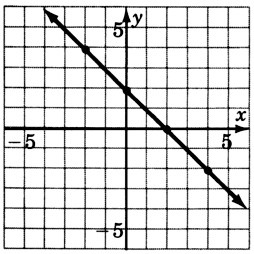
Find the slope of the line.
3/2
-3/2
2
-2


Graph


The table shows pairs of values that satisfy a linear function. What is the y-intercept of the graph of this function?
(0, 1)
(0, 0)
(0, -1)
(0, -10)

What is the slope of the line
-2/3
2/3
3/2
-3/2

Find the slope of the table.
5/2
2/5
-5/2
-2/5

Find the slope from the table.
1/2
5/10
-2
2

Find the slope through these two points.
-8/3
8/3
-2/3
2/3

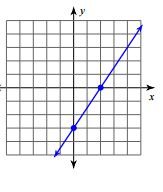


Find the slope of the graphed line.
−23
32
23
Which of the following is NOT THE SAME as slope?
rise over run
change in y over change in x

run over rise
Which of the following is NOT THE SAME as − 32 ?
32
3−2
−32
−3−2
3, 7, 11, 15, ...
1, 4, 9, 16, ...
When using sequences, a1 refers to the
common difference
first term of the sequence
rate of change
a to the first power

