wayground logo

Free Printable Worksheets

Font size

S
M
L
XL
Worksheets

Revision q1 G7

Total questions: 200

Worksheet time: 3hrs 13mins

Name
Class
Date
1.

Anything that has mass and takes up space is called

a)

mass

b)

matter

c)

volume

d)

weight

2.

The amount of matter in an object is called

a)

mass

b)

matter

c)

volume

d)

weight

3.

Anything that has mass and takes up space is called

a)

mass

b)

matter

c)

volume

d)

weight

4.

The amount of space an object takes up is called _______________.

a)

weight

b)

volume

c)

density

d)

mass

5.

True or False: Air is matter.

a)

True

b)

False

6.

A ____________ substance has a definite volume and shape.

a)

gas

b)

solid

c)

liquid

7.

A ___________ substance has a definite volume but not a definite shape.

a)

solid

b)

gas

c)

liquid

8.

A _______________ does not have a definite volume or shape.

a)

gas

b)

liquid

c)

solid

9.

True or False: liquids take the shape of their container.

a)

true

b)

false

10.

What is the outcome of observing a chemical property?

a)

Nothing

b)

A new substance is formed with different properties

c)

NaCl

d)

A rise in thermal conductivity

11.
Ice melting is an example of a
a)
physical change
b)
chemical change
c)
physical property
d)
chemical property
12.
Physical properties are
a)
properties that can be observed without changing the identity of the substance
b)
properties that describe how a substance changes into a completely different substance
c)
properties that we can only observe with our eyes
d)
properties that we need special tools to observe
13.
Which is an example of a chemical change?
a)
melting ice to make water
b)
baking cake batter to make a cake
c)
putting cheese on bread to make a cheese sandwich
d)
cutting an orange into slices for a snack
14.
Hammering wood together to build a playhouse
a)
Chemical change
b)
Physical change
15.
Burning a marshmallow over a campfire
a)
Physical
b)
Chemical
16.
Which of the following is NOT an example of a physical change?
a)
crumpled paper
b)
pencil sharpening
c)
shrunken clothing
d)
rust
17.
Ability to rust is this type of property:
a)
Physical property
b)
Chemical property
18.
Flammability (burns): Chemical or Physical Property
a)
Chemical Property
b)
Physical Property
19.
Blue Color: Chemical or Physical Property
a)
Chemical Property
b)
Physical Property
20.
Is copper tarnishing a physical or chemical change?
a)
Physical 
b)
Chemical
21.
What is matter?
a)
a pure substance
b)
anything that occupies space and possesses mass
c)
an element
d)
a compound
22.

What is a chemical change?

a)

Forming a new substance

b)

When two or more substances combine to make a greater one

c)

When two or more substances combine to make a new chemical substance

d)

Combing substances

23.
Fireworks Exploding are a ________ change.
a)
Physical Change
b)
Chemical Change
24.

Select ALL of the characteristics of a physical change

a)

changes in appearance only

b)

a new substance is not created

c)

changes in the ph level

d)

burning and fire

e)

chemical bonds are not created or broken

25.

Cutting your hair is an example of a ___________ change.

a)

physical

b)

chemical

26.

Identify the state of matter.

a)

Solid

b)

Liquid

c)

Gas

d)

None of these

27.

Which phase of matter has a definite volume and takes the shape of its container?

a)

Liquid

b)

Solid

c)

Gas

d)

None of these

28.

Identify the state of matter.

a)

Solid

b)

Liquid

c)

Gas

d)

None of these

29.

Particles are packed very tightly with each other in a ______.

a)

Liquid

b)

Solid

c)

Gas

d)

Plasma

30.

Snow ______ to form water.

a)

Melts

b)

Condenses

c)

Freeze

d)

Evaporate

31.

Atoms are extremely...

a)

small

b)

large

32.
Matter that has its own shape and takes up space.
a)
solid
b)
liquid
c)
gas
33.
Matter that always fills the shape in a container, such as air.
a)
solid
b)
liquid
c)
gas
34.

What is the process called when a solid changes to a liquid?

a)

Freezing

b)

Evaporation

c)

Melting

d)

Condensation

35.
______________________ takes place when a liquid changes to a solid.
a)
freezing
b)
melting
c)
boiling
d)
sublimation
36.
The phase change from water vapor to liquid water is known as...
a)
evaporation
b)
precipitation
c)
condensation
d)
sublimation
37.
Melting is ...
a)
liquid to solid
b)
solid to liquid
c)
solid to gas
d)
gas to liquid
38.
Freezing is...
a)
Solid to gas
b)
Liquid to solid
c)
Gas to solid
d)
Liquid to gas
39.

What is this state of matter?

a)

solid

b)

liquid

c)

gas

40.

What is this state of matter?

a)

solid

b)

liquid

c)

gas

41.

What is this state of matter?

a)

solid

b)

liquid

c)

gas

42.

Particles are closest together in a...

a)

liquid

b)

gas

c)

solid

43.


Which state of matter has NO definite shape and NO definite volume?

a)

gas

b)

solid

c)

liquid

44.

What is a substance made of two or more elements that are chemically combined called?

a)

A. element

b)

B. compound

c)

C. mixture

d)

D. solution

45.

Is salt (NaCI) a compound or an element?

a)

Compound

b)

element

46.

What is the definition of a compound?

a)

The smallest part of any substance which can exist on its own

b)

Two or more atoms chemically joined together (can be the same or can be different)

c)

A simple substance in which all the atoms are identical

d)

Two or more different elements chemically joined together

47.
All matter is made of .....
a)
energy 
b)
atoms 
c)
air
d)
chemistry
48.

A substance that cannot be broken down into any other substance by ordinary chemical means is called

a)

a molecule.

b)

a mixture.

c)

an element.

d)

a compound.

49.
Carbon Dioxide is a ______ 
a)
compound 
b)
element 
c)
mixtures 
d)
Battle of Bunker Hill 
50.
What is the picture displayed?
a)
atom
b)
element
c)
molecule
d)
compound
51.
This picture represents which of the following?
a)
element
b)
compound
c)
mixture
52.

What is the chemical formula for water?

a)

NaCl

b)

CO2

c)

NH3

d)

H2O

53.
How many electrons does an Iodine atom have?
a)
53
b)
126
c)
73
d)
179
54.
What is the atomic mass of Hydrogen?
a)
1
b)
2
c)
3
d)
0
55.
What is the atomic mass of Gold?
a)
79
b)
196.9665
c)
117
d)
275
56.

What is the atomic number?

a)

35

b)

18

c)

17

d)

52

57.

What does the 6 represent?

a)

Atomic mass

b)

atomic number

c)

chemical symbol

d)

element name

58.

What is potential energy?

a)

energy stored in objects not in motion

b)

energy stored in objects in motion

59.

What is kinetic energy of a moving charge?

a)

electric energy

b)

chemical energy

c)

nuclear energy

d)

sound energy

60.

What is energy?

a)

The ability to do work

b)

A force

c)

Electricity

d)

The ability to transform work

61.
Energy of motion is which type of energy?
a)
Potential
b)
Kinetic
c)
Sound
d)
Gravitational
62.
When plants convert the sun's energy into food, which type of energy is it?
a)
kinetic
b)
chemical
c)
thermal
d)
radiant
63.
The type of energy that allows us to hear is
a)
Mechanical
b)
Sound
c)
Light
d)
Electric
64.
On a roller coaster, where is maximum potential energy?
a)
At the bottom of a big hill
b)
When going around a corner
c)
When going upside down
d)
At the top of a big hill
65.
The ultimate source of energy is:
a)
The sky
b)
The sun
c)
Plants
d)
Movement
66.
Kinetic Energy is:
a)
Energy of motion
b)
always conserved
c)
Energy due to position
67.
Potential Energy is:
a)
The energy of motion
b)
always conserved
c)
The energy due to position
68.
Sound energy is present when...
a)
an object vibrates
b)
energy is created
c)
energy is destroyed
69.
The ability to do work is the definition for which word
a)
chemical energy
b)
mechanical energy
c)
Energy
d)
produce
70.
Is this a heat, light, or sound source?
a)
Sound
b)
Heat 
c)
Light
71.
Light is a form of ______________________
a)
energy
b)
inertia
c)
currency
d)
sound
72.
Energy that is stored in bonds between atoms is:
a)
Mechanical energy
b)
Chemical energy
c)
Kinetic energy
d)
Nuclear energy
73.
Geothermal energy is energy from 
a)
the sun
b)
heat from deep in the earth
c)
wind
d)
inexhaustable
74.
Which type of alternative energy source is shown in this picture?
a)
Wind
b)
Solar
c)
Hydroelectric
d)
Geothermal
75.
What fossil fuel is in the image?
a)
Coal
b)
Natural Gas
c)
Petroleum
76.
How does light travel?
a)
it bounces off objects
b)
in a zigzag pattern
c)
in a straight line
d)
it swirls upward
77.
The roller coaster cart has the most gravitational potential energy at position-
a)
W
b)
X
c)
Y
d)
Z
78.
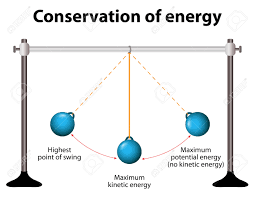
According to the Law of Conservation of Energy, energy cannot be _________ or ____________. 
a)
destroyed, destroyed
b)
created, saved
c)
created, destroyed
d)
lost, found
79.

What is given off from energy?

a)

water

b)

heat

c)

smoke

d)

ash

80.

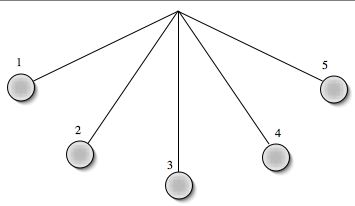
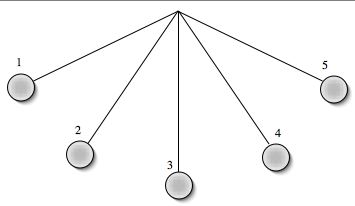
When a pendulum swings, where is potential energy the greatest?

a)

1 and 5

b)

2 and 4

c)

3

d)

2 and 5

81.
At which point is kinetic energy greatest? 
a)
W
b)
X
c)
Y
d)
Z
82.

What type of energy is greatest when the cannonball is at point C?

a)

kinetic energy

b)

potential energy

c)

elastic energy

d)

chemical energy

83.

When a pendulum swings, at which point is kinetic energy the greatest?

a)

1

b)

2

c)

3

d)

5

84.

Conservation of energy means that energy cannot be ________ or ________, but can move and be changed from one form to another.

a)

created, destroyed

b)

gravity, force

c)

created, heated

d)

stolen, destroyed

85.

The amount of kinetic energy an object has depends on its:

a)

Mass and volume

b)

Volume and friction

c)

Mass and speed

d)

Speed and density

86.

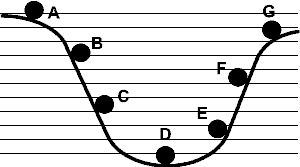
Which point has the most potential energy?

a)

G

b)

F

c)

B

d)

A

87.

Which cart has a little less kinetic energy than cart C?

a)

A

b)

B

c)

C

d)

D

88.

Which point has the most kinetic energy?

a)

A

b)

B

c)

C

d)

D

89.

Which point has the least potential energy?

a)

A

b)

B

c)

C

d)

A and C

90.

Which point has the most potential energy?

a)

A

b)

B

c)

C

d)

A and C

91.
___________ energy can move through empty space.  
a)
Sound 
b)
Nuclear 
c)
Electromagnetic 
d)
Chemical 
92.
This is the energy that can be released by breaking the bonds between compounds. 
a)
electromagnetic
b)
nuclear 
c)
kinetic 
d)
chemical 
93.

A fan plugged into a wall is which transfer of energy

a)

Electrical to mechanical.

b)

Potential to sound.

94.

Where is the kinetic energy the greatest?

a)

A

b)

B

c)

C

d)

D

95.

The roller coaster cart has the most kinetic energy at position-

a)

W

b)

X

c)

Y

d)

Z

96.

What does the Law of Conservation of Energy state?

a)

energy is always created, but not destroyed

b)

energy cannot be created or destroyed

c)

energy cannot be created, but can be destroyed

d)

energy is always being created and destroyed

97.

Energy flows through a system of living things in a model called ___

a)

the carbon cycle

b)

a food chain

98.

Organisms that break down waste are called ___

a)

herbivores

b)

carnivores

c)

decomposers

99.

In an ecosystem, decomposers break down ___

a)

waste

b)

wood

100.

An apple tree is a

a)

decomposer

b)

producer

c)

consumer

101.

A hawk is an example of a

a)

producer

b)

decomposer

c)

consumer

102.

What is a part of the food chain that makes its own food and nutrients?

a)

consumer

b)

producer

c)

omnivore

d)

sun

103.

Which type of consumer eats meat and plants?

a)

Herbivores

b)

Carnivores

c)

Omnivores

d)

Plants

104.

Which type of consumer eats meat only?

a)

Producers

b)

Herbivores

c)

Carnivores

d)

Omnivores

105.

Which type of consumer eats plants only?

a)

Herbivores

b)

Omnivores

c)

Carnivores

d)

Scavengers

106.
The  ____________ provides all the initial energy to plants.
a)
sun
b)
moon
c)
environment
d)
water
107.
_________ cannot make their own food, so they need to consume (eat) plants or animals.
a)
consumers
b)
producers
c)
decomposers
108.

Which of these is true about the food chain shown?

a)

The caterpillar gets energy from the bird.

b)

The caterpillar becomes a bird.

c)

The milkweed plant gets energy from animals.

d)

The bird gets energy from the caterpillar.

109.

According to this food chain, how does the snake get energy?

a)

by eating the hawk

b)

by eating the rabbit

c)

by eating the berries

d)

by being in the Sun

110.

What is a part of the food chain that makes its own food and nutrients?

a)

consumer

b)

producer

c)

omnivore

d)

sun

111.

The diagram shows a food chain.


The squirrel gets its energy directly from -

a)

sun

b)

trees

c)

other squirrels

d)

hawk

112.

What is a producer?

a)

an organism that gets energy from eating other organisms

b)

an organisms that uses sunlight to make its own food

c)

an organism that gets energy from eating dead organisms, non-living material or waste

d)

an organism that uses chemical energy to make its own food

113.
What will cause an object to move?
a)
Applied forces
b)
Balanced forces
c)
Unbalanced forces
114.
(T or F?) A balanced force is only an object that is not moving. 
a)
True 
b)
False
115.
The force that pulls things toward earth.
a)
Speed
b)
Gravity
116.
If an object is stationary (not moving) the forces acting upon it are _____________
a)
unbalanced
b)
weak
c)
balanced
d)
Hulk Smash!
117.
With unbalanced forces, the object will move in the direction of the _______ force.
a)
larger 
b)
smaller 
c)
equal 
d)
cannot be determined
118.
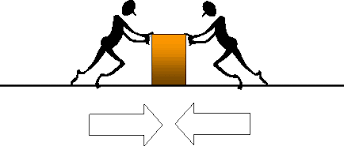
What type of force is shown in the picture?
a)
The Cat force
b)
Star Wars Force
c)
Unbalanced force
d)
Balanced  force
119.
What is a Force?
a)
The distance
b)
Mass
c)
A push or pull
d)
Give me a  failing grade 
120.
The force that opposes the motion of two surfaces sliding past each other is called ___________.
a)
acceleration
b)
inertia
c)
friction
d)
unbalanced
121.
What is the unit of force?
a)
Kilogram
b)
Meter
c)
Pascal
d)
Newton
122.
What type of force?
a)
Magnetic
b)
Gravitational
c)
Applied
d)
Normal
123.
What force brings the pencil down?
a)
Applied
b)
Magnetic
c)
Normal
d)
Gravitational
124.
An _______ force must act on an object for it to CHANGE it's motion
a)
balanced
b)
unbalanced
c)
gravitational
d)
electrical
125.
An _______ force must act on an object for it to CHANGE it's motion
a)
balanced
b)
unbalanced
c)
gravitational
d)
electrical
126.
What is the force that causes objects to fall to Earth?
a)
Air resistance
b)
Gravity
c)
Water resistance
d)
Pressure
127.
A north pole and a south pole will attract.
a)
True
b)
False
128.
In which direction does gravity act?
a)
Downwards
b)
Upwards
c)
In all directions
d)
Towards the centre of the Earth
129.
What type of force is air resistance?
a)
Contact
b)
Non-contact
130.
When two objects rub together, what force do they produce
a)
Gravity
b)
Air resistance
c)
Friction
d)
Water resistance
131.
What type of force is air resistance?
a)
Contact
b)
Non-contact
132.
A description of the speed and direction of an object's motion
a)
Velocity
b)
Speed
c)
Acceleration
d)
Vector
133.

Friction is a

a)

Contact Force

b)

Myth

c)

Non-contact Force

134.

Gravity is a

a)

Contact Force

b)

Myth

c)

Non-contact Force

135.

Which is an example of a non-contact force?

a)

elastic force

b)

normal force

c)

applied force

d)

electric force

136.

Air Resistance Force

a)

Contact Force

b)

Non-Contact Force

137.

Gravitational Force is

a)

A contact force that resists the motion of two objects that are touching

b)

A force that acts between objects that are electrically charged

c)

The force of attraction or repulsion between unlike or like poles

d)

A force of attraction between any two objects in the universe

138.

Is Oil renewable or non renewable?

a)

Renewable

b)

Non-renewable

139.

Is wind renewable or non-renewable?

a)

Renewable

b)

Non-renewable

140.

Is Sun energy renewable or non-renewable?

a)

Renewable

b)

Non-renewable

141.

Is nuclear energy renewable or non-renewable?

a)

Renewable

b)

Non-renewable

142.

Renewable resources ...

a)

are not replaceable

b)

are used more frequently than non renewables

c)

are never going to run out

d)

going to run out

143.

Which of these is non renewable

a)

natural gas

b)

water in a dam

c)

solar power

d)

wind energy

144.

Which of the following is a renewable resource?

a)

Oil

b)

Solar

c)

Coal

d)

Natural Gas

145.

Which of the following is a non-renewable resource?

a)

Water

b)

Sun

c)

Coal

d)

Win

146.

Oil is a __________ energy resource.

a)

Renewable

b)

Non-renewable

147.

Wind is a __________ energy resource.

a)

Renewable

b)

Non-renewable

148.

Which of the following is a non-renewable resource?

a)

Water

b)

Wood

c)

Oil

149.

Fossil Fuel are?

a)

A group of energy resources that were formed from ancient plants and organisms

b)

A group of dinosaur fossils

c)

A type of gas used for planes

150.
What is an example of a renewable resource?
a)
hydroelectric
b)
oil
c)
coal
d)
fossil fuel
151.
what is a renewable resource used for?
a)
food
b)
diging
c)
energy
d)
smelting
152.
Acceleration occurs when an object changes its speed or ______.
a)
direction
b)
force
c)
inertia
d)
mass
153.
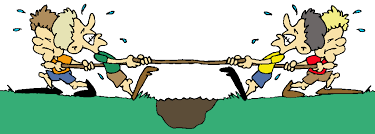
If these teams are pulling with the same amount of force what will happen?
a)
The boy in blue will win.
b)
They will not move at all.
c)
The boy in red will win.
d)
Both will fall down.
154.

this force is ___________ and there will be _____________

a)

unbalanced, no movement

b)

balanced, movement to the left

c)

balanced, no movement

d)

unbalanced, movement to the right

155.
Are forces balanced or unbalanced when a marble rolls down a ramp?
a)
Balanced
b)
Unbalanced
156.
Are forces balanced or unbalanced when a plane is moving at a constant speed in a straight line?
a)
Balanced
b)
Unbalanced
157.
As an object's mass increases, its gravitational pull will ____________.
a)
decrease
b)
increase
c)
stay the same
d)
get weaker
158.
The mass of an object ___________ as it moves away from the center of Earth
a)
stays the same
b)
decreases
c)
increases
d)
doubles
159.
What are balanced forces?
a)
Forces in the same direction
b)
Forces of the same size
c)
forces of the same size in opposite directions
160.
The force that opposes the motion of two surfaces sliding past each other is called ___________.
a)
acceleration
b)
inertia
c)
friction
d)
unbalanced
161.
What is the attraction between two objects because of their mass?
a)
Inertia
b)
Gravity
c)
Gravitational Force
d)
Weight
162.
How is heat transferred when boiling a pot of water on the stove?
a)
conduction
b)
convection
c)
combustion
d)
radiation
163.
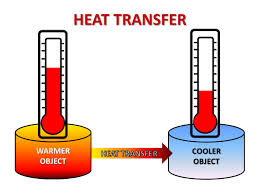
Heat transfers from an area of ____temperature to an area of ___ temperature.
a)
high to low
b)
low to high
c)
high to high
d)
It can travel high to low and low to high. 
164.

The transfer of energy by waves or particles is called

a)

conduction

b)

convection

c)

radiation

d)

insulation

165.

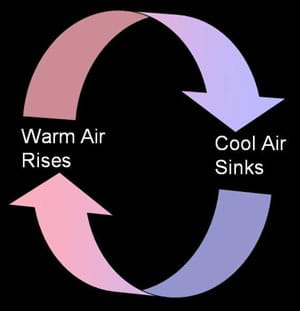
The movement of particles in a circle due to differences in density is called...

a)

radiation

b)

conduction

c)

convection

d)

currents

166.

Heat is also known as .....

a)

thermal energy

b)

power

c)

gravitational potential energy

d)

elastic potential energy

167.

Thermal energy is transferred from ________ temperature to _____________ temperature.

a)

lower, higher

b)

higher, lower

c)

same, same

d)

higher, higher

168.

Which of the following is NOT a means of thermal energy transfer?

a)

conduction

b)

boiling

c)

radiation

d)

convection

169.

If a material conducts heat well, it is known as a _______

a)

conductor

b)

insulator

c)

generator

d)

incubator

170.

How does heat move?

a)

In many directions

b)

from warm places to cooler places

c)

from cold places to warm places

d)

Both B and C

171.

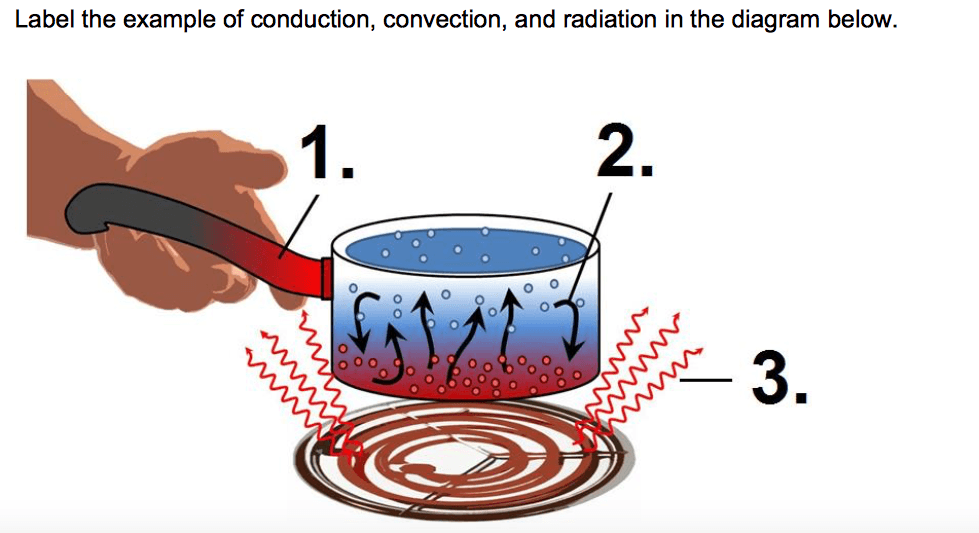
What type of thermal energy transfer is number 1 pointing to?

a)

Convection

b)

Conduction

c)

Radiation

d)

Insulation

172.

What type of thermal energy transfer is number 2 pointing to?

a)

Convection

b)

Conduction

c)

Radiation

d)

Insulation

173.

What type of thermal energy transfer is number 3 pointing to?

a)

Convection

b)

Conduction

c)

Radiation

d)

Insulation

174.

Near the ceiling of a room the air is warmer. The warm air rises because of

a)

conduction

b)

convection

c)

radiation

175.
Which direction is heat flowing in the picture?
a)
from the hand to the ice
b)
from the ice to the hand
c)
heat is not being transferred
d)
there is no way to tell
176.


How is heat transferred when boiling a pot of water on the stove?

<- ( example of a photo)

a)

conduction

b)

convection

c)

radiation

d)

gravity

177.

The transfer of electrical waves or particles is called?

a)

conduction

b)

radiation

c)

radiation

d)

insolation

178.

A pot is placed directly on a stove. The pot gets hot due to ________.

<- Photo of example

a)

conduction

b)

radiaton

c)

convection

d)

gravity

179.

A single H is an example of a/(an) ....

a)

Element

b)

Compound

c)

Molecule

d)

Mixture

180.
a)

Element

b)

Compound

c)

Homogeneous Mixture

d)

Heterogeneous Mixture

181.
a)

Element

b)

Compound

c)

Homogeneous Mixture

d)

Heterogeneous Mixture

182.

Which of the following does not describe elements?

a)

All particles are alike

b)

Can be broken down into simpler substances

c)

Have unique sets of properties

d)

Join together to form compounds

183.
a)
element
b)
compound
c)
mixture of elements and compounds
d)
mixture of compounds
184.
a)
element
b)
compound
c)
mixture of elements
d)
mixture of compounds and elements
185.
What is the picture displayed?
a)
atom
b)
element
c)
molecule
d)
compound
186.

Which item on this element square is the chemical symbol?

a)

Copper

b)

Cu

c)

29

d)

63.546

187.

Which of the following is an element?

a)

cO

b)

CO

c)

Co

d)

OC

188.

Which of the following is an example of a compound?

a)

He

b)

CO

c)

Ca

d)

N

189.

1.       This picture represents part of the Periodic Table. “Na” is called the elements’ chemical –


                           C – Symbol

                           D – Compound

a)

formula

b)

name

c)

symbol

d)

compound

190.

Which of the following best represents an element?

a)

He

b)

LiF

c)

H2O

d)

NaCl

191.
When two or more elements chemically combine
a)
element
b)
compound
c)
mixture
d)
solution
192.
A section of the Periodic Table of Elements is provided. What is the chemical symbol for magnesium?
a)
Mn
b)
Magnesium
c)
Mg
d)
12
193.

Both elements and compounds are pure substances.

a)

Agree

b)

Disagree

194.
Al
a)
Periodic Table
b)
Compound
c)
Element
d)
Nothing
195.
C2H8O
a)
Element
b)
Compound
c)
Periodic Table
d)
Nothing
196.
NaCl
a)
Periodic Table
b)
Element
c)
Compound
d)
Nothing
197.
Pb
a)
Element
b)
Compound
c)
Periodic Table
d)
Nothing
198.
CuSO4
a)
Compound
b)
Element
c)
Nothing
d)
Copper
199.

Which of the following is NOT a mixture?

a)

milk

b)

lemonade

c)

vegetable salad

d)

carbon

200.

Which of these is an element?

a)

Salt (NaCl)

b)

Water (H20)

c)

Oxygen (O)

d)

Carbon Dioxide (CO2)