
 Worksheets
Evolution and Classification Test Review
Total questions: 45
Worksheet time: 46mins
What is the correct order of Classification?
Phylum, Kingdom, Class, Order, Family, Genus, Species
Kingdom, Phylum, Order, Class, Family, Genus, Species
Kingdom, Phylum, Class, Order, Family, Genus, Species
Kingdom, Phylum, Class, Family, Genus, Species
What do scientists use to refer to organisms because common names can create confusion?
Scientific Names
Latin Kingdoms
Nicknames
First Name
The scientific name for an organism comes from its _____.
class and phylum
family and species
kingdom and phylum
genus and species

On this Cladogram, which animals have fur?
Mouse, Chimp
Pigeon, Mouse, Chimp
Lizard, Pigeon, Mouse, Chimp
Chimp

The scientific name of an Platypus is Ornithorhynchus anatinus, what is the species?
Ornithorhynchus
anatinus
Animals living in extremely cold environments usually have special characteristics like thick blubber, thick fur, or other methods of conserving heat. What do these characteristics represent?
Variations
Adaptations
Mutations
Selective Breeding
The finches Darwin studied had different beaks from those on the mainland of South America. This is most likely caused by...
the finches on the mainland built better nests.
there were different food sources on the islands.
the finches on the island had to drink salt water.
different predators on the island.
The process where organisms that are better adapted to their environment will survive and reproduce more successfully than organisms less adapted is called...
Cloning.
Selective Breeding.
Evolution of all species.
Natural Selection.
"Endosymbiosis" means
Living together
Entering together
Living separately
Joining together
Bacteria are an example of a ____ cell.
prokaryotic
eukaryotic
plant
animal
The Endosymbiotic Theory explains
the origin of prokaryotes
how bacteria lives
the origin of eukaryotes
how species develop
Which organelles definitely arose from endosymbiosis?
Nucleus and cell membrane
Chloroplast and mitochondria
Mitochondria and nucleus
Cell wall and chloroplast
What do all eukaryotic cells have in common?
Nucleus and membrane-bound organelles
Cell wall and cell membrane
No nucleus
No cytoplasm
Which type of cells are more complex?
Prokaryote
Eukaryote
Which of the following is evidence to support the endosymbiotic theory?
Mitochondria and chloroplasts have their own DNA, which is similar to prokaryotic DNA.
Fossil evidence shows that the first forms of life were prokaryotic cells.
All eukaryotic cells have a double-layered membrane composed of phosplipids and proteins.
Prokaryotes have the same number and types of enzymes as eukaryotes.

Two students are reading an article about the evidence of the endosymbiotic theory. As they are reading, they have drawn images of what they believe to be occurring on index cards. The two students are engaging in a discussion on how the index cards should be ordered to accurately show the evolution of eukaryotic cells.
Student A claims the order should be B, E, D, A, C. Their reasoning is that since the small circles without lines in the index cards represent chloroplasts, photosynthesizing organisms evolved before aerobic organisms.
Student B claims the order should be B, A, C, E, D. Their reasoning is that since the small ovals with lines in the index cards represent mitochondria, respiratory organisms evolved before photosynthesizing organisms
Use the diagram to answer the question. Which statement below is accurate about the discussion above?
student A has a correct ordering of index cards but incorrect reasoning.
student B has a correct ordering of index cards and correct reasoning.
Student A has a correct ordering of index cards and correct reasoning.
Student B has a correct ordering of index cards but incorrect reasoning.

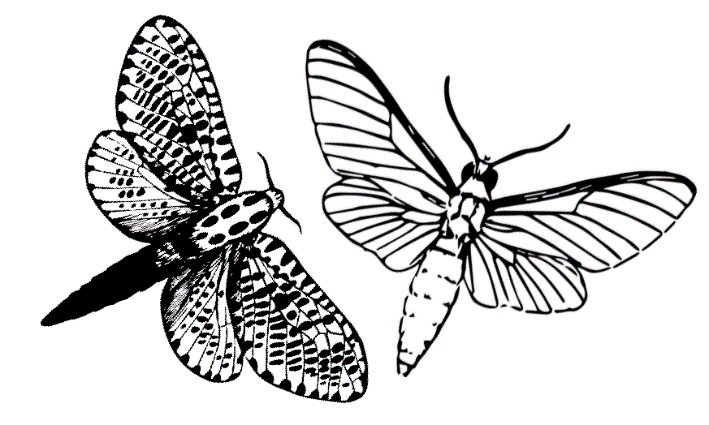
According to natural selection, light colored tree trunks would favor ___________________________.
light colored moths
dark colored moths
red colored moths
red and light colored moths
The passing of genetic traits (DNA) from parent to offspring is __________.
Survival of the fittest
Heredity
Evolution
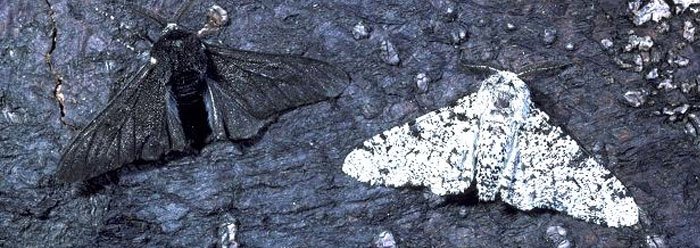
The trees these moths used to live on were white, but have been covered in soot from coal factories. Which moth will be more successful in this environment, and what type of natural selection does this represent?
Dark moth; Directional (One extreme phenotype)
Dark Moth; Disruptive (2 extreme phenotypes)
White moth; Disruptive (2 extreme phenotypes)
Neither will be successful and stabilizing selection would take place

What is the common ancestor of Letters A, B, C, D, E?
1
2
3
4

Using the cladogram, which two organisms are more closely related Lizards and Newts OR Lampreys and Lizards
Newts and Lizards
Lampreys and Lizards

Which trait(s) do conifers have?
vascular tissue only
vascular tissue and seeds
vascular tissue, seeds and flowers
seeds only


What do both the squirrel and lion have in common that the other animals do not?
They are both vertebrates
They both have lungs
They are both mammals
They both lose their canine teeth.

According to this image, which two domains of life are most related?
Bacteria & Archaea
Archaea & Eukarya
Eukarya & Bacteria
A clade contains
all the organisms with similar appearances
organisms living within the same ecosystem
an ancestral species and all the organisms that came before it
an ancestral species and all its descendants

eukaryotic, multicellular, chitin cell wall, absorptive heterotroph
protist
animal
plant
fungi

Who is most closely related to Taxidea taxus?
Lutra lutra
Panthera pardus
Canis latrans
Canis lupus

arachnids and insects?
Shows how different groups of organisms have changed over time.
fossil record
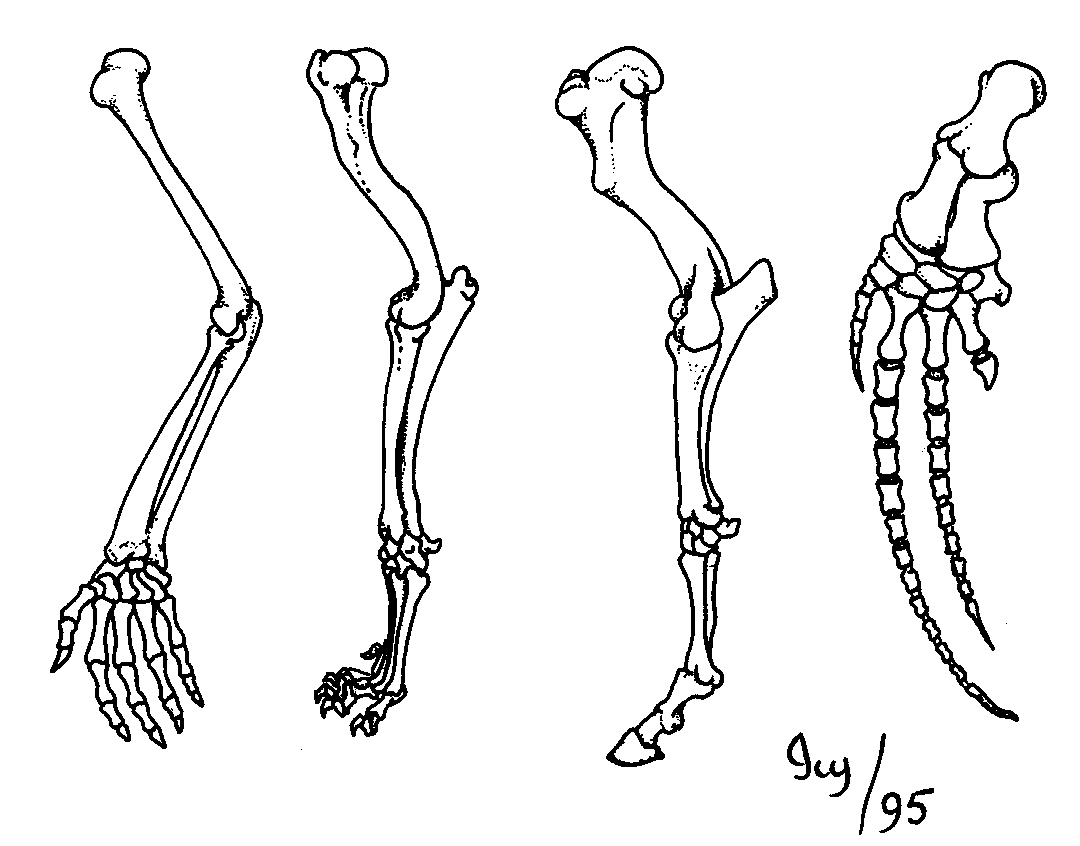
homologous structures
embryology

True or False: Viruses that cause disease are killed using antibiotics.
True
False

The disease smallpox was eradicated (ended) in 1979 because
of worldwide vaccination
it went away naturally
of antibiotic treatment
of variolation (blowing smallpox up the nose)
Which term is related to viruses?
Vaccines
Antibiotics
Treat
Bacteria

